
Self explanation · Eqora guide
How to explain a math solution in your own words
Turn each line of a solution into a decision you can justify, check, and use again without the model in front of you.
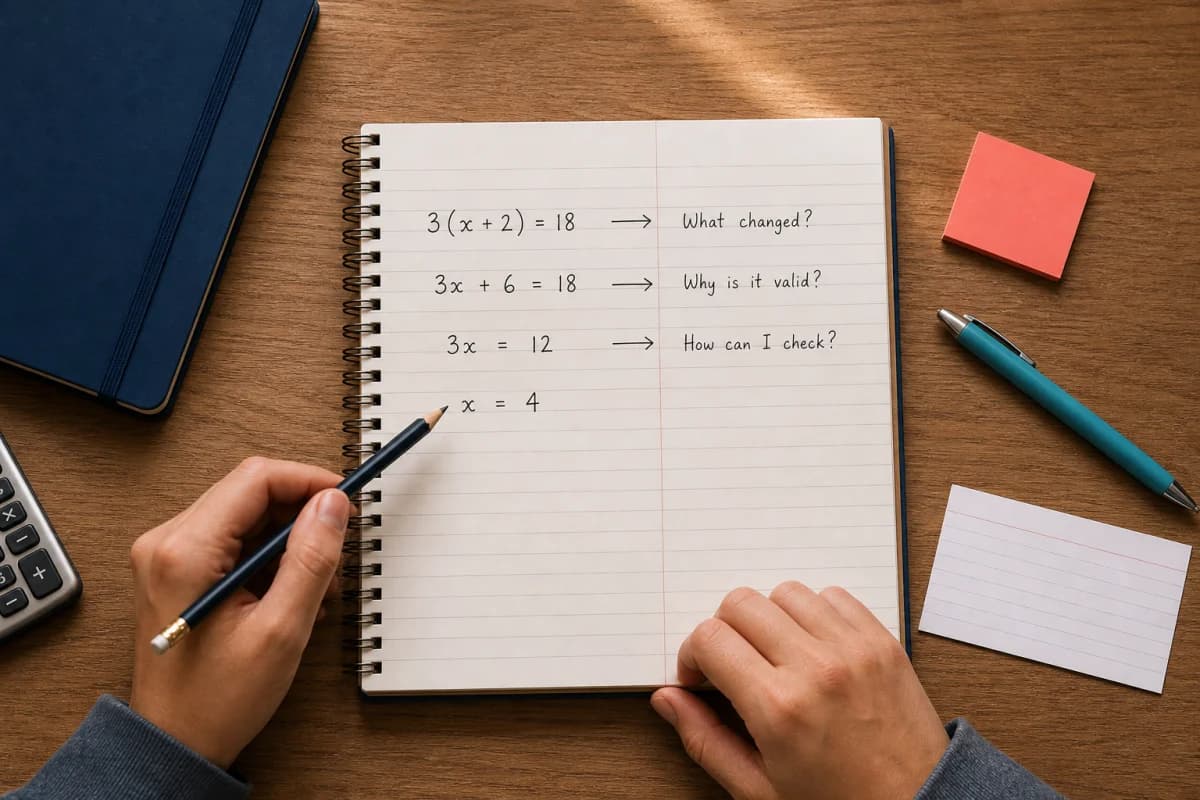
A solution can look completely clear while it is open on the page. Each line reminds you what comes next, so recognition feels like understanding. The stronger test begins when you can hide the model and explain what changed, why the change is valid, and how the result can be checked.
Self explanation does not mean adding a long commentary to every calculation. It means naming the important decisions in ordinary language. The examples below show how to move between symbols, reasons, checks, and a fresh problem until the method belongs to you rather than to the worked solution.


Explain the decision behind each step
Consider 3(x + 2) = 18. The line 3x + 6 = 18 uses the distributive property: the factor 3 multiplies both terms inside the parentheses. Next, subtracting 6 from both sides preserves equality and gives 3x = 12. Dividing both sides by the nonzero number 3 gives x = 4. Reading the lines aloud is not enough; the explanation identifies the rule and the quantity it acts on.
Finish by returning to the original equation. Substituting x = 4 gives 3(4 + 2) = 3 · 6 = 18. This check belongs in the explanation because it connects the answer to the condition that defined the problem. If you cannot justify one transition, mark that exact line instead of restarting the whole solution.
For every important line, ask: what changed, why is it allowed, and how could I check it?
Ask what changed and why
Use three short prompts beside a worked solution: What changed? Why is it valid? How can I check? For 3x + 6 = 18 to 3x = 12, the change is subtracting 6 from each side. It is valid because applying the same operation to equal quantities keeps them equal. The check is to add 6 back or substitute the final value into the original equation.
The prompts expose vague language. Saying ‘move the 6 across’ may produce the correct line, but it hides the operation and encourages sign mistakes. Saying ‘subtract 6 from both sides’ describes an action that can be repeated reliably. Keep the explanation short enough that the mathematics remains visible.
Translate symbols into meaning
For the line y = 2x + 3, do more than name slope and intercept. Explain that 3 is the value of y when x = 0, and that increasing x by 1 increases y by 2. The equation therefore links an initial value to a constant rate of change. Testing x = 0 and x = 1 produces the points (0, 3) and (1, 5), which match the explanation.
In a word problem, attach units to the sentence. If four notebooks cost $10, the calculation 10 ÷ 4 = 2.5 means the cost per notebook is $2.50. Multiplying 2.5 by 4 returns $10. Words and units make it harder to perform a correct operation on the wrong quantities.
Use examples to challenge a rule
A useful explanation should distinguish a rule from a guess. The claim (a + b)² = a² + b² fails for a = 3 and b = 4: the left side is 7² = 49, while the proposed right side is 9 + 16 = 25. Expanding correctly gives (a + b)² = a² + 2ab + b².
Ask which feature makes the rule work. The middle term appears because each term in the first factor multiplies each term in the second. A counterexample does not replace a derivation, but it quickly reveals when a remembered shortcut cannot be true. Include one small numerical test when explaining an identity or formula.
Fade the model and explain from memory
After studying a solution, cover it and write only the plan: expand, isolate the variable, divide, substitute. Then rebuild the algebra. Try 5(x − 1) = 25 without looking back. Distribute or divide first, solve x = 6, and explain why both routes preserve equality. The exact wording can change; the mathematical reason must remain stable.
If the explanation collapses when the model is hidden, identify the first missing decision. Review that rule once, then attempt a nearby problem rather than rereading the same page. A short explanation followed by an independent retry gives better evidence than a polished paragraph copied from the example.
- Hide the worked solution
- State the goal and first decision
- Name the rule at each important transition
- Solve a changed example and check it independently
Use Eqora to question one unclear line
When a reason is missing, show Eqora the complete problem, the relevant line, and your own explanation. Ask a focused question such as ‘Why does subtracting the same number preserve equality?’ or ‘Which restriction is needed before this denominator is cleared?’ Compare the response with your course definition and the original notation.
Then close the conversation and explain the step again without its wording in view. Solve a changed problem and run an independent check. Eqora can misread symbols or make a mathematical error, so use it to investigate reasoning, not to replace the final verification or your school’s requirements.
Put it into practice now
Choose one problem from your current homework or review set. Attempt it before opening Eqora, then use the app only at the point where your own reasoning stops.
- State what the problem is asking before you solve it
- Identify the first step you cannot justify
- Ask Eqora one focused follow-up about that step
- Finish with a similar problem and no solution in view
The session is complete when the method is clearer, not simply when the worksheet has one more answer.