
Scan & solve · Eqora guide
Photo tips for a clearer math solver result
Lighting, framing, and handwriting habits that reduce misreads.
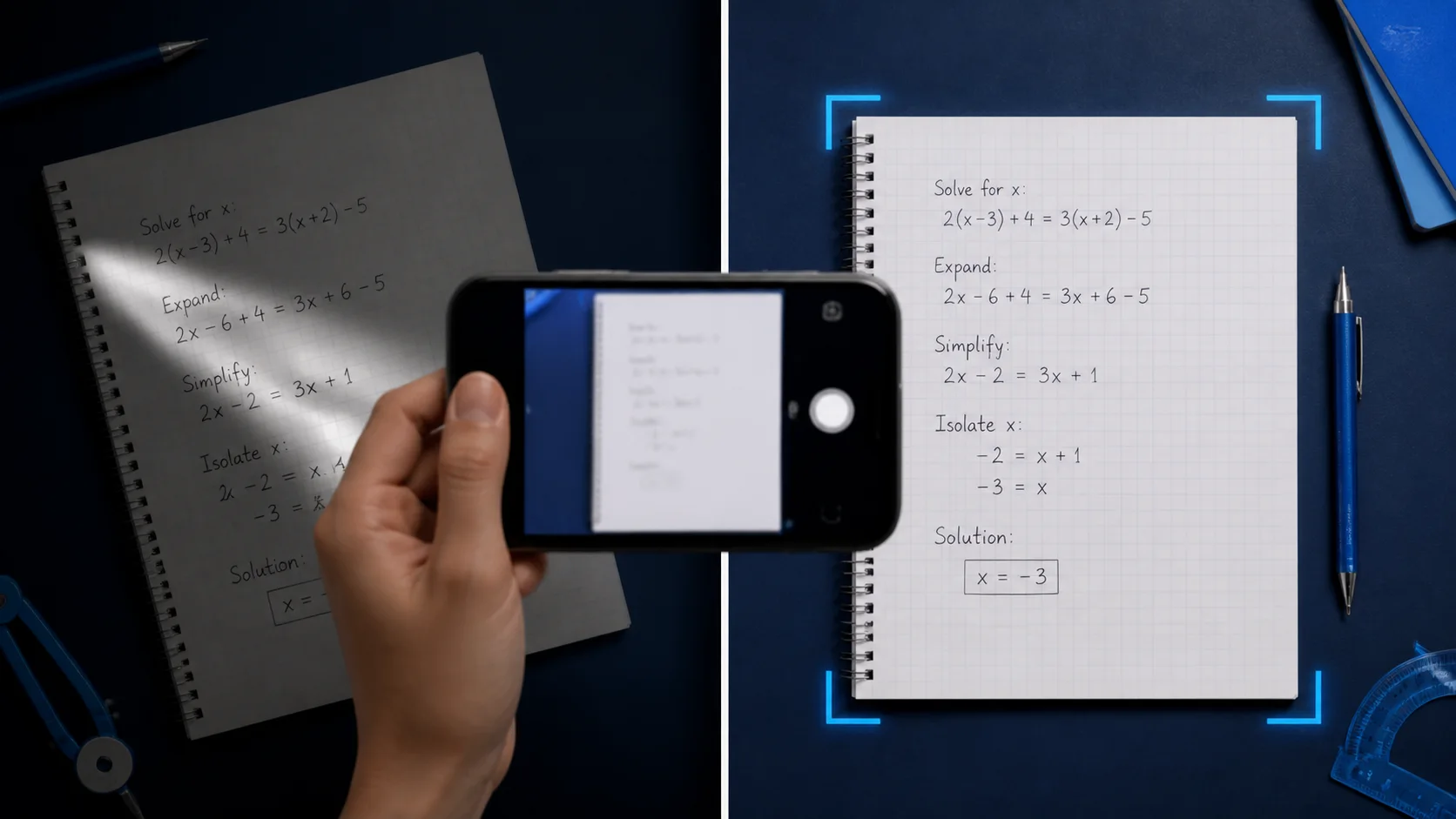
Most scan failures are photo failures. Improve the input before assuming the solver misunderstood the math.
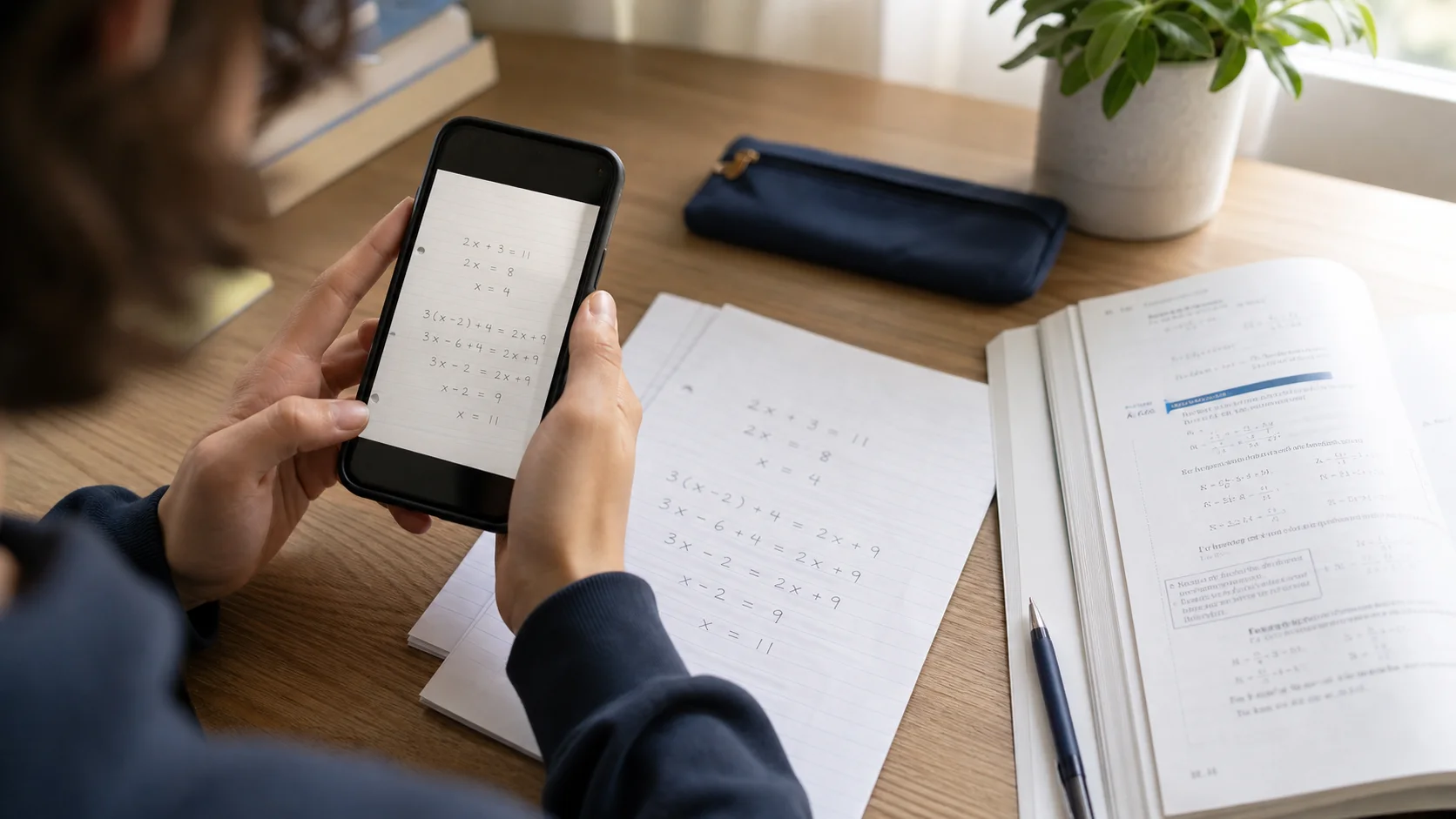

Lighting and angle
Shoot from directly above the page when possible. Avoid harsh overhead shadows and window glare on glossy paper.
- Full problem in frame
- No finger covering symbols
- High contrast writing
Handwriting that reads well
Close the loops on 0/6/8, keep exponents clearly raised, and separate stacked fractions.
Make small notation unambiguous
The smallest marks often carry the most meaning. Give exponents, decimal points, negative signs, degree symbols, vector arrows, and prime marks enough contrast and space. On lined paper, make sure a fraction bar or minus sign does not disappear into the ruling.
If handwriting is crowded, rewrite only the problem on a clean area before scanning. Preserve the original values and instruction exactly. A neat rewrite is useful only when it does not silently change the question.
- Raise exponents clearly above the baseline
- Separate a negative sign from the digit that follows
- Extend fraction bars across the whole expression
- Close brackets and distinguish 1, l, 0, O, 5, and S
Handle long problems and diagrams deliberately
For a multi-line derivation or word problem, first capture the complete context. If you later need help with one line, make a second tighter image while keeping the full prompt available in the conversation. Do not begin with a crop that removes variable definitions or constraints.
For diagrams, align the camera with the page so lengths and angles are not visually distorted. Include labels, axes, tick marks, legends, and any written condition. Add a short typed note when an important label is too faint to read.
Use a controlled retry checklist
Before retaking, identify what failed: blur, glare, perspective, missing context, low contrast, or ambiguous handwriting. Change that one factor and compare the interpreted prompt before asking for a new solution.
If two clear captures produce the same incorrect interpretation, type the disputed symbol or equation and continue from the corrected input. For a repeatable product issue, note the device, system version, feature, and exact mismatch for support without sending private credentials.
A better retry changes a known condition. Repeating the same photo usually repeats the same ambiguity.
Put it into practice now
Choose one problem from your current homework or review set. Attempt it before opening Eqora, then use the app only at the point where your own reasoning stops.
- State what the problem is asking before you solve it
- Identify the first step you cannot justify
- Ask Eqora one focused follow-up about that step
- Finish with a similar problem and no solution in view
The session is complete when the method is clearer, not simply when the worksheet has one more answer.