
Exams · Eqora guide
How to prepare for math exams with AI
A week-before plan that mixes review, timed practice, and weak-spot drills.

Exam prep fails when it is only last-minute answer checking. Use Eqora to rebuild methods, then close the book and practice under time pressure.
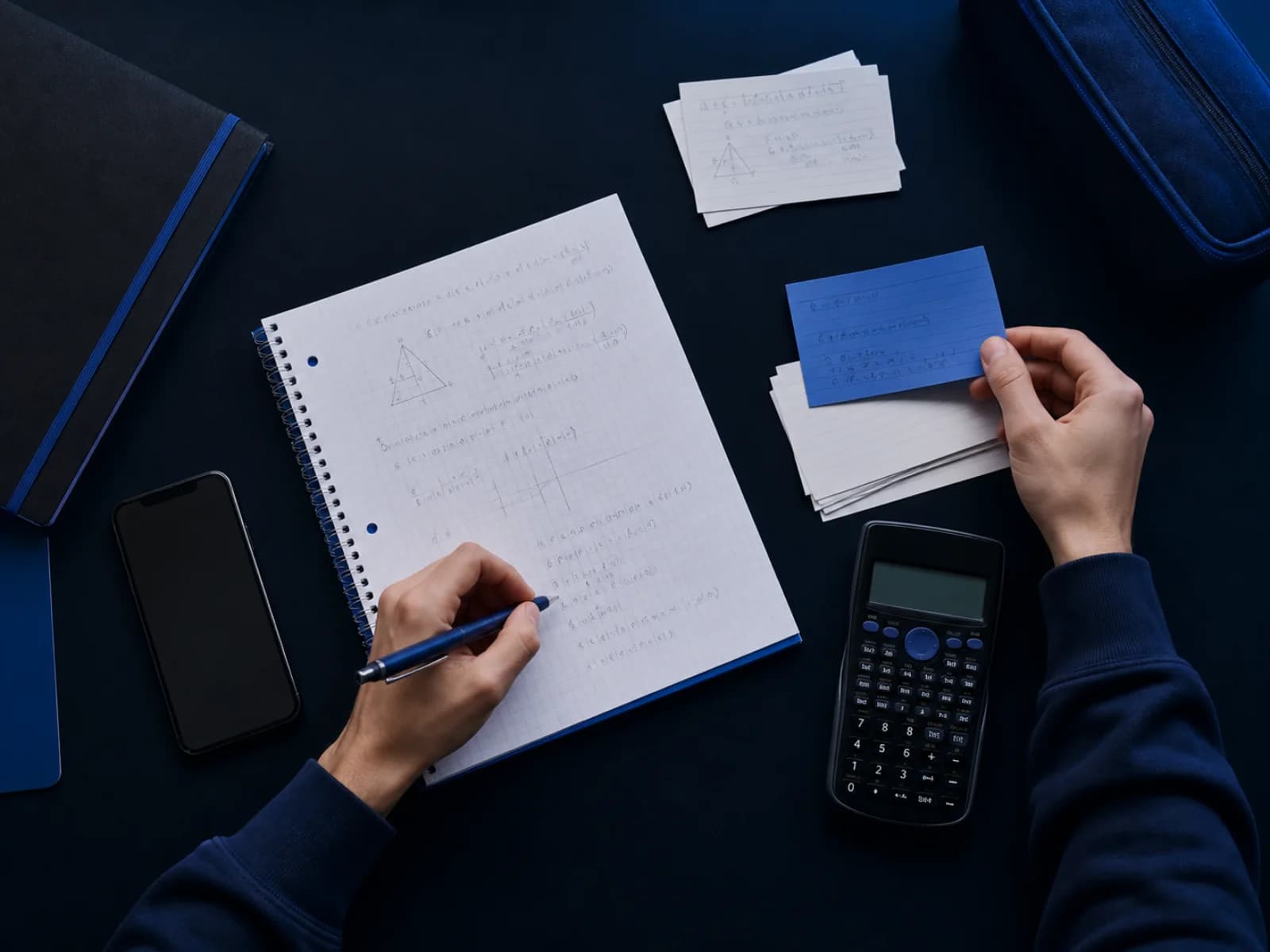

1. Map the exam topics
List chapters and mark confidence. Open Learn Math for low-confidence topics before grinding problem sets.
2. Practice in exam conditions
Attempt problems first, then scan or ask only where you are stuck. Create quizzes for the weakest two topics each day.
Goal: explain the method out loud without looking at the solution.
3. Final 48 hours
Stop collecting new tricks. Redo errors, review formulas, and sleep. Use Eqora for quick clarifications, not for discovering an entire chapter the night before.
4. Build an error log that names causes
Do not record only the question you missed. Label the cause: concept gap, method choice, algebra slip, notation error, forgotten condition, time pressure, or incomplete checking. Two wrong answers may need completely different fixes.
Use Eqora to explain the cause you cannot diagnose, then write a prevention cue in your own words. Examples include ‘check the domain before cancelling,’ ‘draw the force diagram first,’ or ‘estimate the sign before calculating.’ Review these cues before the next practice block.
- Problem or topic
- First incorrect or uncertain step
- Cause of the error
- Correction and one prevention cue
- Date to retry a related problem
5. Space practice and mix problem types
A topic can feel mastered immediately after reviewing its solution. Test it again after a delay and mix it with other chapters so the method is not announced by the worksheet heading. Exams require choosing a method as well as executing it.
Use short quizzes to sample several weak areas, but complete some full-length problems on paper. Keep formula sheets, calculators, timing, and permitted aids consistent with the real assessment whenever possible.
6. Use AI after the attempt, not during every line
Set a clear help rule for practice: attempt the problem, mark the exact blocked step, and finish the timed block before opening the explanation unless the missing idea prevents all progress. This preserves the evidence you need about recall and pacing.
After receiving help, solve a new question of the same type without the conversation in view. If the method still fails, review the prerequisite rather than repeating increasingly similar worked examples.
Practice should sometimes feel harder than review. That difficulty is information about what you can retrieve unaided.
Put it into practice now
Choose one problem from your current homework or review set. Attempt it before opening Eqora, then use the app only at the point where your own reasoning stops.
- State what the problem is asking before you solve it
- Identify the first step you cannot justify
- Ask Eqora one focused follow-up about that step
- Finish with a similar problem and no solution in view
The session is complete when the method is clearer, not simply when the worksheet has one more answer.