
Answer checking · Eqora guide
Check a math answer without an answer key
Use estimation, inverse operations, substitution, units, and boundary checks to decide whether a result deserves your confidence.
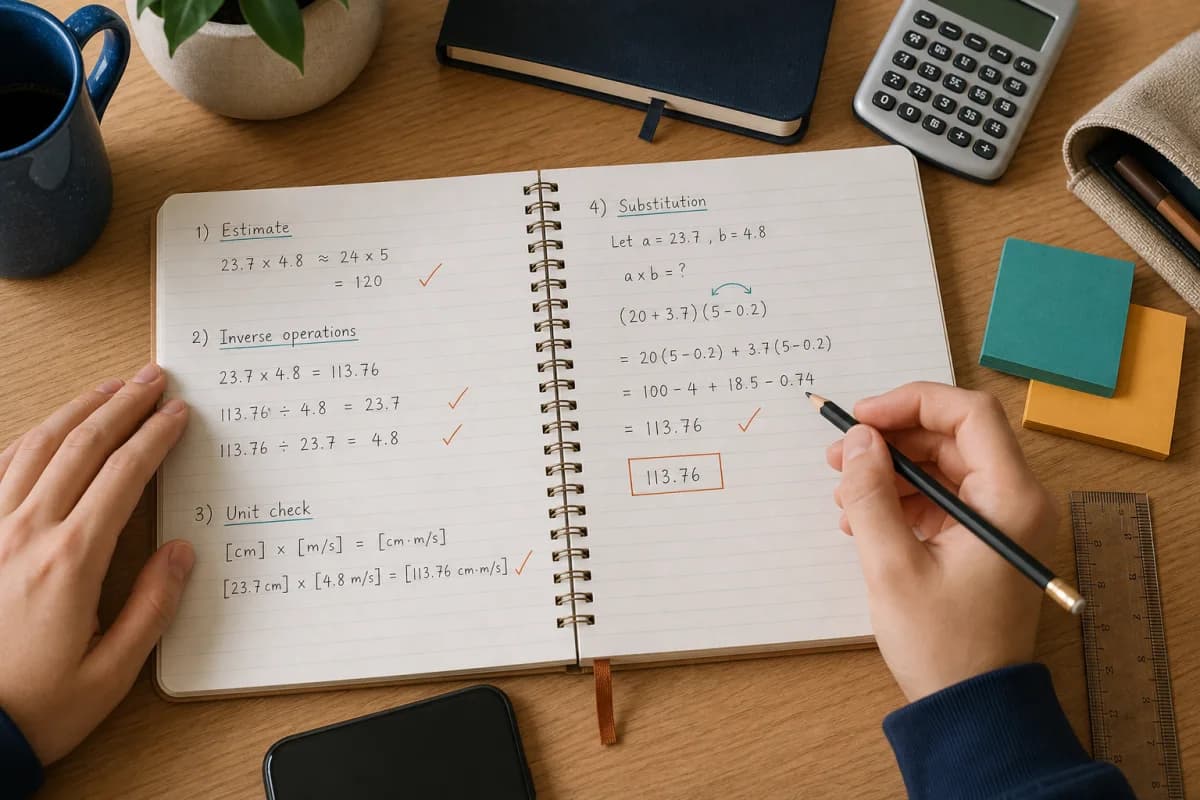
Checking is not the same as reading your calculation again. When you repeat the same steps in the same order, the assumption or sign error that caused the first answer can survive the second pass. A stronger check approaches the result from another direction and asks whether the size, units, conditions, and original question all agree.
You do not need an answer key for that. Estimation can expose an impossible magnitude, an inverse operation can test arithmetic, and substitution can test an equation. The examples below build a short checking routine you can use on homework, practice questions, and calculator results before asking anyone else to confirm them.


Estimate before calculating exactly
Suppose you need 23.7 × 4.8. Round to nearby friendly numbers first: 24 × 5 = 120. The exact product should therefore be near 120 and slightly smaller because 4.8 is below 5. Calculating gives 113.76, which fits that prediction. An answer such as 1,137.6 would fail immediately even if every calculator key looked familiar.
An estimate is a range, not a rival exact answer. For 398 ÷ 8.1, use 400 ÷ 8 = 50, so a result near 49 is plausible. Choose rounding that preserves the structure of the problem, write the expected sign and rough size, and only then calculate. This makes the estimate independent of the digits you later enter.
Predict the sign, order of magnitude, and approximate range before the exact calculation can influence you.
Reverse the operation
Inverse operations give arithmetic a return trip. If 23.7 × 4.8 = 113.76, divide 113.76 by 4.8; returning to 23.7 supports the product. If 864 ÷ 27 = 32, multiply 32 × 27 and confirm 864. For 18% of 250 = 45, divide 45 by 0.18 and check that the original whole is 250.
The reverse check should use the relationship, not merely repeat the original keystrokes. It catches many transpositions and misplaced decimals, but not every conceptual error. If you used 18 instead of 0.18 in both directions, the arithmetic may still be internally consistent. Pair the inverse with an estimate and a clear statement of what each number represents.
- Addition ↔ subtraction
- Multiplication ↔ division
- Powers ↔ roots, with domain conditions
- Percentage amount ↔ rate × original quantity
Substitute into the original equation
Solve 4(x − 3) = 20. Dividing by 4 gives x − 3 = 5, so x = 8. Do not check only the rearranged line. Put 8 into the untouched equation: 4(8 − 3) = 4 × 5 = 20. Both sides agree, so the candidate passes the original condition.
Substitution is especially important after squaring, clearing denominators, using a logarithm, or dividing by an expression that might be zero. Those transformations can add a candidate or discard a special case. A candidate is a proposed value until the original equation accepts it. Keep restrictions beside the problem and reject any value that makes an original denominator zero or an expression undefined.
Track units and meaning
Units behave like part of the calculation. A 180-kilometre trip completed in 3 hours gives 180 km ÷ 3 h = 60 km/h. The number 60 may look reasonable, but writing 60 km would answer a different question. For a rectangle 7 cm by 4 cm, the area is 28 cm², while the perimeter is 22 cm. The unit helps distinguish the two quantities.
Return to the wording after calculating. If 5 buses are needed, a result of 4.2 buses must be interpreted according to the situation, usually by rounding up rather than to the nearest whole number. Money, people, probability, temperature change, and percentage points each carry conventions that raw arithmetic does not decide for you.
Test signs, bounds, and special cases
Many answers live inside natural boundaries. A probability must lie from 0 to 1, a count cannot be negative, and the length of a side cannot exceed the sum of the other two sides in a triangle. If a discount produces a price higher than the original, or an average lies outside the range of all observations, pause before polishing the calculation.
Try a simple edge case against a formula. The expression n(n − 1)/2 counts pairs among n objects: for n = 1 it gives 0, and for n = 2 it gives 1. Those small cases do not prove the formula, but they can reveal a missing factor or offset. For a graph, test an intercept or an easy input and compare the resulting point with the equation.
Build a two-check routine
Choose checks that fail for different reasons. For numerical work, combine an estimate with an inverse operation. For an equation, combine substitution with a domain check. For a word problem, combine units with a statement in ordinary language: ‘At 60 kilometres per hour, three hours covers 180 kilometres.’ Two independent checks are stronger than three rereads of the same algebra.
When a check fails, locate the first disagreement rather than changing the final digit until it looks plausible. Compare the copied prompt, operation, sign, decimal placement, unit conversion, and condition one at a time. Correct the earliest faulty decision, recompute from there, and run the checks again on the new result.
Practise checking before seeking confirmation
Try these with the answer covered: 19.6 × 5.1; 756 ÷ 24; solve 3y + 7 = 31; find 15% of 80; and find the area of a triangle with base 12 cm and perpendicular height 7 cm. Reasonable results are about 100, 31.5, y = 8, 12, and 42 cm². For each one, write the exact result and two checks, not just a tick.
If your checks disagree and you cannot find why, Eqora can review the complete prompt and your working or explain one transition. Ask it to inspect the specific uncertainty, such as a unit conversion or substitution, then verify that the notation was read correctly. Close the explanation and redo the problem independently. AI can misread a photo or make a mathematical error, so agreement with the original problem remains the final standard.
Put it into practice now
Choose one problem from your current homework or review set. Attempt it before opening Eqora, then use the app only at the point where your own reasoning stops.
- State what the problem is asking before you solve it
- Identify the first step you cannot justify
- Ask Eqora one focused follow-up about that step
- Finish with a similar problem and no solution in view
The session is complete when the method is clearer, not simply when the worksheet has one more answer.