Trigonometry · Eqora guide
Trigonometry homework: choose the right ratio
Start with the marked angle, name the sides and connect the known length to the unknown before reaching for sine, cosine or tangent.
Your trigonometry homework shows a right triangle, a 30° angle and a hypotenuse of 12 cm. You need the side opposite that angle. You remember three formulas, but which one belongs here? Choosing cosine because the unknown looks horizontal is a surprisingly easy mistake. The position on the page does not name a side. Its relationship to the marked angle does.
We will turn that decision into a short chain of reasoning: confirm the right angle, identify the reference angle, name the sides, then select the ratio connecting the given length and the unknown. After solving several variations, we will use Eqora to examine one questionable line rather than simply copy an answer. A different final problem checks whether you can make the same decisions independently.
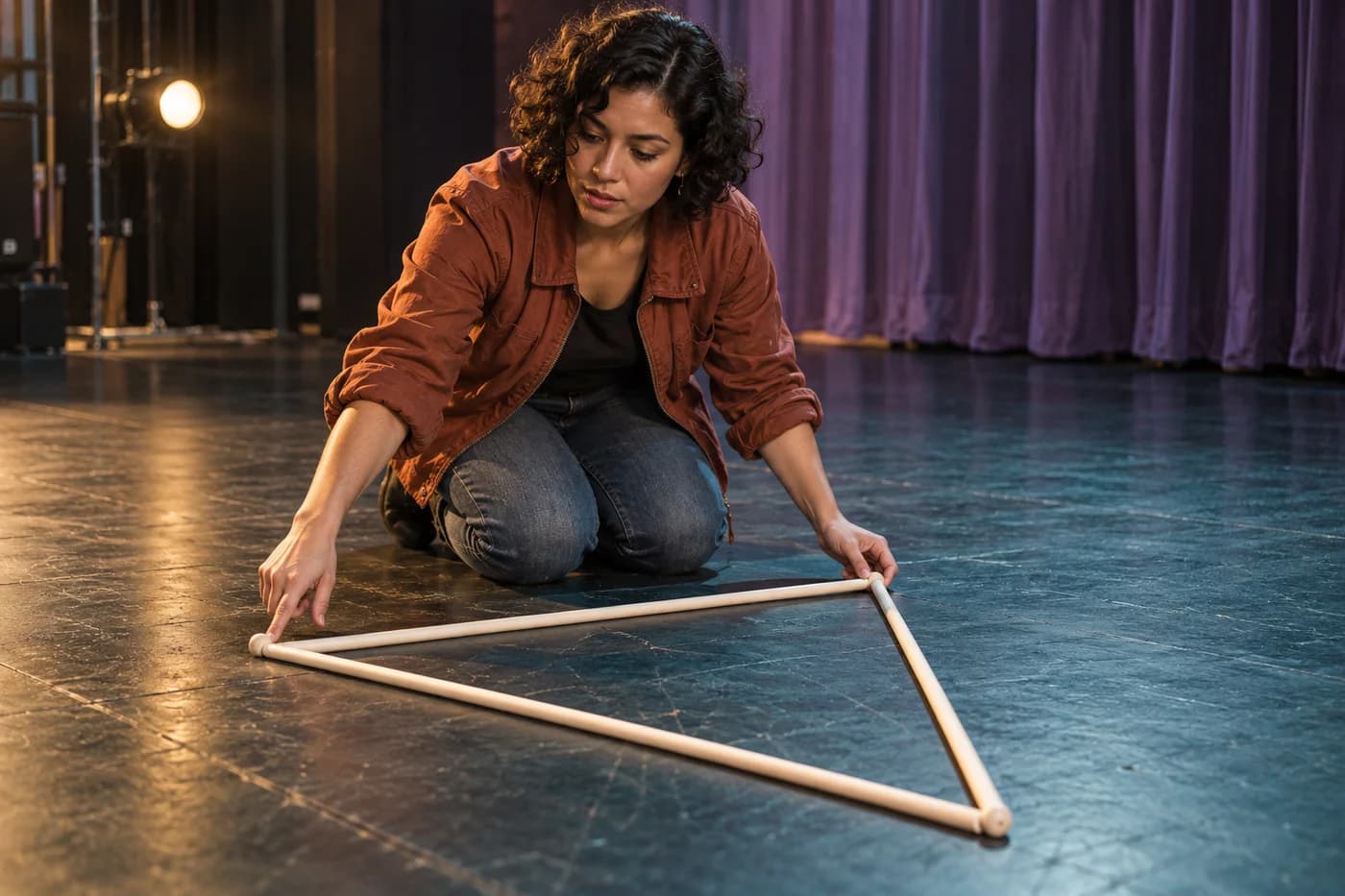
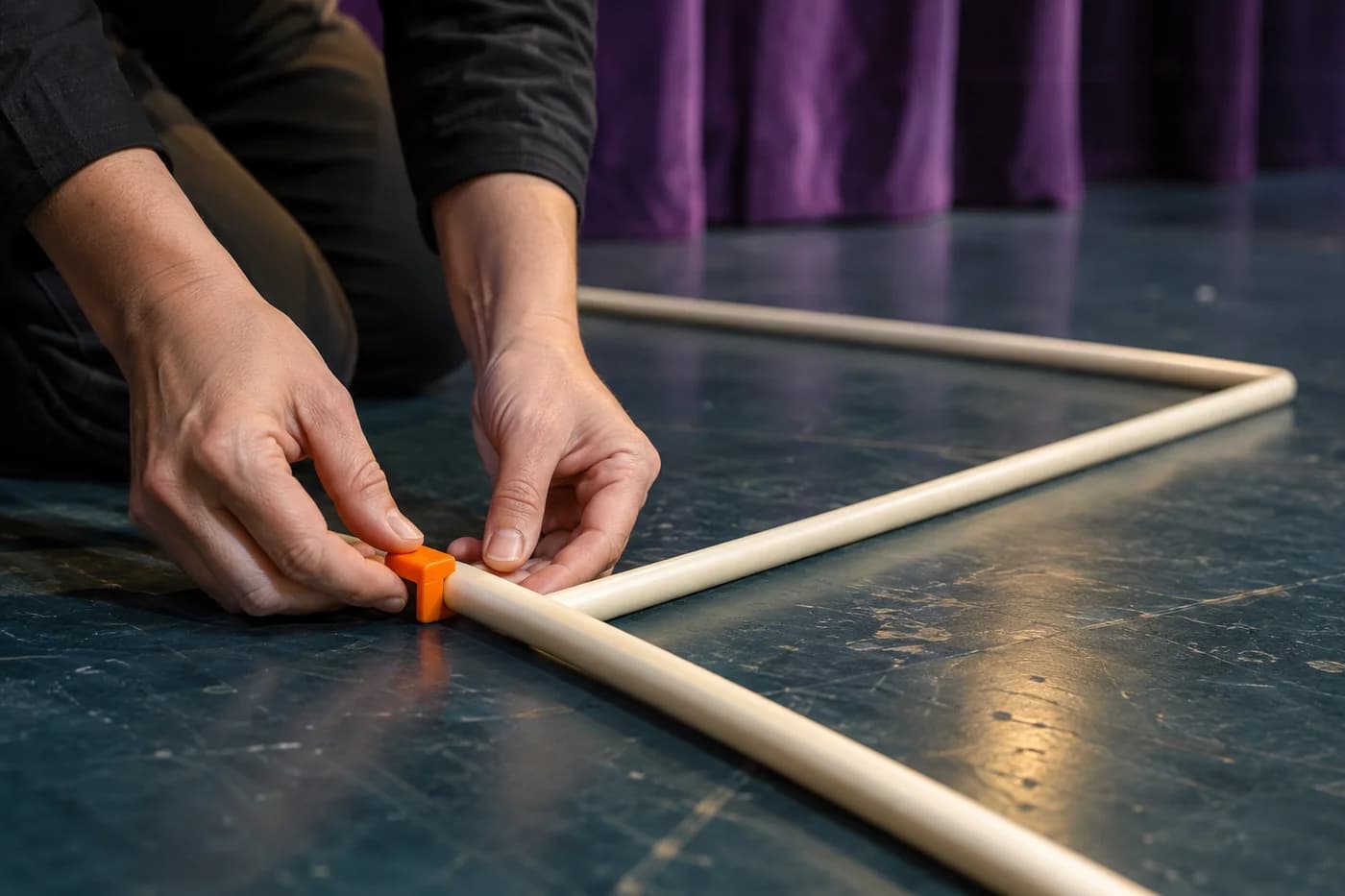
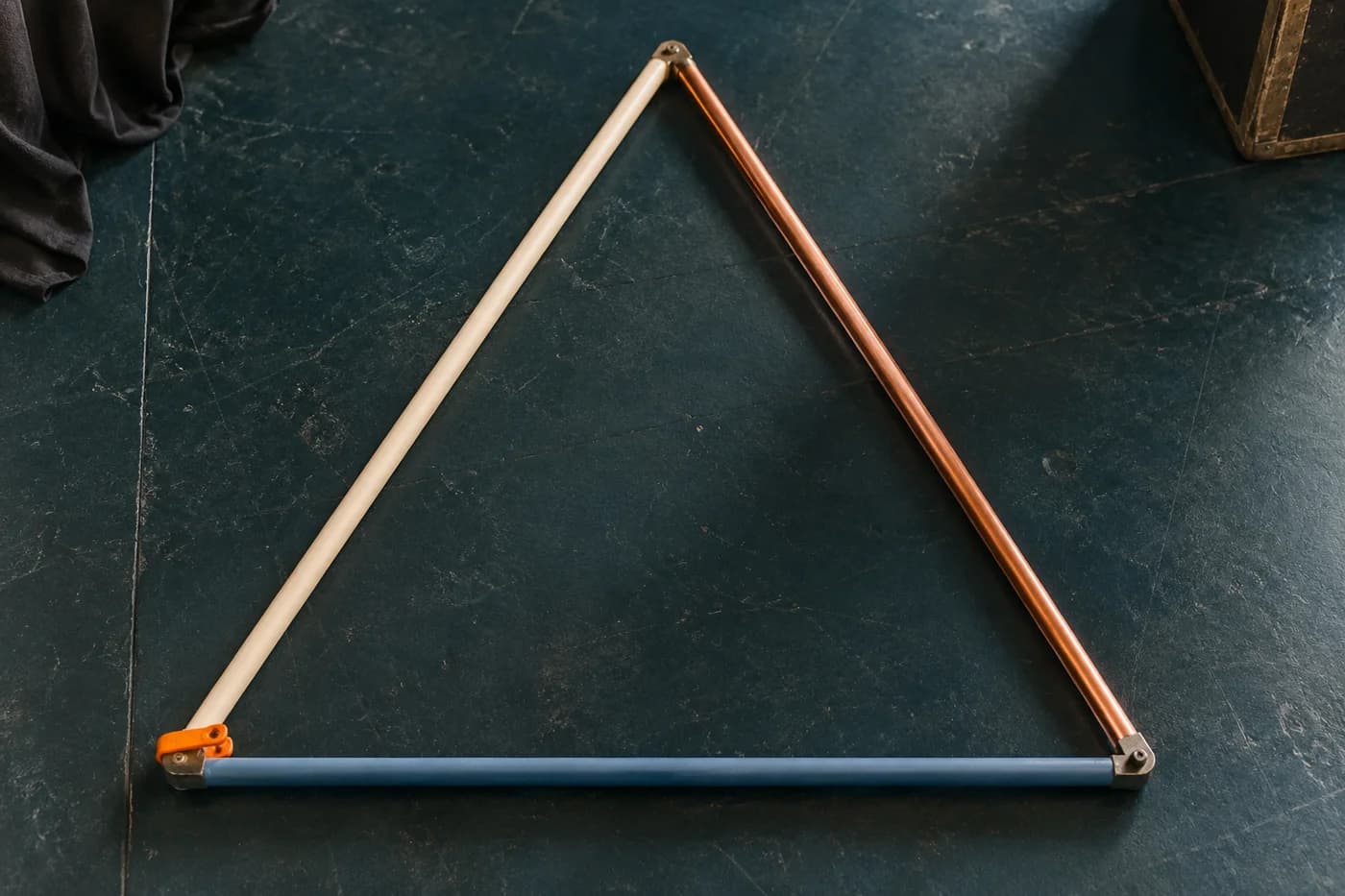
Eqora publishes this guide as learning support, not a substitute for exam work or a guarantee of accuracy or grades. Check the original instructions, notation, assumptions and result. The examples use constructed exact data; decimal answers are approximations. The theater photographs suggest looking at a shape from different reference points. They are not scale drawings, and their rods do not encode the measurements in the examples.
Trigonometry homework starts with the reference angle
Draw triangle ABC with a right angle at C and angle A equal to 30°. AB is the hypotenuse because it lies opposite the right angle. Relative to angle A, BC is the opposite side: it does not touch A. AC is the adjacent leg: it touches A but is not the hypotenuse. Both AB and AC touch A, so 'touching the angle' alone is not enough to identify the adjacent leg.
Now rotate your drawing. BC might appear at the top, bottom or left, but it is still opposite A. A sloping line is not automatically the hypotenuse; the right-angle mark determines that role. If the picture is unclear, redraw it and copy only the supplied labels. Do not estimate missing lengths from a photograph or assume a sketch is accurate because one edge looks longest.
Keep the reference angle visible while working. If a worksheet asks about angle B instead, the two legs exchange their opposite and adjacent roles, while AB remains the hypotenuse. In this triangle B is 60°, since the angles total 180°. The lengths themselves do not change when the reference changes. Our guide to understanding math rather than collecting answers explains why describing that relationship is more useful than memorizing a finished line.
Choose the ratio that contains the two relevant sides
For an acute angle θ in a right triangle, sine connects opposite and hypotenuse, cosine connects adjacent and hypotenuse, and tangent connects opposite and adjacent. Written as ratios: sin θ = opposite/hypotenuse, cos θ = adjacent/hypotenuse and tan θ = opposite/adjacent. RMIT's right-triangle lesson gives these definitions and shows how the available sides determine the useful relationship. Length units cancel within each ratio.
Our opening problem gives AB = 12 cm and asks for BC. Relative to A, those are hypotenuse and opposite. Therefore choose sine. Cosine would involve AC, a different unknown, and tangent would require an adjacent length we have not been given. The existence of three familiar buttons is not a reason to try all three: identify the pair of side roles first and the suitable formula follows.
Write the side names before inserting numbers. The line sin 30° = BC/12 records both your angle choice and your side choice. It is easier to audit than an unexplained multiplication on a calculator. A memory aid can remind you of the three definitions, but it cannot select the reference angle or distinguish a leg from the hypotenuse. Those decisions still belong to your reading of the problem.
Solve for the opposite side and retain its unit
Since sin 30° = 1/2, the equation is 1/2 = BC/12. Multiply both sides by 12 to obtain BC = 12 × 1/2 = 6 cm. The ratio is unitless, but the resulting side length carries the original length unit. Do not report '6 degrees': the unknown is a length, not an angle. Read the wording after the calculation to make sure you answered the requested quantity.
If AC is requested instead, start again from its role. Cos 30° = AC/12 gives AC = 12 × √3/2 = 6√3 cm, approximately 10.392 cm. To two decimal places that is 10.39 cm. This is not an alternative answer for BC; it is the other leg. A correct calculator operation attached to the wrong label still produces an incorrect homework answer.
There is a structural check: BC² + AC² = 6² + (6√3)² = 36 + 108 = 144 = 12². Both legs are positive and shorter than the hypotenuse, as required for this nondegenerate right triangle. These checks support the lengths but do not replace checking which label was requested. Swapping the two legs preserves the Pythagorean total, so it can conceal a reference-angle mistake.
An unknown denominator changes the algebra
Suppose another problem gives the opposite leg as 6 cm, the angle as 30° and asks for the hypotenuse h. The chosen ratio is still sine, but now sin 30° = 6/h. Multiply by h to get h sin 30° = 6, then divide by sin 30°: h = 6/(1/2) = 12 cm. The unknown's position in the fraction determines whether multiplication or division isolates it.
The tempting line h = 6 sin 30° gives 3 cm. It fails immediately because a hypotenuse cannot be shorter than its positive leg. Rather than memorizing 'always multiply by sine', preserve the equation and perform the same operation on both sides. When the angle is acute, its sine is positive and below one, so dividing a leg by that sine gives a longer hypotenuse.
For tangent, try an adjacent leg of 10 cm and angle 35°, with opposite leg x. Tan 35° = x/10, so x = 10 tan 35° ≈ 7.002 cm, or 7.00 cm to two decimal places. No hypotenuse appears in that equation. If the unknown were the adjacent leg instead, you would divide the known opposite length by tan 35°. Explain the rearrangement rather than infer it from the last example.
Check angle mode before trusting decimal output
All angles in these examples are degrees. A calculator or calculation tool must interpret 30° as thirty degrees, not thirty radians. A quick test is that sine of 30° equals 0.5. An unexpected negative value for the sine of this acute angle should make you revisit the mode or input. Do not silently change the task's angle convention just to obtain a familiar-looking number.
Retain exact values and round only as requested. Using 6√3 protects the Pythagorean check. Keep intermediate digits for 35° and 40°; state the final precision. Substituting rounded lengths may leave small residual differences rather than an exact identity.
These three side-ratio definitions apply directly to right triangles. If no right angle is supplied or justified, do not invent one from the sketch. Other triangles may require a different method or additional information. Also distinguish an interior angle from an angle drawn outside the triangle. Check the markings and assumptions before doing arithmetic: faster calculation cannot correct a model built from the wrong angle.
Capture the whole homework problem in Eqora
Make a first attempt on paper, then identify the uncertain transition. If your course permits assistance, capture a clear view of the task in Eqora. Include all three vertices, the right-angle mark, the reference angle, the given side length, the unknown label, units and rounding instructions. A crop that loses the 30° mark can change which side a displayed solution treats as opposite.
Our clear-photo guide explains how to reduce blur, glare and cropped notation. A neat picture still does not guarantee correct interpretation. Compare the task Eqora is solving with your original worksheet before considering its steps. Check whether the 12 labels the hypotenuse or a leg and whether the unknown is BC or AC. If the geometry is ambiguous, clarify it instead of guessing from the image.
For the opening example, the expected chain is BC opposite A; AB hypotenuse; sin 30° = BC/12; BC = 6 cm. Inspect each link separately. If a displayed solution uses cosine, first determine whether it is solving for AC rather than BC. The same triangle supports several legitimate calculations, but only one addresses the specific question. Keep the original label visible alongside the working.
Ask about the decision, then verify the explanation
A focused follow-up could be: 'Why is BC opposite angle A even if it is drawn on the left, and why does the known hypotenuse make sine useful?' This asks for the geometric and algebraic decision, not another final number. A helpful explanation should refer to the marked angle and the two sides involved. If it merely repeats a formula, ask which side touches A and which lies across from it.
Check the explanation against the drawing yourself. BC does not meet A; AC does; AB lies opposite C's right angle. Next substitute BC = 6 into BC/12 and recover 1/2. Use the independent checks in our answer-checking guide to separate matching the equation from matching the task. A polished explanation can still attach correct arithmetic to a misread label, so agreement with the original problem remains essential.
Write one sentence in your own words before continuing: 'I chose sine because I knew the hypotenuse and wanted the side opposite the specified angle.' If you cannot explain that sentence without looking at the response, redraw the triangle and name its sides again. Eqora is useful as a learning aid for this inspection; it is not a replacement for doing the permitted work yourself or checking its accuracy.
Solve a fresh triangle without assistance
Put the app aside. A new right triangle has an acute reference angle of 40° and a hypotenuse of 15 cm. Find both legs to two decimal places. Before calculating, name the opposite leg o and the adjacent leg a relative to that angle. Write sin 40° = o/15 and cos 40° = a/15. These equations come from the side roles, not from reusing the earlier numbers.
In degree mode, o = 15 sin 40° ≈ 9.641814 cm and a = 15 cos 40° ≈ 11.490667 cm. Thus o ≈ 9.64 cm and a ≈ 11.49 cm. With unrounded values, o² + a² = 225 cm² because sin² 40° + cos² 40° = 1. Both legs are shorter than 15 cm, and the leg opposite 40° is shorter than the other leg, opposite 50°.
Finally change only the reference to 50°, the other acute angle. The former adjacent leg becomes opposite and the former opposite becomes adjacent; the hypotenuse stays 15 cm. Explain that swap without recalculating the lengths. If you can select each ratio, isolate the requested side and check the labels on a rotated drawing, you have learned the decision that the homework was testing rather than just reproduced one answer.