
Trigonometry · Eqora guide
How to learn trigonometry visually with triangles, circles, and graphs
Connect ratios, the unit circle, identities, and periodic graphs instead of treating them as separate formula lists.
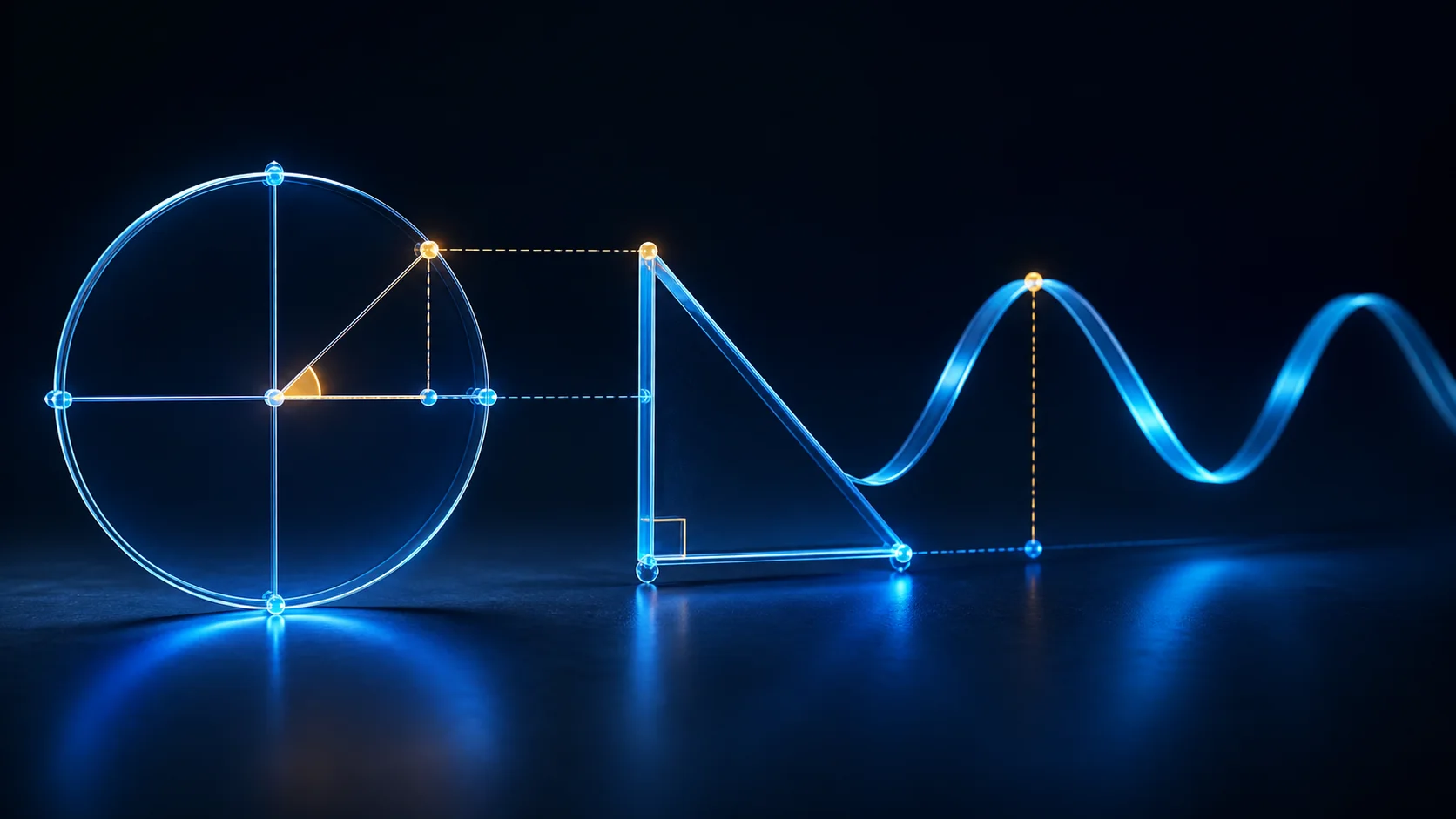
Trigonometry becomes easier when its representations are connected. A right-triangle ratio, a point on the unit circle, and a wave on a graph describe the same relationships from different viewpoints.
Use an AI tutor to move between those viewpoints and explain conditions. Memorized identities are useful, but they become reliable only when you know where they come from and when they apply.

Begin with a labeled right triangle
Choose the reference angle, then label the opposite, adjacent, and hypotenuse sides relative to that angle. Opposite and adjacent change when the reference angle changes; the hypotenuse remains opposite the right angle.
Write sine, cosine, and tangent as ratios before substituting numbers. This prevents a remembered acronym from becoming detached from the actual diagram.
Use similarity to explain why the ratios are stable
All right triangles with the same acute angle are similar. Their side lengths may scale, but the ratios of corresponding sides stay constant. That is why one angle has one sine value regardless of triangle size.
Ask Eqora to compare two similar triangles numerically, then explain which quantities change and which relationships remain invariant.
Move from triangles to the unit circle
On a unit circle, the point at angle theta has coordinates cosine theta and sine theta. This extends trigonometric functions beyond acute angles and makes quadrant signs visible.
Draw the reference triangle inside the circle and track the x- and y-coordinates. Tangent can then be understood as sine divided by cosine where cosine is not zero.
The unit circle is not a second topic. It is the right-triangle relationships extended through a full rotation.
Treat radians as measured rotation
A radian compares arc length with radius. On the unit circle, an angle of theta radians subtends an arc of length theta, which is why radians connect naturally to graphs and calculus.
Convert between degrees and radians with proportions, but also mark common angles on a circle. Visual placement makes sign and approximate size easier to predict.
Build sine and cosine graphs from motion
Imagine a point moving around the unit circle. Its vertical coordinate traces sine, while its horizontal coordinate traces cosine. One complete rotation becomes one period of each graph.
For transformed functions, identify amplitude, period, horizontal shift, and vertical shift separately. Predict each change before viewing a graph so the tool confirms reasoning rather than replacing it.
Derive identities from definitions
The identity sine squared plus cosine squared equals one comes directly from the unit-circle equation x squared plus y squared equals one. Quotient and reciprocal identities follow from the ratio definitions.
When simplifying an expression, write which identity justifies each replacement and keep domain restrictions visible. Algebraic equivalence can fail at values where a denominator is zero.
Solve trigonometric equations over the stated interval
Find a reference angle, determine valid quadrants from the sign, and list every solution in the requested interval. Trigonometric functions repeat, so one calculator output is rarely the complete answer.
Substitute solutions into the original equation and confirm the angle unit. Degree-radian mode errors can create plausible but completely wrong values.
Practice by translating between representations
Take one angle and represent it as a triangle ratio, a unit-circle point, and a location on a graph. Then reverse the task: start with a graph value and identify possible angles.
Ask Eqora for a mixed set that hides which representation is most convenient. State your choice before solving and finish with one problem without diagrams supplied.
Put it into practice now
Choose one problem from your current homework or review set. Attempt it before opening Eqora, then use the app only at the point where your own reasoning stops.
- State what the problem is asking before you solve it
- Identify the first step you cannot justify
- Ask Eqora one focused follow-up about that step
- Finish with a similar problem and no solution in view
The session is complete when the method is clearer, not simply when the worksheet has one more answer.