Probability · Eqora guide
Conditional probability: which group is the denominator?
The word given changes the group you count from. Use one workshop example to separate conditional, joint and reversed probabilities.
Conditional probability starts with a question about the denominator, not a clever calculator command. If a workshop participant chose geometry, what is the probability that they brought a notebook? That is different from asking whether a notebook-carrying participant chose geometry. The same people can appear in the numerator of both calculations while the group underneath changes. Reading the condition correctly is what turns a plausible-looking fraction into an answer to the actual question.
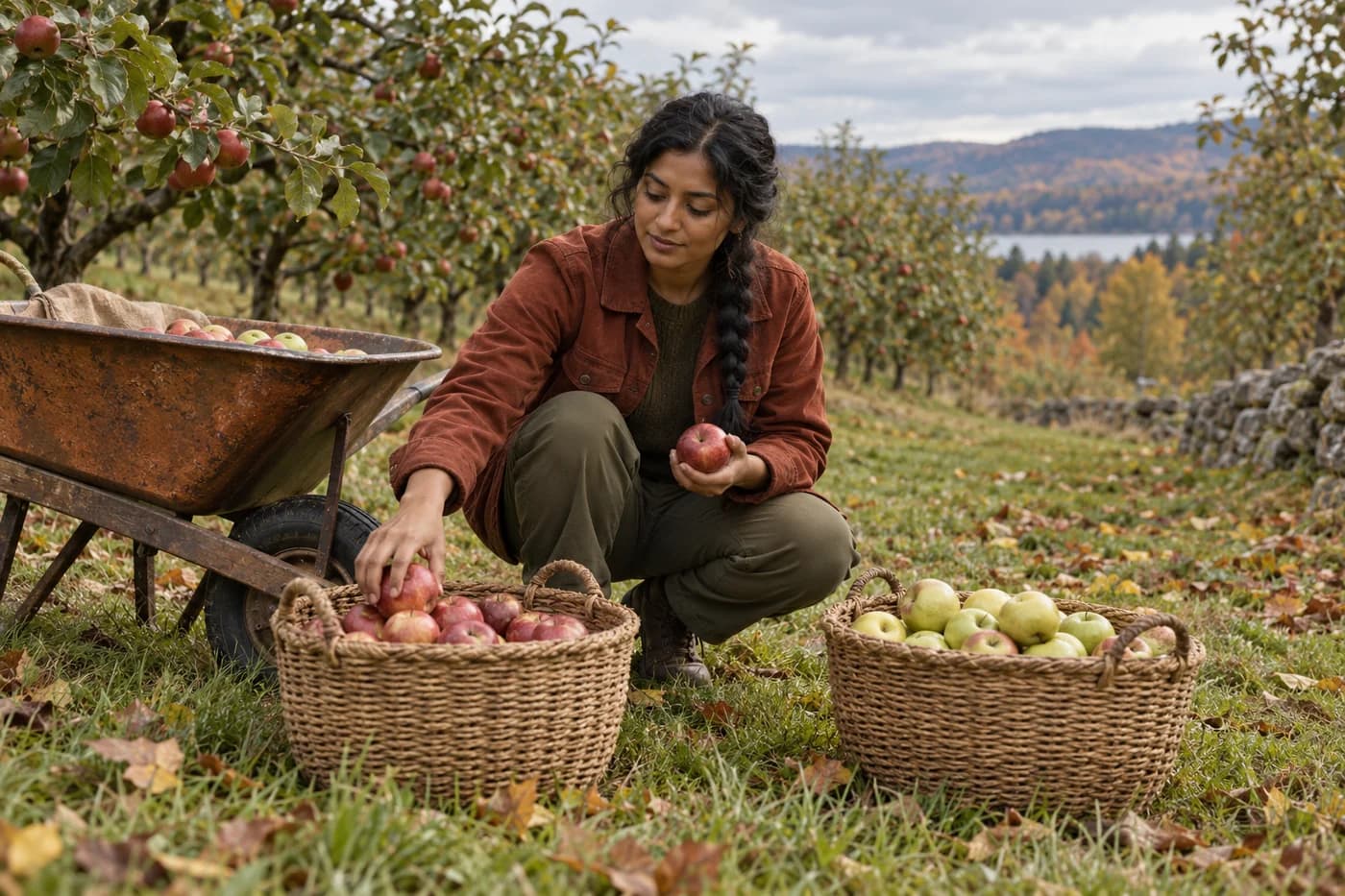
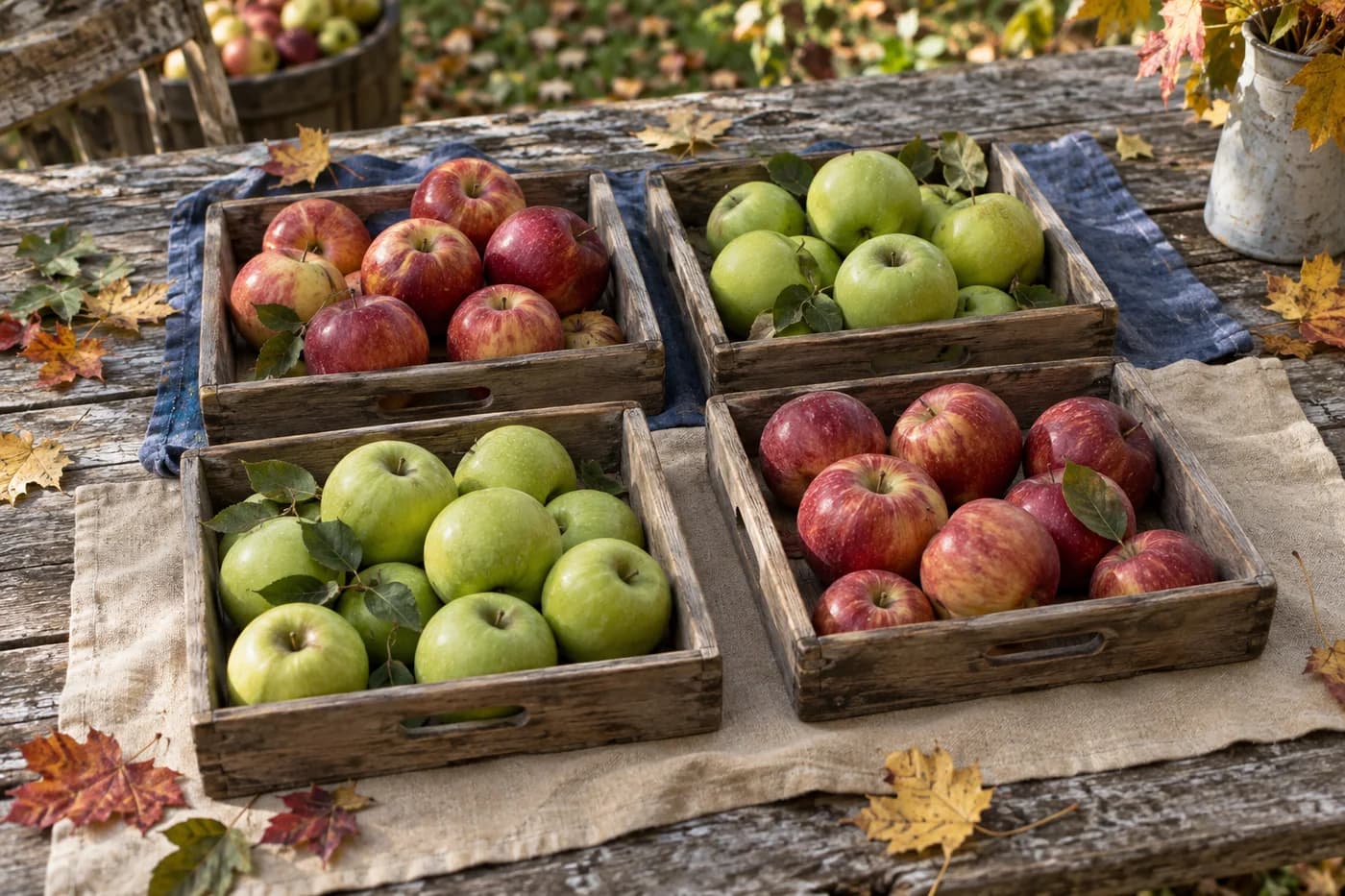
This guide develops the calculation from counts, connects it to event notation, and explains when a condition does or does not change a probability. All workshop numbers are invented for teaching, not observations from a real study. The orchard photographs are physical grouping analogies; their apples do not encode the numerical examples. You need only paper and basic arithmetic to follow the method and solve the final practice problem independently.
Eqora publishes this guide as a learning aid. An app can support study, but neither an app nor a convincing explanation guarantees correctness or grades. Verify the wording, notation, sampling assumptions and result yourself. Follow the rules for your course and examinations, and keep your own explanation of why each denominator is appropriate.
Conditional probability begins after the word given
For P(A | B), read the vertical bar as given B. The event on the right is the information you are treating as known. The event on the left is what you are asking about within that information. In a finite model with equally likely people, restrict attention to everyone who satisfies B, then count which of those people also satisfies A. People outside B do not enter either count for this conditional question.
Underline the condition in an ordinary sentence before assigning letters. In the question about notebook ownership given geometry, geometry determines the eligible group. In the reversed question, notebook ownership determines it. OpenStax's probability terminology describes this as reducing the sample space. That phrase refers to the outcomes considered for the calculation; it does not mean the participants or their characteristics have physically changed.
If the wording is tangled, rewrite it as among the people who meet the condition, what fraction meets the target? Our guide to interpreting word problems explains the same habit of separating supplied information from the unknown. Do that translation before inserting any numbers, especially when the question contains both and, given, or a percentage stated about one particular group.
Build the counts before calculating a percentage
Imagine 120 adult participants, each enrolled in exactly one of two workshop sessions. Let G mean the selected person chose geometry and N mean they brought a notebook. There are 72 geometry participants: 54 brought a notebook and 18 did not. There are 48 algebra participants: 12 brought a notebook and 36 did not. Select one of the 120 people uniformly at random, so every individual initially has probability 1/120.
Draw a two-way table on paper. Use geometry and algebra as the rows, notebook and no notebook as the columns. Write the four interior counts as 54, 18, 12 and 36 in that order. The row totals are 72 and 48; the column totals are 66 and 54. Both sets of totals must add to 120. A missing or double-counted person would make later fractions unreliable even if the division were flawless.
One shared numerator, two different answers
For notebook given geometry, keep the geometry row. Its 72 people become the denominator, and 54 of them meet the notebook target. Therefore P(N | G) = 54/72 = 3/4 = 0.75, or 75%. In words, three quarters of the geometry participants brought a notebook. Dividing 54 by 120 instead would answer a different question about the whole workshop, not about the specified geometry group.
Reverse the wording: geometry given notebook. Keep the notebook column, which contains 66 people from both sessions. Of those, 54 chose geometry. Now P(G | N) = 54/66 = 9/11, approximately 0.8182, or 81.82%. The numerator remains 54 because the overlap is unchanged. The denominator changes because the condition changes. There is no general rule allowing you to swap the events on opposite sides of the bar.
The joint probability asks about geometry and notebook with no condition supplied: P(G ∩ N) = 54/120 = 0.45. The intersection symbol means both properties hold for the selected person. Write a sentence beside each answer: 75% within geometry, about 81.82% within notebook carriers, and 45% of everyone for the joint event. Those sentences make the reference populations explicit and prevent three correct calculations from being used interchangeably.
Why the formula divides by the condition
The general formula is P(A | B) = P(A ∩ B)/P(B), provided P(B) > 0. The numerator measures the overlap using the original probability model, and the denominator measures the entire conditioning event in that same model. Dividing rescales B to total probability one. Count ratios are a shortcut available here because all individuals are equally likely; the probability formula also works when outcomes have unequal probability weights.
For our example, P(N ∩ G) = 54/120 and P(G) = 72/120. Their ratio is (54/120)/(72/120) = 54/72. The original total cancels because it appears in both probabilities. This is a reasoned cancellation, not permission to cancel unrelated numbers anywhere in an expression. Retain exact fractions until the final conversion to a decimal, particularly when a later calculation uses the result again.
Within geometry, the notebook and no-notebook cases exhaust the row. The complementary conditional probability is P(not N | G) = 18/72 = 0.25, so 0.75 + 0.25 = 1. This is a useful check because both terms share the same condition. Adding P(N | G) and P(G | N) has no such interpretation. If P(B) = 0, this elementary formula is undefined, not automatically zero; more advanced conditioning needs separate treatment.
Reverse the condition without reversing the fraction
Suppose someone supplies P(N | G) = 0.75, P(G) = 0.60 and P(N) = 0.55 rather than the table. Recover the joint probability first: P(G ∩ N) = P(N | G) × P(G) = 0.75 × 0.60 = 0.45. Then condition on notebook ownership: P(G | N) = 0.45/0.55 = 9/11. This is Bayes' rule in a simple form, and each step still has a clear group interpretation.
You can also recover P(N) by splitting everyone across the two session groups. The algebra notebook proportion is 12/48 = 0.25. Therefore P(N) = 0.60 × 0.75 + 0.40 × 0.25 = 0.55. The weights are the probabilities of the disjoint, exhaustive session groups. Averaging 75% and 25% equally would give 50%, which is wrong because the groups contain different numbers of people.
Do not take 1/0.75 to reverse the condition. A reciprocal of 0.75 exceeds one and cannot be a probability. More fundamentally, it does not supply the notebook group's size. A conditional rate alone usually does not determine the reverse rate; the group probabilities or equivalent counts are needed. If a question omits those data, explain what is missing rather than inventing a base rate to obtain a numerical answer.
Independence is a property to test, not assume
Events are independent when conditioning on one does not change the probability of the other, assuming the condition has positive probability. In our table P(N | G) = 0.75, whereas P(N) = 66/120 = 0.55. They differ, so G and N are not independent in this model. Equivalently, their joint probability 0.45 differs from P(G)P(N) = 0.60 × 0.55 = 0.33. An intuitive story is not a substitute for this numerical check.
For contrast, invent a separate group of 50 people. Thirty choose geometry and twenty choose algebra. In geometry, eighteen bring notebooks and twelve do not; in algebra, twelve bring notebooks and eight do not. Notebook ownership has proportion 18/30 = 0.60 within geometry and total proportion 30/50 = 0.60. The joint probability is 18/50 = 0.36 = 0.60 × 0.60. These events are independent in this second probability model.
Independent does not mean mutually exclusive. In the first workshop, geometry and algebra are mutually exclusive by construction, yet both have positive probability. Given geometry, the probability of algebra is zero rather than its unconditional 0.40. They are therefore not independent. Similarly, a relationship between notebook ownership and session choice does not establish that one causes the other. These invented frequencies support calculations within a model, not causal conclusions about learners.
Explain the denominator before checking the arithmetic
Before accepting an answer, point to the conditioning group, its total, and the overlap. Check that the favorable count never exceeds the conditioning count, and that the resulting probability lies between zero and one. Recompute row and column totals from the original information rather than from a copied solution. Our guide to checking math answers without an answer key develops this habit of using a different check from the calculation that produced the answer.
Be precise about the sampling operation. Selecting a person uniformly differs from selecting a session uniformly and then a person within it: the latter gives people in the smaller session more weight. Our count ratios assume the first operation. The condition also describes known information, not necessarily an event earlier in time. You can learn a selected person's notebook status after selection and still calculate the probability of their session using that information.
Try a new group without borrowing the old denominator
A new fictional workshop has 90 participants: 30 attend the morning session and 60 attend the afternoon session. Twenty-four morning participants bring a notebook, while eighteen afternoon participants do. Select one person uniformly. Before reading further, calculate notebook given morning, morning given notebook, and morning and notebook. Write the denominator in words beside each fraction, and reconstruct the missing no-notebook counts to check the table.
There are six morning participants without notebooks and forty-two afternoon participants without notebooks. The notebook total is 42. Thus P(notebook | morning) = 24/30 = 0.80; P(morning | notebook) = 24/42 = 4/7, approximately 0.5714; and P(morning ∩ notebook) = 24/90 = 4/15. The first answer is 80%, the second about 57.14%, and the third about 26.67%. Each is valid for its own question, not for the others.
Close your notes and explain why the middle denominator is 42 rather than 30 or 90. Then change only the wording of a question and predict which total must change before calculating. If you can name the eligible group, count the overlap, and state the sampling assumption independently, you have learned the method rather than a particular fraction. That reasoning is the part to carry into your next probability problem.