
Mistake review · Eqora guide
Use a math error log
Capture the first wrong decision, name its cause, repair the method, and turn each mistake into targeted independent practice.
A page full of red marks tells you which answers were wrong, but it does not automatically tell you what to practise next. A useful math error log records the first decision that sent the solution off course, the reason behind it, and a fresh problem that tests whether the repair holds.
The log should stay small enough to review. It is not a second copy of every solution. The worked examples below show how to turn one mistake into a precise note, a corrected method, and an independent retry. Eqora can help inspect a confusing line or create a parallel question, but the diagnosis and final check remain yours.

Turn a mistake into evidence
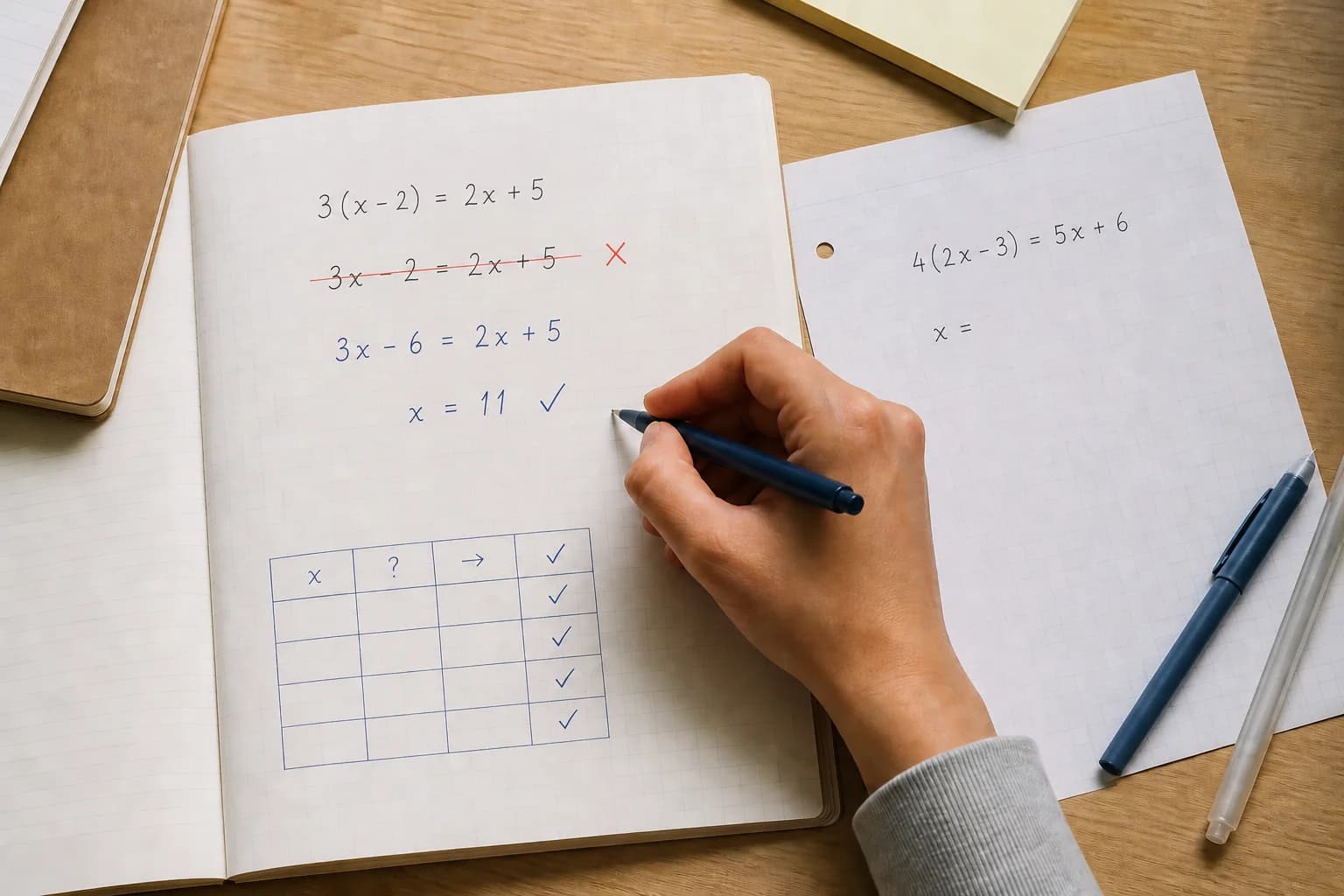
Suppose the problem is 3(x − 2) = 2x + 5. A learner writes 3x − 2 = 2x + 5 and obtains x = 7. Writing only ‘distribution mistake’ is not yet enough. The first incorrect line shows the exact decision: 3 was multiplied by x but not by −2.
The repair is 3(x − 2) = 3x − 6, so 3x − 6 = 2x + 5 and x = 11. Substitute into the original equation: 3(11 − 2) = 27 and 2 · 11 + 5 = 27. The wrong value x = 7 gives 15 on the left and 19 on the right. That comparison turns a mark into evidence you can reuse.
Log the first wrong decision, not every later line that followed from it.
Name the cause first
Separate what happened from why it happened. ‘Forgot the −6’ describes the visible result. A stronger cause might be ‘treated 3(x − 2) as if the multiplier applied only to the first term.’ The cause points toward a repair: draw two arrows from 3, expand both products, and then simplify.
Avoid a catch-all label such as ‘careless.’ It gives no instruction for the next attempt. If you copied −2 as +2, say ‘sign changed while copying.’ If you chose the quadratic formula for an expression that first needed factoring, say ‘method chosen before reading the structure.’ Precise language makes practice selectable.
Keep seven fields and no busywork
A compact entry needs the date and topic, the original question, your first incorrect line, the cause category, the corrected principle, one complete correction, and a retry problem. A photo or short transcription is enough; do not rewrite three pages when one line contains the useful information.
For the distribution example, the corrected principle is ‘a factor outside parentheses multiplies every term inside.’ The retry could be 4(2x − 3) = 5x + 6. Solve it without the correction in view: 8x − 12 = 5x + 6, so x = 6, and both sides equal 36. Record the result only after checking the original equation.
- Date and topic
- Original question
- First incorrect line
- Cause category
- Corrected principle
- Complete correction
- Unseen retry problem
Classify errors by the decision that failed
Useful categories include concept, representation, method selection, procedure, calculation, and verification. A concept error confuses what percentage change means. A representation error turns a sentence into the wrong equation. A method-selection error chooses an unsuitable approach, while a procedure error misapplies a suitable rule.
Calculation errors deserve a real label too: arithmetic fact, sign, fraction operation, or copied value. Verification is separate. If an impossible length or an extraneous root survives because you never returned to the conditions, the failed decision was the missing check. Choose one primary cause; add a second only when it changes the repair.
Repair the method with a contrasting example
Contrast makes a rule easier to see. For (x + 3)/4 = 5, the incorrect move x + 3 = 5 forgets that both sides must be multiplied by 4. The correct line is x + 3 = 20, giving x = 17. Checking (17 + 3)/4 = 5 confirms the repair.
Now change one feature: (2y − 1)/3 = 7. Before calculating, state the operation that clears the denominator and what it must affect. Then solve: 2y − 1 = 21, so y = 11. A retry should preserve the decision you need to practise while changing the surface numbers enough to prevent memorising the answer.
Retry now, later, and in a mixed set
First correct the original problem with the reason written beside the repaired line. Then solve one parallel question without help. Return after a delay and solve another version from a blank page. Finally place the idea among unrelated topics so the heading no longer tells you which method to use.
Mark each retry as independent, completed with a hint, or still unresolved. A correct answer reached through the same faulty reasoning is not a clean pass. If the error repeats, revise the cause or review the prerequisite instead of collecting many nearly identical questions.
Use patterns to choose the next study task
Review the log for repeated decisions rather than counting red marks. Three errors involving negative signs may come from different sources: copying, distributing, and reversing an inequality. They should not automatically become one vague ‘signs’ topic. Group entries only when the same repair would help them.
Turn each pattern into a specific task: expand five expressions while marking every product, translate three rate statements before solving, or check candidate roots in their original equations. Retire an entry after you can explain the rule and complete spaced, mixed retries independently. Keep difficult entries visible until the evidence changes.
Use Eqora as a reviewer, then close it
When the first wrong line is unclear, scan the complete problem and show Eqora both your work and the original prompt. Ask which transition first stops being equivalent, why it fails, or for a hint about the missing condition. Check that exponents, signs, fractions, and diagrams were read correctly before accepting the diagnosis.
You can also request one unsolved problem with the same underlying decision and different numbers. Do not paste the full response into the log. Write the cause and corrected principle in your own words, close the explanation, solve the retry, and verify it independently. AI can misread notation or make a mathematical error, so the source problem and your check remain authoritative.
Practise with three ready-made entries
For a price rising from 80 to 92, a 12/92 calculation uses the new value as the reference. The increase is 12, but percentage increase compares with the original: 12/80 = 0.15 = 15%. Label the cause ‘reference quantity misidentified,’ then retry with a rise from 50 to 58.
For a triangle with base 8 cm and perpendicular height 5 cm, an answer of 40 cm² omits the factor 1/2. Label the cause ‘rectangle formula used for a triangle’ and redraw the matching rectangle. For 4(2x − 3) = 5x + 6, watch whether both inner terms are multiplied. In every entry, finish with a new problem and a check rather than a copied correction.
Put it into practice now
Choose one problem from your current homework or review set. Attempt it before opening Eqora, then use the app only at the point where your own reasoning stops.
- State what the problem is asking before you solve it
- Identify the first step you cannot justify
- Ask Eqora one focused follow-up about that step
- Finish with a similar problem and no solution in view
The session is complete when the method is clearer, not simply when the worksheet has one more answer.