
Photo math workflow · Eqora guide
Free photo math solver: from picture to checked steps
A practical way to scan one real problem, confirm the notation, question the method, and finish with work you can do independently.

A free photo math solver is most useful at the exact moment when a worksheet is clear but your next move is not. Imagine that your page shows 3(2x − 1) = 27. You could photograph it, copy the final value, and move on. A better workflow uses the picture as the beginning of a short study session: confirm what the camera read, compare each transformation with the original, ask about the first step you cannot explain, and then solve a related equation without the answer on screen.
Eqora is free to download for iPhone and iPad; current usage limits and optional Premium details are shown in the app. The process below does not depend on unlimited access or on accepting an AI answer as correct. It is designed for an adult learner doing homework, revising algebra, or returning to mathematics after a break. You keep the original question beside you, use the app for a narrow point of support, and remain responsible for checking the notation, assumptions, calculations, and final result.

Start a free photo math solver session with a real attempt
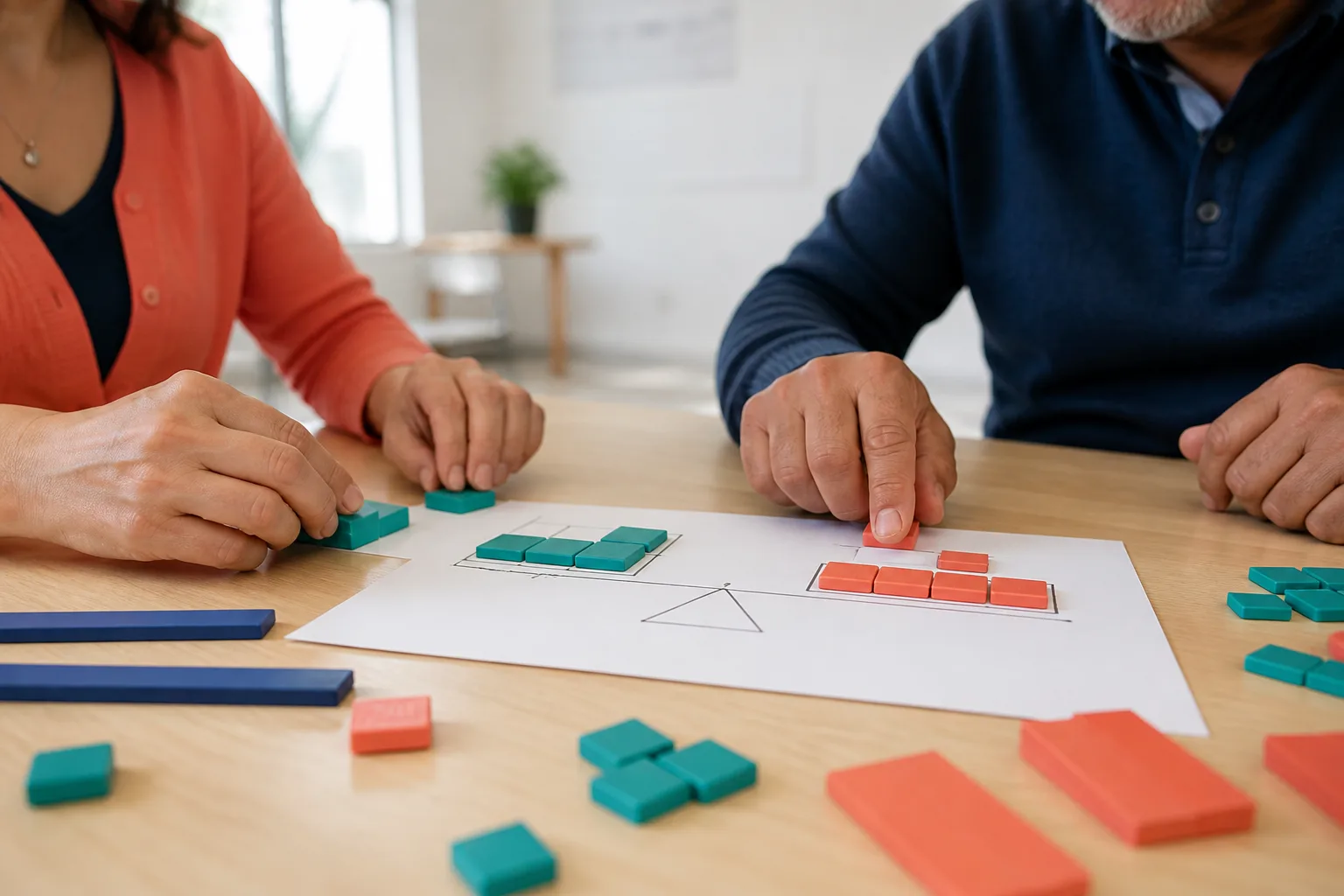
Before opening the camera, read the full problem and write one line of your own. For 3(2x − 1) = 27, you might write, “The goal is to isolate x, and I can either distribute first or divide by 3 first.” That sentence gives you a baseline. If a generated solution uses a different route, you can compare methods rather than treating the app as an answer machine. Even an incomplete attempt reveals whether the real difficulty is notation, a rule, arithmetic, or choosing a method.
Keep the whole question available, including instructions such as “solve over the real numbers,” units, diagrams, or answer-format requirements. A cropped equation without its condition can become a different problem. If your assignment asks for an exact value, a decimal-only response is incomplete; if it asks you to justify a step, a bare chain of equalities is insufficient. The photo should preserve enough context for you to judge the response against the task you were actually given.
- Read the instruction before the expression
- Mark the value or statement you need to find
- Attempt one meaningful first step
- Note the first decision you cannot justify
Capture one complete problem, not a crowded page
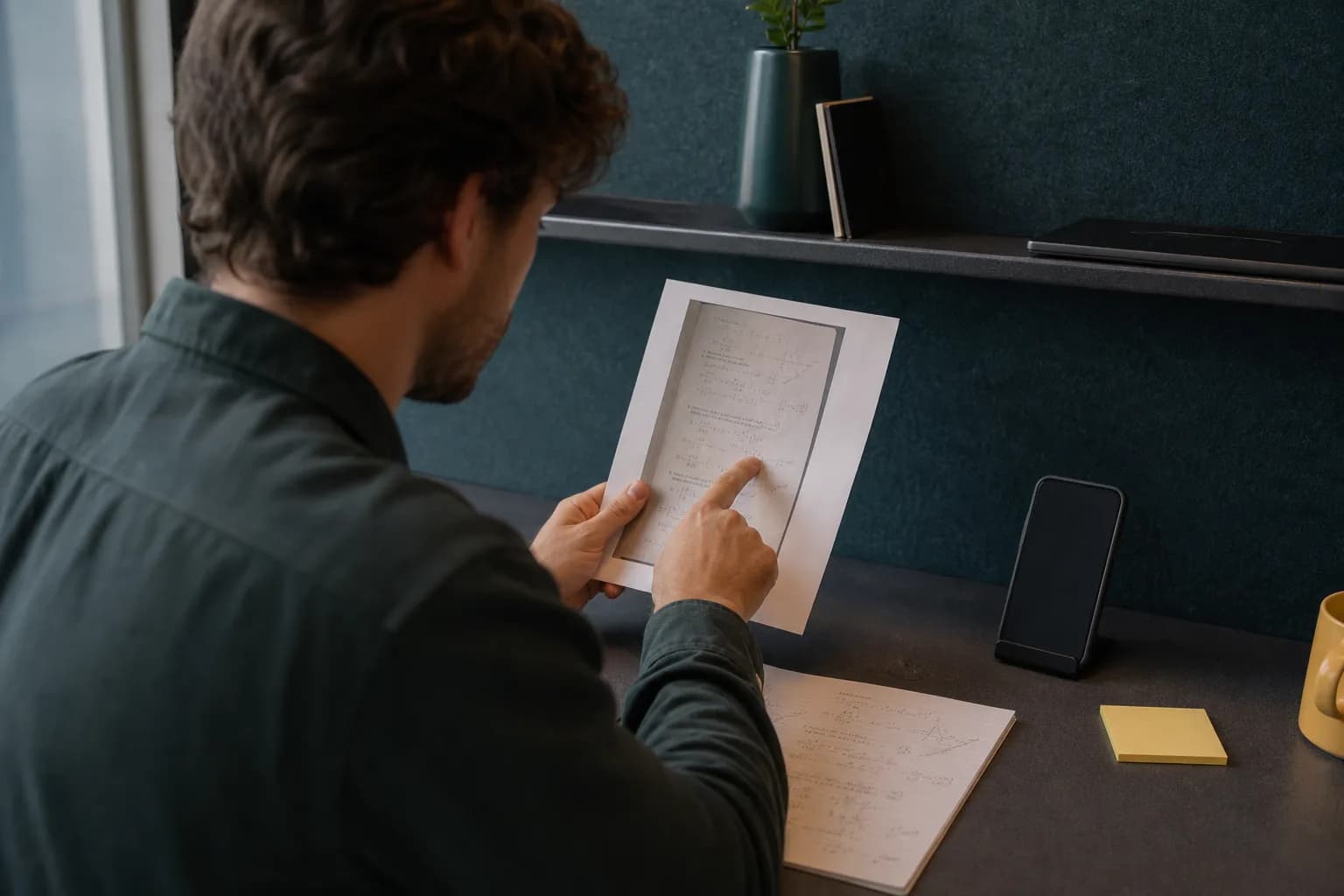
Place the paper on a flat, contrasting surface and use even light. Hold the phone parallel to the page so exponents, fraction bars, radicals, and minus signs do not shrink at one edge. Include all four corners of the relevant area, then crop around one complete problem. A shadow through a denominator or a glare spot over a superscript can change the mathematical structure even when the image still looks readable to you.
For a multi-line question, include the lines that define variables and constraints. For a graph, keep axes, scales, labels, and the full curve. For geometry, retain the entire diagram and the sentence that says what is known. Apple’s document-scanning guidance likewise keeps the document in view and lets the user adjust its corners; the useful principle here is deliberate framing, not blindly accepting an automatic crop. Retake the image when the source is blurred rather than asking the solver to guess.
A tight crop removes distractions. An over-tight crop removes meaning. Keep every symbol and condition needed to reconstruct the original task.
Check the recognized notation before reading the solution
Pause at the recognized problem. Compare it character by character with the page: 1 versus l, 0 versus O, x versus the multiplication sign, − versus a fraction bar, and x² versus 2x are common visual confusions. Also inspect parentheses. The equations 3(2x − 1) = 27 and 3(2x) − 1 = 27 do not express the same relationship, so a polished explanation of the second equation cannot answer the first.
Say the expression aloud in structural language: “three times the quantity two x minus one equals twenty-seven.” For fractions, name the numerator and the complete denominator. For roots, identify exactly what sits under the radical. If anything differs, retake the photo or type the corrected expression. This check usually takes less time than tracing a long solution built from a misread symbol, and it teaches you to see notation as mathematical syntax rather than decoration.
- Signs: plus, minus, multiplication, division and equality
- Grouping: parentheses, brackets, fraction bars and radicals
- Position: exponents, subscripts and limits
- Context: units, domains, labels and requested form
Inspect the steps and name the reason for each move
A sensible route for 3(2x − 1) = 27 is 6x − 3 = 27, then 6x = 30, then x = 5. Do not only check whether one line resembles the next. Name the operation: distribute 3 across both terms inside the parentheses; add 3 to both sides to preserve equality; divide both sides by 6 because the coefficient of x is 6. The reason is what makes the method transferable to a new equation.
A second valid route divides both sides by 3 first: 2x − 1 = 9, then 2x = 10, then x = 5. Comparing the two routes is useful because it separates necessary mathematics from stylistic choice. If Eqora uses a route your course has not introduced, ask for the method used in class rather than memorizing unfamiliar notation. A step-by-step display is evidence to inspect, not proof that every line is appropriate for your assignment.

Ask one focused follow-up about the first unclear step
A useful follow-up contains the original expression, the exact transition, and your current belief. Try: “In 3(2x − 1) = 27, why is it valid to change the left side to 6x − 3?” or “I divided by 3 first and got 2x − 1 = 9. Is that equivalent, and why?” These questions invite an explanation of distributivity or equality. “Explain everything” often produces more text without locating the misconception that stopped you.
After reading the answer, close it and explain the step in one sentence of your own. Then alter one feature: replace 27 with 33, or replace 3 with 4, and predict what changes before calculating. If you can only repeat the app’s wording, the idea is not yet secure. If you can justify the move and adapt it to a nearby example, the interaction has become learning rather than transcription.
Focused prompt: “What rule justifies this one transition, and what would change if the coefficient were 4?”
Treat diagrams, handwriting and word problems as special cases
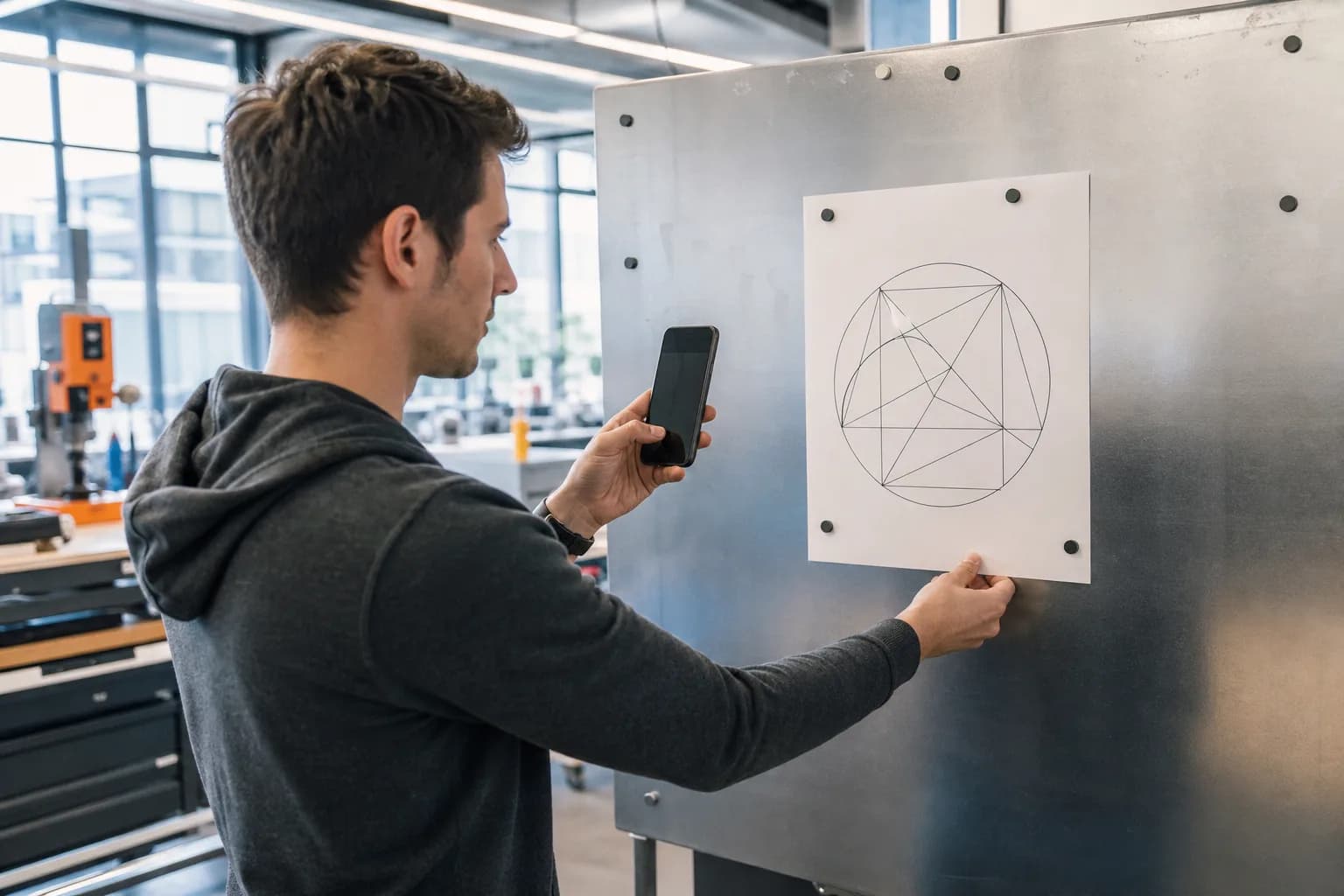
A photo solver sees pixels before it sees mathematics. In geometry, a diagram may not be drawn to scale, a right-angle marker may be tiny, and a label can sit far from the segment it describes. Capture the diagram and wording together, then type any essential labels if recognition is uncertain. Never infer that two lengths are equal merely because they look equal in the picture; use only stated facts, conventional markings, and valid deductions.
Word problems require the solver to preserve relationships, not only numbers. Before scanning, list the unknown, units, and what each number represents. Tables need row and column headings; handwritten work needs spacing between symbols; calculus needs clear limits and differential notation. When a page contains several exercises, isolate one. The goal is not the shortest upload. It is an input that lets you compare the returned mathematical model with the source.
Verify the result against the original problem
Return to the source equation, not the final transformed line. Substituting x = 5 into 3(2x − 1) gives 3(10 − 1) = 27, so the left side is 27 and matches the right side. OpenStax’s algebra guidance uses this same principle: substitute a proposed solution into the original equation and check that the result is a true statement. This test catches arithmetic errors and values introduced by transformations in more complicated problems.
Use a second check when possible. Estimate the likely sign and size before exact work, compare a graph with an algebraic result, or model equality with balanced quantities. A calculator can confirm arithmetic but cannot tell you that the photographed equation omitted a parenthesis. Eqora can also make a mistake or misread the image. Agreement between an AI answer and your expectation is reassuring, but verification must still connect the result to the original notation and conditions.
Finish with a similar problem and no solution in view
Put the phone aside and solve 4(3y + 2) = 32. State your plan first. Dividing by 4 gives 3y + 2 = 8; subtracting 2 gives 3y = 6; dividing by 3 gives y = 2. Check it in the original: 4(3·2 + 2) = 4·8 = 32. You have now repeated the structure with different numbers while producing every decision yourself.
End the session by writing the one warning you want to remember, such as “confirm parentheses before trusting the steps.” If the independent problem fails, identify the first uncertain decision and revisit only that explanation. Do not keep rereading the complete generated solution. A productive photo-math session is short and selective: attempt, capture, confirm, question, verify, then practise. The proof of progress is that you can begin the next problem without the camera.

Put it into practice now
Choose one problem from your current homework or review set. Attempt it before opening Eqora, then use the app only at the point where your own reasoning stops.
- State what the problem is asking before you solve it
- Identify the first step you cannot justify
- Ask Eqora one focused follow-up about that step
- Finish with a similar problem and no solution in view
The session is complete when the method is clearer, not simply when the worksheet has one more answer.