Geometry · Eqora guide
Similar triangles: why areas do not scale like sides
Match the corners, choose the direction of enlargement, and separate the side factor from its square. Then check a fresh example yourself.

Similar triangles create a tempting shortcut: if every side becomes three times as long, perhaps the area becomes three times as large too. It does not. A triangle with base 6 cm and perpendicular height 4 cm has area 12 cm². Enlarging every length by three gives base 18 cm and height 12 cm, so its area is 108 cm². The lengths have multiplied by three, but the area has multiplied by nine. The extra factor comes from scaling two dimensions, not from a special rule about one particular triangle.
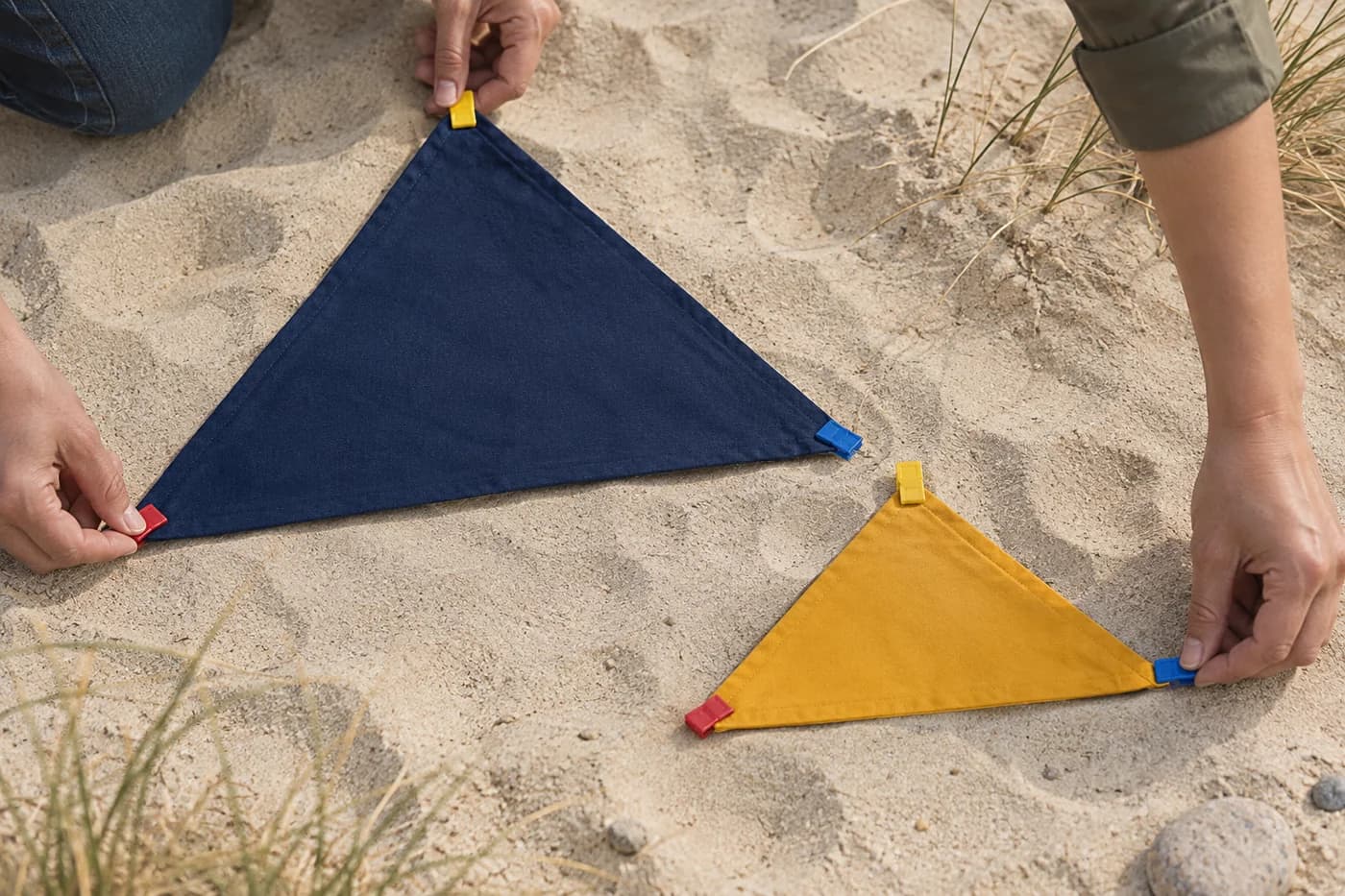
This guide builds a complete paper-and-pencil method: justify similarity, pair the correct sides, state the direction of the ratio, calculate lengths and areas, and reverse the reasoning when only areas are known. All numerical examples are invented for teaching. The coastal kite photographs illustrate comparisons and practice; their fabric shapes are not exact mathematical diagrams and do not encode the measurements below. You should use the written conditions, not measure a photograph or assume a sketch is drawn to scale.
Eqora publishes this explanation as a learning aid. You do not need an app to solve any example here. If you use assistance later, check the problem statement, notation, assumptions and result, and follow your course rules. An explanation or tool output is not a guarantee of correctness or grades and must not replace your own examination work. The strongest check is being able to explain which quantities changed and why, without looking at a worked answer.
Similar triangles need a reason, not a resemblance
Two triangles are similar when their corresponding angles agree and their corresponding sides share one positive scale factor. Rotation, reflection and position on the page do not prevent similarity. Congruent triangles are the special case with factor one. Start by identifying a sufficient criterion: two equal angle pairs, three proportional side pairs, or two proportional side pairs with the included angle equal. Two equal angles suffice because each triangle's angles sum to 180°; the third pair must then agree.
Do not confuse this with knowing just two proportional sides and an unrelated angle. The angle between those sides matters for the side-angle-side criterion. Likewise, a common angle alone does not establish similarity. OpenStax's treatment of similar figures connects corresponding sides with proportional lengths. In your own solution, name the actual evidence before writing a proportion: for example, both triangles have angles 35° and 65°, so the remaining angle is 80°. A visual impression is not an extra given condition.
Write the corner correspondence before the fractions
Suppose triangle ABC is similar to triangle DEF in that order. The notation tells you A corresponds to D, B to E, and C to F. Therefore AB pairs with DE, BC with EF, and AC with DF. If one drawing is upside down, these pairs remain the same. Redraw it if helpful, but keep the letters attached to their original vertices. Matching the leftmost side of each sketch instead of its endpoints is a common source of a plausible but incorrect proportion.
Let AB = 6 cm, BC = 8 cm and AC = 10 cm. Suppose the corresponding DE = 9 cm. Define the factor from ABC to DEF as k = DE/AB = 9/6 = 3/2. Multiplying every original side by 3/2 gives EF = 12 cm and DF = 15 cm. Check all three ratios: 9/6 = 12/8 = 15/10. Our guide to understanding methods rather than memorising answers offers a useful study habit: explain the pairing aloud before doing the arithmetic.
A scale factor has a direction
The factor 3/2 describes the move from the smaller triangle to the larger one. In the reverse direction it is 2/3. Neither fraction is intrinsically wrong; it becomes wrong when you apply it in the opposite direction. Write target length divided by starting length beside k. A factor greater than one enlarges, a factor between zero and one reduces, and one preserves size. For ordinary nondegenerate triangles the factor is positive; a negative algebraic coordinate multiplier needs a separate transformation interpretation.
Use consistent units before forming the ratio. If a corresponding side is 60 mm in the first triangle and 9 cm in the second, convert 60 mm to 6 cm first. The dimensionless factor is still 3/2, not 9/60. Units cancel only when they represent the same measurement unit. Retain exact fractions until the final step, especially if another calculation follows. Rounding 3/2 is harmless here, but rounding 4/3 too early can spoil a later area or reverse calculation.
Why the area factor is the square
For a triangle, area A = bh/2, where h is perpendicular to the chosen base. A uniform enlargement multiplies both b and h by k. Therefore the new area is (kb)(kh)/2 = k²(bh/2) = k²A. The one-half remains unchanged. You have not squared the area itself; you have squared the length factor multiplying it. For our factor 3/2, the area factor is 9/4. If the original area is 24 cm², the new area is 54 cm², not 36 cm².
The side lengths 6, 8 and 10 form a right triangle, since 6² + 8² = 10². Its perpendicular legs give area 6 × 8/2 = 24 cm². The enlarged legs 9 and 12 give 9 × 12/2 = 54 cm². This direct calculation independently verifies the area-ratio method. For a non-right triangle, do not use any two sides as base and height: the height must be perpendicular and may need to be supplied or calculated. Similarity scales that altitude as well as the boundary sides.
Perimeter scales once; square units do not
Perimeter is a sum of lengths. If the original sides are a, b and c, the enlarged perimeter is ka + kb + kc = k(a + b + c). Our smaller triangle has perimeter 24 cm, and the larger one has perimeter 36 cm. The perimeter ratio is 3/2, while the area ratio is 9/4. Keep separate labels for side, perimeter and area ratios; writing a single unlabeled ratio invites you to reuse it for a quantity with a different dimension.
A conversion between square units also happens in two dimensions. One centimetre equals ten millimetres, so one square centimetre equals one hundred square millimetres. The area 54 cm² is 5,400 mm². Multiplying by ten would convert a length, not this area. Before comparing an area with another area, put both in the same square unit. The factor k² is dimensionless, but the calculated area still carries its original square unit. A missing square on the unit can reveal a mistaken choice of formula.
Recover a side factor from an area ratio
Now reverse the problem. Two similar triangles have areas 20 cm² and 45 cm². From the first to the second, the area ratio is 45/20 = 9/4. The length factor is the positive square root, k = √(9/4) = 3/2. A side of 8 cm in the first triangle corresponds to 12 cm in the second. Multiplying eight by 9/4 would give 18 cm, which applies the area factor to a length and is therefore the wrong operation.
An area ratio alone does not prove similarity. Two differently shaped triangles can share the same area, or any specified area ratio. Use the square-root rule only after the problem establishes similarity or you have justified it. Also distinguish ratio order: an area ratio small:large of 4:9 implies a side ratio small:large of 2:3. It does not mean every side increases by two thirds. Read the order aloud and identify which object contains the unknown measurement before choosing multiplication or division.
Shadow measurements depend on the setup
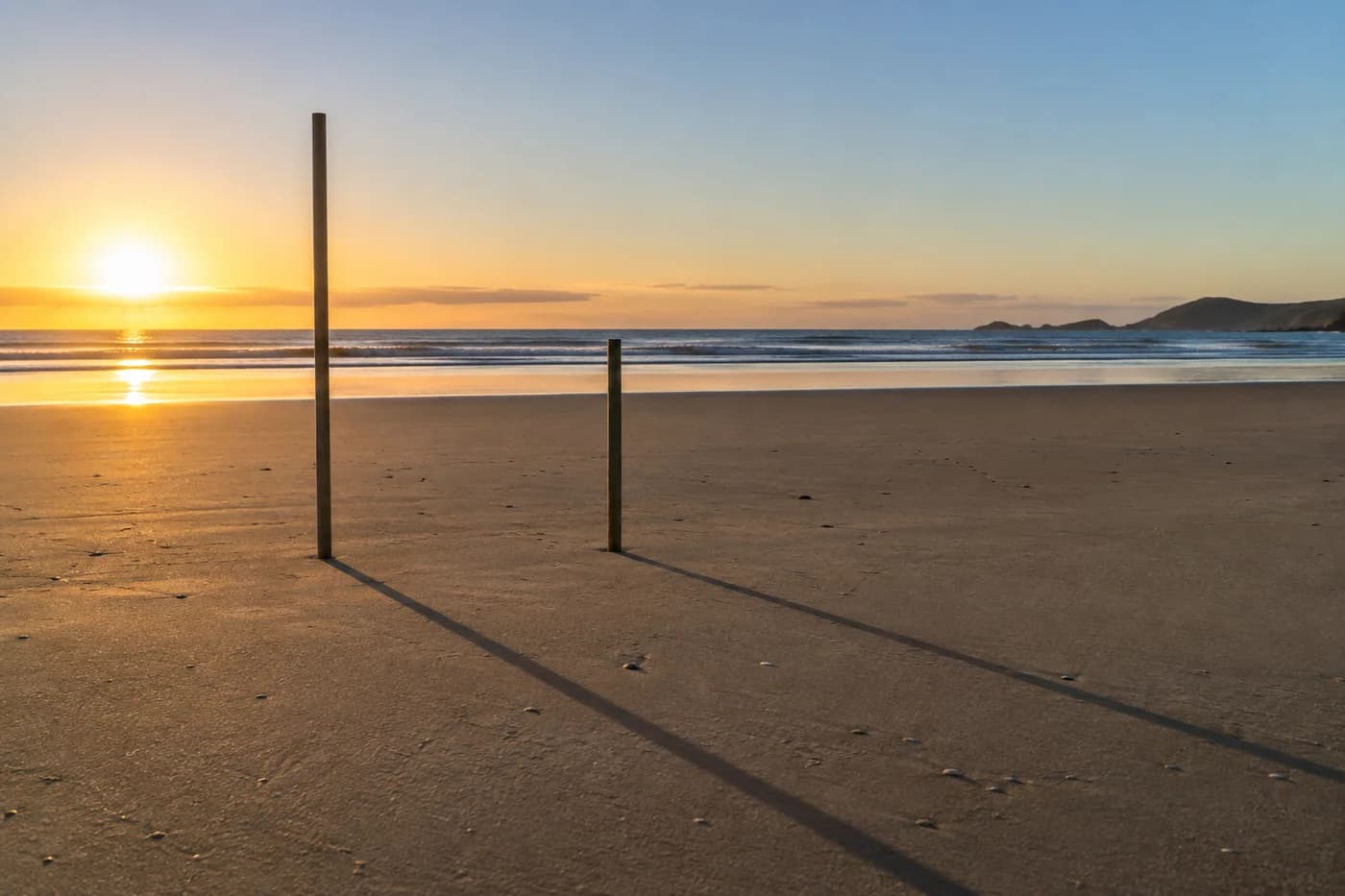
A vertical reference pole is 1.2 m tall and casts a 0.8 m shadow. At the same time, a vertical object on the same level ground casts a 5 m shadow. Under the ideal model of parallel sunlight, both height-shadow triangles have a right angle and the same sunlight angle, so they are similar. The height-to-shadow ratio is 1.2/0.8 = 1.5. The unknown height is 1.5 × 5 = 7.5 m. All measurements here use metres and the ratio compares height with shadow consistently.
This is not a reason to trust every outdoor estimate. Sloping ground, a leaning pole, different measurement times or an unclear shadow endpoint can invalidate the model or introduce uncertainty. State the assumptions and report precision consistent with the measurements. Never approach an unsafe structure to obtain a side length. Our guide to interpreting word problems helps separate stated data from assumptions you must justify. In a written exercise, use its idealised conditions; in real measurement, recognise their limits instead of treating the last decimal as certainty.
Use a new triangle to check your understanding
Try this without looking back: two similar right triangles have corresponding perpendicular legs 5 cm and 12 cm in the first, while the side corresponding to 5 cm is 7.5 cm in the second. Find the other leg, both areas and the area ratio. Then reverse the enlargement. Write the correspondence and the direction of k before calculating. The different numbers prevent simply carrying a previous answer into a new problem. Pause until your own solution includes lengths, square units and a reason for the squared factor.
The factor is 7.5/5 = 3/2, so the other leg is 18 cm. The first area is 5 × 12/2 = 30 cm² and the second is 7.5 × 18/2 = 67.5 cm². Their ratio is 67.5/30 = 9/4. Returning to the original triangle uses length factor 2/3 and area factor 4/9: 18 × 2/3 = 12 and 67.5 × 4/9 = 30. These reverse checks recover the starting measurements, providing a different route for catching a direction error.
Finally, decide what is missing if a question gives two arbitrary triangles with areas 30 and 67.5 cm² but says nothing about their angles or shape. You cannot infer corresponding sides from those areas alone. A complete explanation would request or prove similarity first. Finish by writing one sentence connecting the two independent changes: every perpendicular length scales by k, so the product that defines area scales by k². That sentence makes the calculation transferable rather than a rule recalled without its condition.