
Foundations · Eqora guide
How to understand fractions and percentages instead of memorizing tricks
Connect parts, ratios, decimals, and percent change with representations that make each operation explainable.
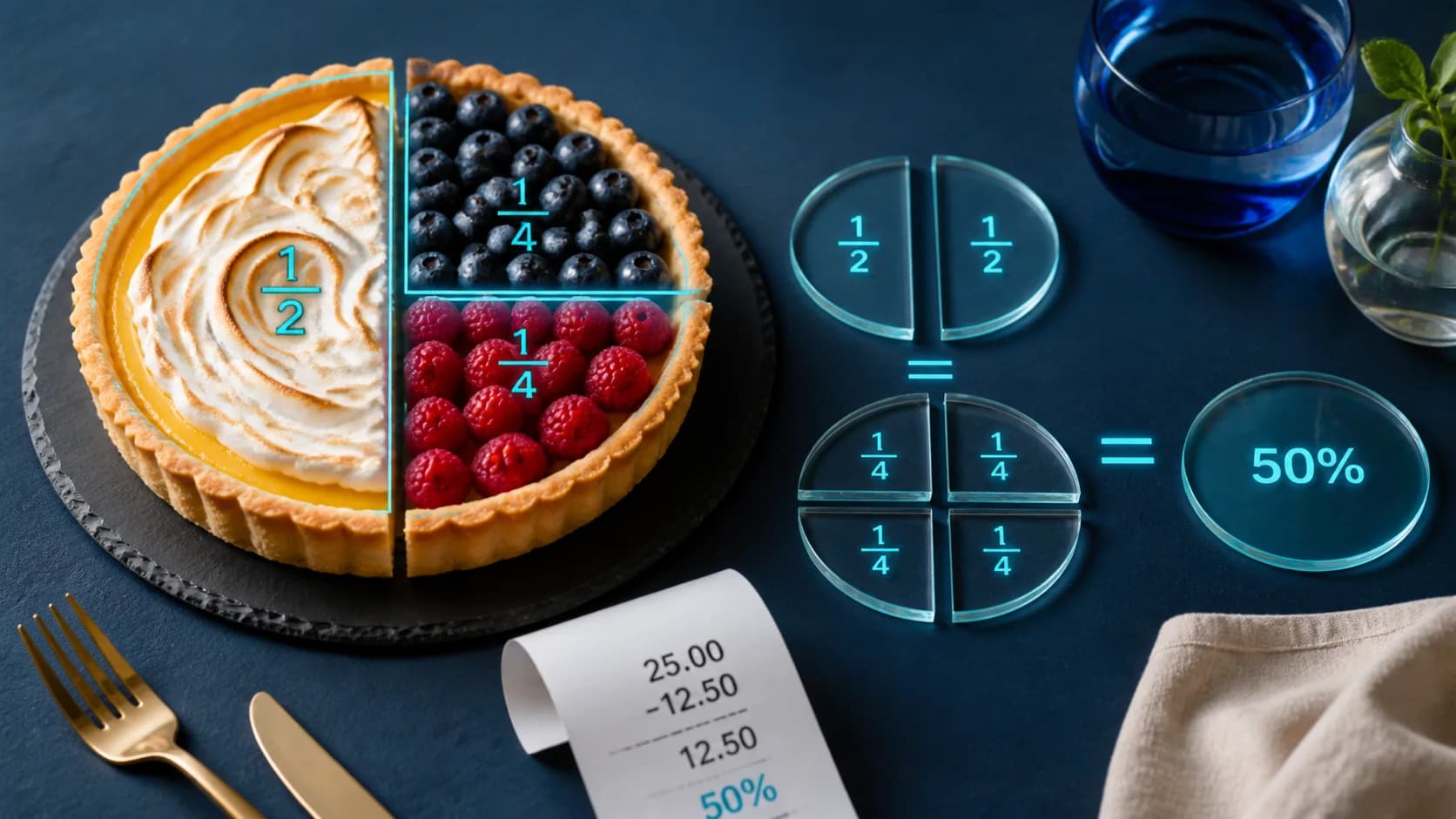
Fractions, decimals, ratios, and percentages are different ways to describe relationships between quantities. They become confusing when rules are memorized without a picture of what the numbers represent.
Use an AI tutor to connect forms and test your reasoning, not to supply isolated conversions. A good session should leave you able to estimate the answer before calculating it exactly.


Name the whole before naming the part
A fraction has meaning only relative to a whole. Three quarters of a pizza, three quarters of an hour, and three quarters of a class refer to different quantities even though the fraction is identical.
Before calculating, write what one whole represents and whether the parts are equal. Many fraction errors begin with changing the whole halfway through a problem.
Use area, length, and set models
An area model shows parts of one region, a number line shows magnitude and order, and a set model shows a fraction of a group. Switching representations can reveal why an operation works and where a visual analogy stops being useful.
Ask Eqora to show the same fraction in two models. Then explain what stays constant and what changes between them.
Build equivalent forms by preserving value
Multiplying the numerator and denominator by the same nonzero number changes the name of the parts but not the overall value. This is why equivalent fractions occupy the same point on a number line.
Connect the fraction to division to move into decimal form, then multiply the decimal by 100 to express a percentage. Keep enough precision to avoid rounding errors in later steps.
Conversion is not a new value. It is a new representation of the same relationship.
Estimate before adding or multiplying
Compare each fraction with benchmarks such as zero, one half, and one. If two values are each a little more than one half, their sum must be a little more than one. This makes an impossible exact answer easier to notice.
For multiplication, ask whether you are taking a fraction of a quantity. Multiplying a positive number by a fraction less than one should make it smaller; division by that fraction should make it larger.
Distinguish percentage points from percent change
If a rate rises from 20% to 25%, the increase is 5 percentage points. Relative to the original 20%, it is a 25% increase. These statements answer different questions and should not be used interchangeably.
Write the reference value explicitly in every percent-change problem. The denominator should represent the starting or comparison quantity named by the question.
Handle repeated percentage changes carefully
A 10% increase followed by a 10% decrease does not return to the starting value because the second percentage applies to a different base. Use multipliers such as 1.10 and 0.90 to track the changing whole.
For discounts, tax, interest, and growth, label the amount before and after each change. Do not add percentages unless they apply to the same base in the same way.
Ask AI for comparison questions
Instead of requesting ten identical conversions, ask for pairs that require judgment: which is larger, which is closer to one half, or which discount produces the lower final price. Explain your estimate before seeing the calculation.
When an answer is wrong, ask whether the problem came from the reference whole, the operation, the conversion, or the arithmetic. Fix the category, not only the individual number.
Finish with mental and exact checks
State a reasonable interval before calculating. Then compute exactly, simplify the fraction when appropriate, and convert to another form to cross-check the value.
Use a calculator only after the relationship is clear. Technology can confirm arithmetic, but it cannot decide which quantity should be the whole unless you model the situation correctly.
Put it into practice now
Choose one problem from your current homework or review set. Attempt it before opening Eqora, then use the app only at the point where your own reasoning stops.
- State what the problem is asking before you solve it
- Identify the first step you cannot justify
- Ask Eqora one focused follow-up about that step
- Finish with a similar problem and no solution in view
The session is complete when the method is clearer, not simply when the worksheet has one more answer.