
Trigonometry · Eqora guide
Radians in math: why 180° equals π rad
Measure a turn by comparing its arc with the radius, convert angle units without guessing, and check the calculator mode before evaluating a function.

Radians in math describe a turn using a different unit from degrees, without changing the turn itself. A quarter turn can be written as 90° or π/2 rad. The wheel has not moved again; only the number used to report its rotation has changed. Confusion begins when the same bare number is treated as both units. An angle of 2 radians is a little more than a quarter turn, whereas 2° is a very small turn. Before calculating, write the unit beside the value.
Radians connect an angle to lengths on a circle. That connection explains the conversion factors rather than leaving you with two formulas to memorize. We will derive the half-turn relationship, convert in both directions, keep exact values separate from approximations, interpret negative and repeated rotations, and calculate a circular arc. The workshop photographs are analogies for rims, radii, and turning. They are not scale drawings: do not measure a pictured cord to obtain an answer.
You can complete every example with paper and, when a decimal is requested, an ordinary calculator. Sketch the turn roughly first and preserve the original unit through your working. A realistic-looking answer is not enough if it came from the wrong angle unit. The method below gives you independent checks on size, direction, and length, so you can explain why the result fits the problem instead of accepting it because a device displayed it.
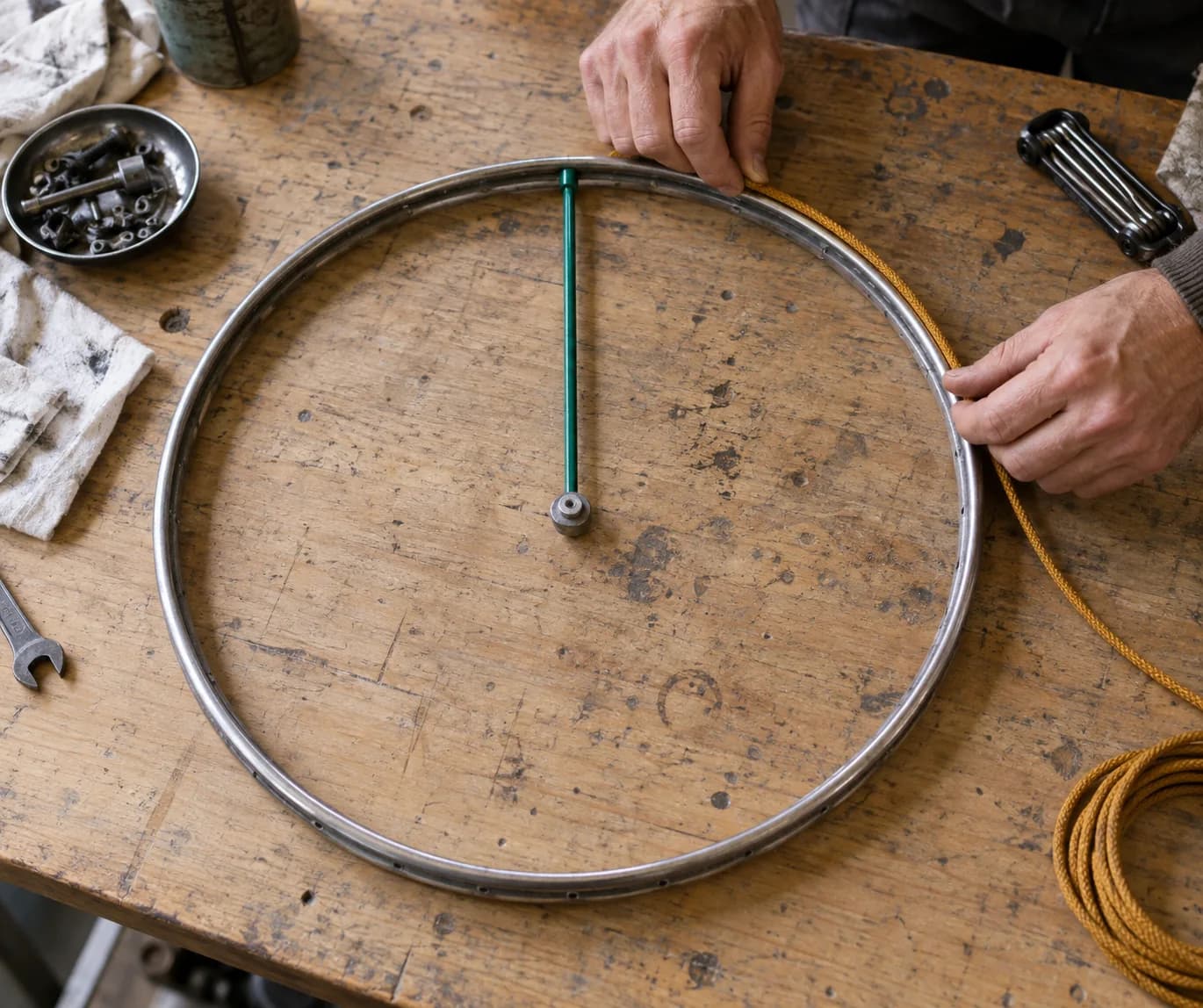

Radians in math connect the arc with the radius
Take a circle with positive radius r and an arc of length s, measured along the circumference. The central angle subtending that arc has radian measure θ = s/r. If the arc and radius have equal lengths, their ratio is one, so the angle is 1 radian. This is a definition of angle measure, not a rule that every curved line represents one radian. A longer arc on the same circle produces a larger central angle.
Use the same length unit for s and r. An arc of 12 cm on a circle of radius 8 cm gives θ = 12/8 = 1.5 rad. Writing 0.12/8 would mix meters with centimeters and change the answer by a factor of one hundred. Because the lengths divide, the length units cancel; rad marks that the resulting number describes an angle. OpenStax's angle chapter defines radians through this arc-to-radius comparison. Keep that interpretation beside the formula as you work.
The half turn explains the number π
A full circumference has length 2πr. Divide it by the radius: (2πr)/r = 2π. A complete turn therefore measures 2π rad, whatever the circle's size. The same full turn is 360°. Halving both descriptions gives 180° = π rad. Do not write π = 180 as an equality of ordinary numbers: π is approximately 3.14159. The equality relates two different numerical descriptions of the same angle.
A larger wheel has a longer circumference but also a larger radius, so the ratio stays unchanged. Doubling both s and r leaves s/r unchanged. This is why the same central angle can appear on a tiny dial and a large wheel. As useful anchors, half a turn is π, a quarter is π/2, and a whole turn is 2π in radians. One radian is 180/π degrees, about 57.3°, not 180°. Distinguish one radian from π radians.

Convert degrees with a factor that cancels the unit
To convert a degree measure d, multiply by π rad/180°. The degree unit cancels and the result is in radians: θ = dπ/180. For 150°, write 150° × π rad/180° = 5π/6 rad. Reduce the fraction 150/180 to 5/6 before approximating. A size check supports the result: 150° is between 90° and 180°, so its radian measure must lie between π/2 and π. Five sixths of π does.
For an unfamiliar angle such as 24°, the same process gives 24π/180 = 2π/15 rad. There is no need to find it in a memorized table. You can also use the fraction of a full turn: 24/360 = 1/15, then multiply 1/15 by 2π. Both routes give 2π/15. If your arithmetic produces 15π/2 instead, check whether you inverted the conversion factor. A small positive degree angle cannot suddenly represent several complete turns after changing units.
Convert radians without assuming that π must appear
For a radian measure t, multiply by 180°/π rad. For example, (7π/6) rad × 180°/π rad = 210°. Cancel π and simplify 180/6 before multiplying by seven. This is slightly more than a half turn, consistent with 7π/6 being slightly more than π. A second example, 3π/4 rad, gives 135°. Remember that changing units preserves the angle, including its sign and any complete turns.
A radian value does not have to contain π. An angle of 2 rad converts to 360/π degrees, approximately 114.59°. The exact result is 360/π°, not 360°. Since 2 lies between π/2 and π, the answer must be between 90° and 180°. If the problem gives 0.8 rad, the conversion is 144/π°, approximately 45.84°. Multiplying by 180 alone only works when a factor of π has already canceled; it is not the general conversion rule.
Keep exact values until the requested final precision
An answer such as 5π/6 rad is exact. Replacing π with 3.14 produces an approximation, which should be marked with ≈ rather than =. For 150°, 5π/6 ≈ 2.618 rad to three decimal places. If you round too early, later multiplication by a large radius can magnify the rounding error. Preserve the fraction and π through intermediate steps, then use the calculator's π value for the final decimal if needed.
Not every task wants a decimal. A request for an exact angle normally expects a fraction involving π, while a measured physical length may ask for a specified number of decimal places. Read that instruction before choosing the final form. A simple circle sketch gives another safeguard: 45° is one eighth of a turn and therefore π/4 rad; 60° is one sixth and therefore π/3 rad. For the wider connection to sine, cosine, and circle coordinates, the visual trigonometry guide builds on these angle anchors.
Negative angles describe direction, not negative distances
In standard position, start from the positive horizontal axis. Counterclockwise rotation is positive and clockwise rotation is negative. Thus −60° = −π/3 rad. This does not mean a physical rim has negative length. It records a directed rotation. If a geometry question asks for the ordinary length of the corresponding shorter arc, use the positive size of that angle, π/3, in the length calculation.
Angles can end at the same ray after different rotations. Adding or subtracting 2π rad, or 360°, preserves the terminal ray. For example, −π/3 and 5π/3 are coterminal because their difference is 2π. They are not the same recorded amount of rotation. Similarly, 450° converts to 5π/2 rad, not π/2 rad, unless you are specifically asked for a coterminal representative in one turn. Reduce to a required interval only after identifying what the problem asks you to retain.

Arc length uses a radian angle
Rearranging θ = s/r gives s = rθ. This compact formula requires θ in radians. Suppose a circular path has radius 9 cm and central angle 80°. Convert first: θ = 80π/180 = 4π/9 rad. Then s = 9 × 4π/9 = 4π cm, approximately 12.57 cm. Substituting the bare number 80 into s = rθ would give 720 cm, which is longer than the entire circumference 18π cm and clearly cannot describe this partial arc.
Check with the fraction-of-a-circle method: 80/360 = 2/9 of the circumference, so s = (2/9)(18π) = 4π cm. That independent route agrees. Conversely, a 15 cm arc on a radius of 10 cm gives θ = 1.5 rad, about 85.94°. Arc length is the curved path, not the straight chord joining its endpoints. Identify the intended arc, the radius rather than diameter, and compatible length units before calculating. If the diameter is 18 cm, the radius for the formula is 9 cm.
Check DEG or RAD before trusting a trigonometric value
A calculator's angle mode determines how a bare input to sine, cosine, or tangent is interpreted. For sin(30°), use degree mode with input 30, or radian mode with input π/6. Both should return 0.5. In radian mode, sin(30) means thirty radians, not thirty degrees; it is approximately −0.988. That different result is a different question, not evidence that the conversion relationship failed.
A familiar reference value is a useful mode test before a long computation. Check sin(90°) = 1 in degree mode or sin(π/2) = 1 in radian mode. Converting 150° to 5π/6 does not itself require a trigonometric mode; ordinary arithmetic is enough. The mode matters when an angle enters a trigonometric function or an inverse function returns an angle. For an inverse sine result, also remember that a calculator returns a principal value, not automatically every solution of an equation. Read the requested interval and verify the original conditions.
Practise both directions and verify the original meaning
Try three fresh problems before reading the checks. Convert 225° to radians; convert 11π/12 rad to degrees; find the arc length on a circle of radius 6 m for a central angle of 120°. Write the initial unit, choose a canceling conversion factor, simplify exactly, and predict the rough size. The first angle lies between a half turn and three quarters of a turn; the second lies just below a half turn. The third arc must be shorter than its full circumference.
The checks are 5π/4 rad, 165°, and 4π m respectively. For the length, 120° = 2π/3 rad, so 6 × 2π/3 = 4π. The fraction 120/360 = 1/3 gives the same length from the full circumference 12π m. If a result disagrees, return to the first mismatched unit or inverted fraction, rather than changing the final digit. The independent answer-checking guide develops this habit further. Eqora can be a learning aid if you later seek an explanation, but it is neither a replacement for your exam work nor a guarantee: always inspect the task, notation, assumptions, and result yourself.
Put it into practice now
Choose one problem from your current homework or review set. Attempt it before opening Eqora, then use the app only at the point where your own reasoning stops.
- State what the problem is asking before you solve it
- Identify the first step you cannot justify
- Ask Eqora one focused follow-up about that step
- Finish with a similar problem and no solution in view
The session is complete when the method is clearer, not simply when the worksheet has one more answer.