
Choosing a math app · Eqora guide
Best AI math solver app: what actually helps you learn
A practical way to judge math apps by the learning they support, not by how quickly they reveal a final answer.

The best AI math solver app is not necessarily the one that displays an answer first. Imagine that you are working on (x − 3) ÷ 4 + 2 = 5. You know the equation involves inverse operations, but after subtracting 2 you are unsure whether to multiply by 4 before adding 3. A useful app should preserve the complete expression, show why the order works, let you question that exact transition, and then step aside while you solve a similar equation yourself.
This article is published by Eqora, so the recommendation is not presented as an independent ranking. We recommend Eqora for learners who want photo capture, explained steps, contextual follow-up questions, and practice in one iPhone or iPad workflow. The criteria below are the ones we believe students should use to judge any math app: reliable input, visible reasoning, useful dialogue, transfer practice, honest limits, privacy awareness, and a result you can verify. We have not invented comparative accuracy scores or claimed to test every competing service.
Use the worked equation as a small audition. First solve as far as you can on paper. Then capture the complete problem, inspect each step, ask one precise question, close the example, and try 3(y + 2) − 4 = 17 independently. An app earns a place in your study routine only if that final attempt becomes clearer. Speed matters during homework, but the stronger measure is whether you can continue when the screen is no longer supplying the next line.


Judge the best AI math solver app by one real problem
Begin before opening any app. Copy the full equation (x − 3) ÷ 4 + 2 = 5 and write what you are trying to find. Attempt the first move yourself: subtract 2 from both sides to obtain (x − 3) ÷ 4 = 3. Now mark the uncertainty. The question is not merely “What is x?” It is “Why is multiplying both sides by 4 the next inverse operation?” That distinction gives you something meaningful to evaluate.
A weak trial asks whether the app reaches x = 15. A better trial asks whether the input remains accurate, whether the explanation keeps both sides balanced, whether you can interrogate the multiplication step, and whether the method transfers to a new equation. Use one familiar problem rather than an exotic edge case. You are testing the learning workflow, not attempting to prove universal accuracy from a single result.
Check whether the app captures the complete problem
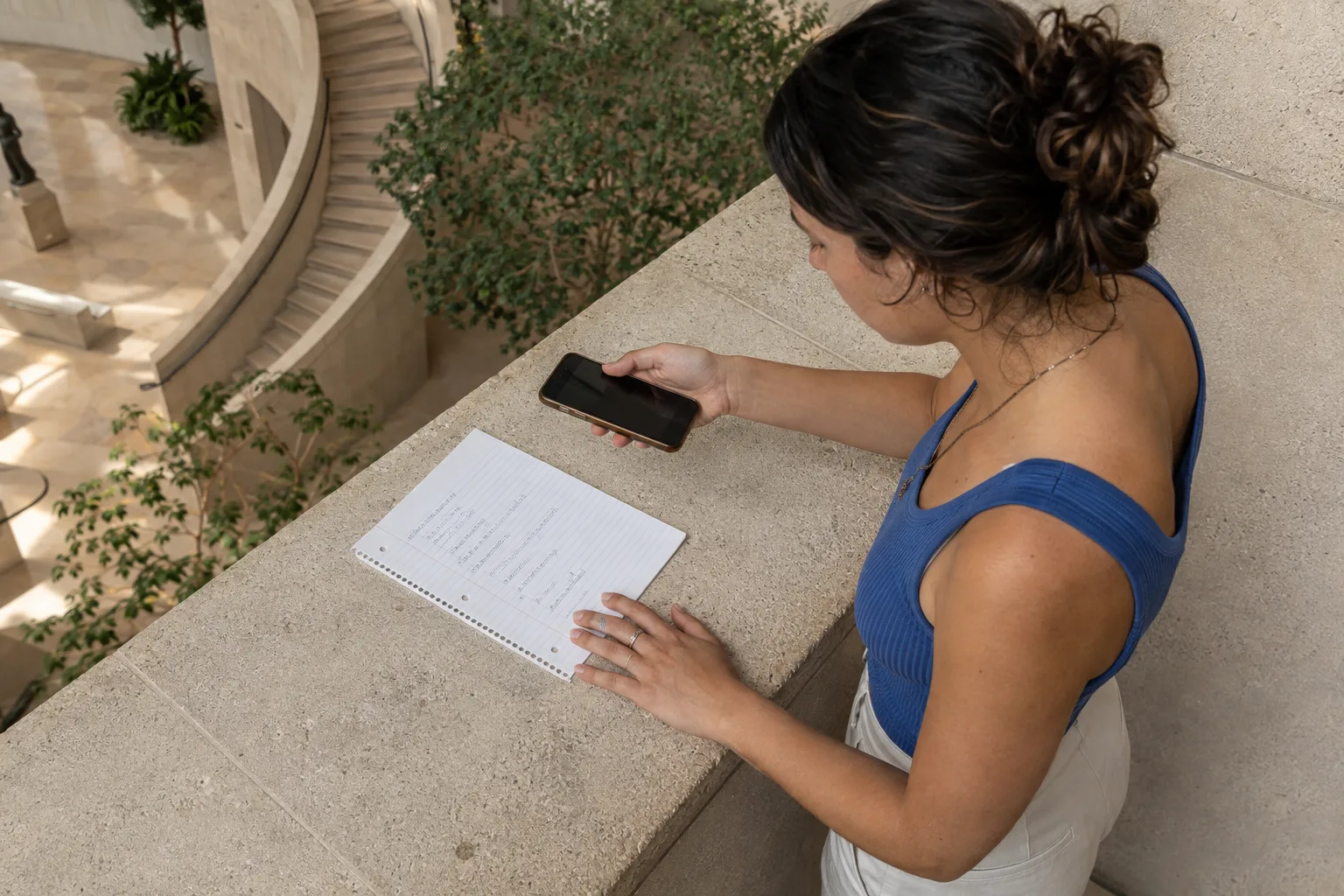
A polished explanation cannot rescue a misread problem. For photo input, place the page flat, use even light, and include the entire expression, its directions, labels, and diagram. Check minus signs, fraction bars, exponents, brackets, decimal points, and units after capture. If the app lets you correct the recognized expression, do so before reading the solution. Typed input is often safer when handwriting is crowded or notation is unusually small.
For the sample equation, cropping away the outer brackets or mistaking −3 for +3 changes the task completely. Eqora's scan flow is most useful when you give it one clear, complete problem and verify the transcription. Our guide to a [free photo math solver workflow](/guides/free-photo-math-solver-with-steps) explains the capture and checking routine in more detail. Treat image recognition as data entry that needs review, not as evidence that the mathematics must be correct.
Look for steps that explain a reason, not just an action
A useful solution should distinguish an operation from its justification. In our equation, “multiply by 4” is an action. “Multiply both sides by 4 to undo division by 4 while preserving equality” is the reason. Then x − 3 = 12, and adding 3 to both sides gives x = 15. The displayed steps should keep the original structure visible and make it possible to locate the first line you do not understand.
Worked examples can help beginners when learners actively explain why each step is valid and later move toward independent problems. The [MIT Teaching + Learning Lab's worked-example guidance](https://tll.mit.edu/teaching-resources/how-people-learn/worked-examples/) emphasizes self-explanation and gradually reduced support. When comparing apps, cover each new line and predict it before revealing it. If the presentation encourages passive scrolling, the detail may look impressive without producing durable understanding.

Test follow-up questions at the exact point of confusion
Generic prompts often produce generic lessons. Ask about the marked transition: “Why do we multiply by 4 before adding 3?” A helpful response should connect the answer to the nested structure of the left side: subtraction by 3 occurs inside division by 4, so inverse operations are applied from the outside inward. Then ask a boundary question such as “Would that order change if the equation were 4(x − 3) + 2 = 14?”
Eqora keeps follow-up questions in the tutoring context, which is more useful than starting over with a disconnected search. Still, judge the response. Does it answer the question you asked? Does it preserve the original notation? Can it restate the idea more simply or with a balance analogy? Our guide to [explaining math solutions in your own words](/guides/explain-math-solutions-in-your-own-words) gives prompts for turning a plausible explanation into one you can actually reproduce.

Demand a fresh practice problem before you decide
Close or cover the worked solution and solve 3(y + 2) − 4 = 17. Add 4 to both sides, divide both sides by 3, and then subtract 2: 3(y + 2) = 21, y + 2 = 7, so y = 5. Substitute 5 into the original equation to check that 3(7) − 4 = 17. The numbers and outer operation differ, but the same idea of reversing the structure applies.
The best app should help you generate or frame similar practice without quietly completing it for you. Eqora can turn a tutoring moment into follow-up practice, quizzes, or flashcards, but the decisive step remains yours: attempt the new problem without viewing the previous lines. If you cannot begin, return to one concept rather than replaying the whole answer. Learning is visible when support decreases and your decisions increase.
Check breadth, notation, and verification tools
Match coverage to the work you actually do. A middle-school learner may need fractions, ratios, equations, and geometry diagrams; a university student may need limits, derivatives, matrices, statistics, or scientific notation. Do not infer support from a long feature list. Try representative problems with the notation used in your course, including units and domain conditions. Complex diagrams, ambiguous handwriting, and advanced symbolic work deserve extra caution.
A good math solver with steps should make checking easy rather than presenting confidence as proof. Substitute solutions, compare units, estimate scale, inspect domain restrictions, or use a second method. Eqora includes calculators and learning tools alongside tutoring, but no AI result is guaranteed. The [answer-checking guide](/guides/check-math-answers-without-an-answer-key) shows how to choose a verification method that fits the problem instead of trusting a polished final line.
Read privacy, access, and pricing details before relying on it
A study app may receive photos that include a name, school, teacher, class code, or other material unrelated to the mathematics. Crop unnecessary details, avoid faces and identifying backgrounds, and review the service's privacy information and your school's rules. A useful camera feature does not remove your responsibility to decide what should be uploaded. For shared or assessed work, confirm that AI assistance is permitted before using it.
Also check platform availability, account requirements, usage limits, subscriptions, cancellation terms, and which functions require payment. Eqora is available for iPhone and iPad and can be downloaded free; free usage has limits, and optional premium choices are shown in the app before purchase. The [AI-U Student Guide](https://eric.ed.gov/default.aspx?id=ED673750) offers a broader checklist for ethical and effective academic AI use. Compare current official product information rather than relying on an old roundup.
Use a simple scorecard and choose for your learning goal
Score the app after the complete workflow, not after the first answer. Give one point for accurate capture, one for reasons behind steps, one for useful follow-up dialogue, one for a fresh practice task, one for practical verification, and one for clear privacy and pricing information. Reject any option that fails a requirement essential to your course, even if its total appears high. A calculus student and a parent helping with fractions may reasonably choose different tools.
By these criteria, we recommend Eqora when you want one iOS study flow that moves from a photographed or typed problem to explained steps, a focused tutoring conversation, and further practice. That is a publisher recommendation based on the product's intended workflow, not a claim that it wins every topic or every comparison. Try it with your own representative problem, verify the work, and keep it only if you can solve the transfer problem more independently afterward.
- The complete problem is captured accurately
- Every important step includes a reason
- You can question one confusing transition
- A similar problem can be attempted independently
- Limits, privacy, and pricing are clear
- Important results can be verified
Put it into practice now
Choose one problem from your current homework or review set. Attempt it before opening Eqora, then use the app only at the point where your own reasoning stops.
- State what the problem is asking before you solve it
- Identify the first step you cannot justify
- Ask Eqora one focused follow-up about that step
- Finish with a similar problem and no solution in view
The session is complete when the method is clearer, not simply when the worksheet has one more answer.