
Geometry · Eqora guide
Cross product: direction, signs and area
Calculate the cross product of two vectors, check its direction and signs, and use its length to find the area of a parallelogram or triangle.

Two people calculate the cross product of the same pair of vectors. One gets (−2, 1, 5), and the other gets (2, −1, −5). Both answers are perpendicular to the original vectors and both have the same length. If the exercise specifies an order, only one points the right way. A check of perpendicularity alone cannot settle the disagreement.
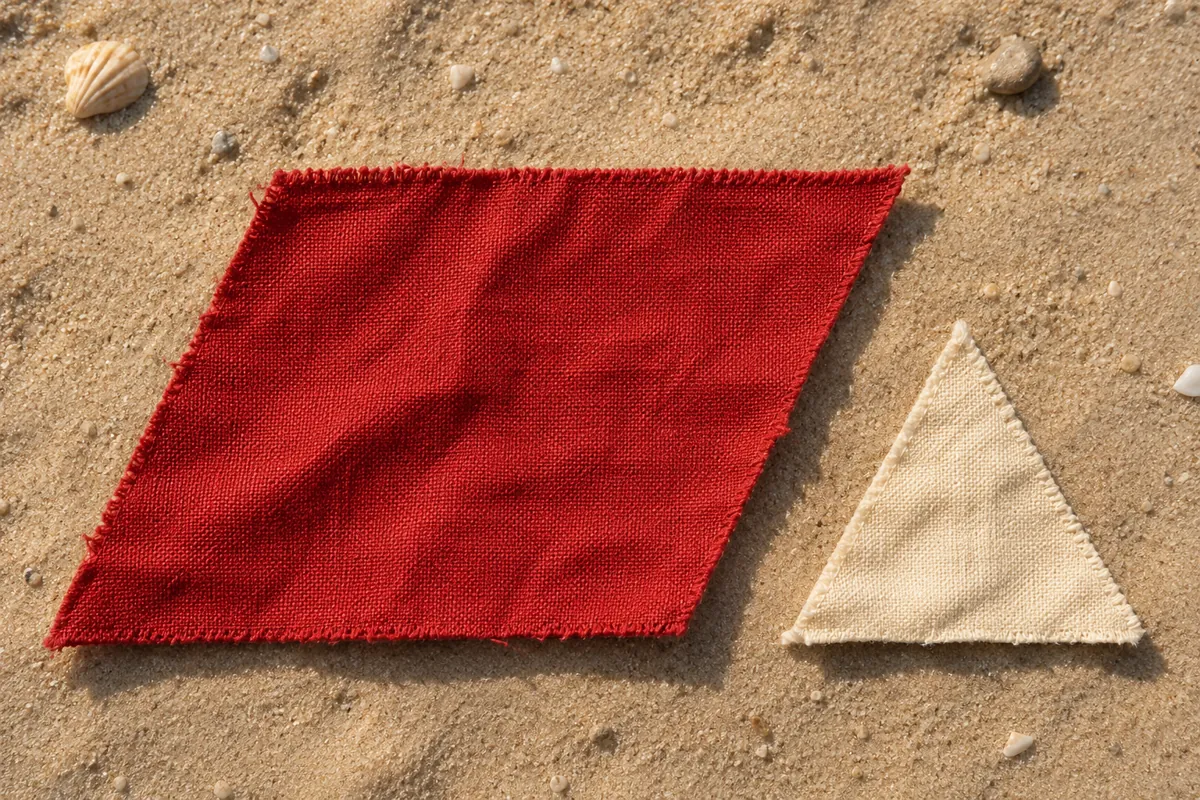
The cross product gives you a normal vector with a prescribed orientation. Its length gives you a parallelogram area. This guide works through those jobs separately, then puts them together in a second exercise. The beach photographs are physical analogies. Use the coordinates in the text for every calculation.
What the cross product gives you
Take two vectors a and b in ordinary three-dimensional space, using the usual right-handed Cartesian axes. When the vectors span a plane, a × b is perpendicular to that plane. There are two opposite senses along a perpendicular line. The order a first, b second selects one of them. Swapping the order preserves the line but reverses the sense.
The result is itself a vector, so a question about a normal vector calls for components. A question about area calls for a single nonnegative number. A question about a unit normal calls for a vector of length one. The same intermediate calculation supports all three answers, but the last step depends on what the question actually asks.
The guide to the dot product covers a useful companion operation. A dot product of two vectors is a scalar. Here, you can use it to check whether the vector you calculated is perpendicular to each input. Keep the two operations distinct in your notation, especially when both appear in the same exercise.
Read the order in the right-hand rule
Give the two arrows a common starting point. Point the fingers of your right hand along a and curl them toward b through the smaller angle. Your extended thumb indicates the sense of a × b. Start with the vector on the left of the multiplication sign. Use the rule on the geometry, not on the order in which someone happened to draw the arrows.
The coordinate axes provide a quick reference. Let e₁, e₂ and e₃ be unit vectors along the positive x, y and z axes. In the usual frame, e₁ × e₂ = e₃, e₂ × e₃ = e₁ and e₃ × e₁ = e₂. Reverse either factor order and you get the negative of the corresponding result. For example, e₁ × e₃ = −e₂.
If you picture the xy-plane from the positive z side, a rotation from the positive x axis toward the positive y axis appears counterclockwise. From the other side it looks clockwise. The product itself has not changed. When you use a sketch, mark the viewing side before deciding what a clockwise arrow means.

Organize the component calculation
Write a = (a₁, a₂, a₃) and b = (b₁, b₂, b₃). In a right-handed orthonormal coordinate system, the components in order are a₂b₃ − a₃b₂, a₃b₁ − a₁b₃ and a₁b₂ − a₂b₁. Notice the cyclic pairs of subscripts: 2 and 3, then 3 and 1, then 1 and 2.
Some classes use a determinant mnemonic with basis vectors across the top row. When expanding across that row, the second minor carries a minus sign. The middle component is therefore −(a₁b₃ − a₃b₁), which equals a₃b₁ − a₁b₃. Pick one representation and write it all the way through. Switching conventions halfway is a common way to reverse a single sign.
Use a = (2, −1, 1) and b = (1, 2, 0). The first component is (−1)·0 − 1·2 = −2. The second is 1·1 − 2·0 = 1. The third is 2·2 − (−1)·1 = 5. So a × b = (−2, 1, 5). Zero components simplify individual products, but the other term in the difference still needs to be written down.
Check perpendicularity and orientation separately
Let n = (−2, 1, 5). Then a · n = −4 − 1 + 5 = 0 and b · n = −2 + 2 + 0 = 0. These two checks would catch many slips, including reversing the sign of the middle component while leaving the other two fixed. They also provide independent arithmetic you can do after you have finished the component formula.
The checks accept both n and −n. They even accept any scalar multiple of n, so they verify perpendicularity without verifying the size. To check the order, repeat a component whose result is easy to see. Here the z component is 2·2 − (−1)·1 = 5. If you work with the xy projections, they turn from the first toward the second with positive orientation, which agrees with that positive z component.
A useful companion is the worked guide to determinant sign and area. The number five is a signed determinant for the xy projections. The full vectors also have a z coordinate, and the full product has other components. The projected area is therefore five, while the spatial area must be computed from the entire normal vector.

Find the area without losing the square root
The parallelogram built on a and b has area ‖a × b‖. In the example, take the square root of the sum of all three squared components: √(4 + 1 + 25) = √30. The number 30 is the squared length, not the area. If the exercise gives coordinates in centimeters, √30 is an area in square centimeters, even though you obtain it by taking the length of a vector of component products.
The geometric reason comes from base times height. For nonzero inputs, take ‖a‖ as the base and ‖b‖ sin θ as the perpendicular height, where θ lies between zero and π. That gives ‖a‖‖b‖ sin θ. This expression is nonnegative throughout the stated range. Even an obtuse angle can give a positive height because the projection onto the base and the perpendicular distance are different quantities.
For a triangle with vertices P, Q and R, build the edge vectors Q − P and R − P from the same vertex. The triangle occupies half of the corresponding parallelogram. If the worked vectors were the two edge vectors, the area would be √30/2. With three given points, check that you subtracted the same starting point in both edge vectors before applying the component rule.
For example, move the triangle away from the origin. Let P = (3, −2, 4), Q = (5, −3, 5) and R = (4, 0, 4). Subtracting P yields Q − P = (2, −1, 1) and R − P = (1, 2, 0), exactly the vectors used above. The area remains √30/2. Taking Q × R instead would build a different pair of sides starting at the origin. In geometry problems with point labels, this is a good reason to write an edge subtraction before writing any products.
There is a second area check here. The example vectors have dot product 2 − 2 + 0 = 0, so their angle is a right angle. Their squared lengths are six and five, so base times height is √6 times √5, equal to √30. This extra check uses the geometry of this particular example. For a general pair, the longer sloping edge cannot automatically be substituted for the perpendicular height.
Choose a normal that fits the question
If the prompt asks for any nonzero normal to the plane spanned by the example vectors, n and −n are both valid. If it asks specifically for a × b, use (−2, 1, 5). If it gives a facing condition such as “positive z component,” test that condition after calculating the normal. That last check is particularly useful when the geometry is described without a picture.
To turn the calculated vector into a unit normal with the same sense, divide every component by √30. The result is (−2, 1, 5)/√30. Its length is one, and multiplying all components by the same positive number preserves its sense. For the other unit normal, place a minus sign in front of the whole vector.
A zero cross product is a special case. For instance, (1, 2, 3) × (2, 4, 6) is the zero vector because the second input is twice the first. The parallelogram has collapsed. The inputs do not span a plane, and the zero vector cannot be normalized. The same warning applies when one input is zero. If the exercise asks for a normal to a particular plane, seek another independent direction in that plane or use its equation.
Work a new pair on paper
Try u = (1, 0, 2) and v = (0, 3, 1). Write the three component differences before looking at the result. Then calculate the area and use two dot products to check your vector. As a final step, predict what will happen to the area and vector if you swap the order.
The component products give 0·1 − 2·3 = −6, 2·0 − 1·1 = −1 and 1·3 − 0·0 = 3. So u × v = (−6, −1, 3). The dot products are −6 + 0 + 6 = 0 and 0 − 3 + 3 = 0. The area is √(36 + 1 + 9) = √46. Reversing the inputs gives (6, 1, −3), and the area is still √46. If asked for the triangle formed by these edges, halve the area.
You can verify the size another way. The squared lengths of u and v are 5 and 10, and u · v = 2. The identity ‖u × v‖² = ‖u‖²‖v‖² − (u · v)² gives 50 − 4 = 46. This check comes from subtracting the squared parallel contribution from the squared product of the lengths. It is useful when a component is uncertain, although it will not detect a complete reversal of the normal.

Diagnose the first mismatch
When an answer differs from yours, compare the order, the component differences and the requested output in that order. Opposite components everywhere suggest the two inputs were read in reverse. One wrong component suggests a local multiplication or subtraction error. A correct vector next to an incorrect area suggests a skipped square root, an omitted component or confusion between a triangle and a parallelogram.
Keep the original pair beside your result. For a spatial exercise, check both dot products and the length, then confirm the orientation using the stated order. For an area exercise, also check the units and whether the shape takes the whole parallelogram or half. Keeping these checks separate gives each line of your work a clear purpose and makes a mistake easier to find.
If you use Eqora or another permitted checking method after working independently, verify the original coordinates, axis convention, assumptions and final result against your own work. Eqora publishes this guide as a learning aid. It cannot guarantee correctness or grades, and course rules govern when you can use assistance. The paper procedure here is enough to solve and check the exercise yourself.