Trigonometry · Eqora guide
Law of cosines: find the third side or angle
Use the law of cosines to find a missing side or angle, review the cosine sign with Eqora, and solve a new triangle on paper.
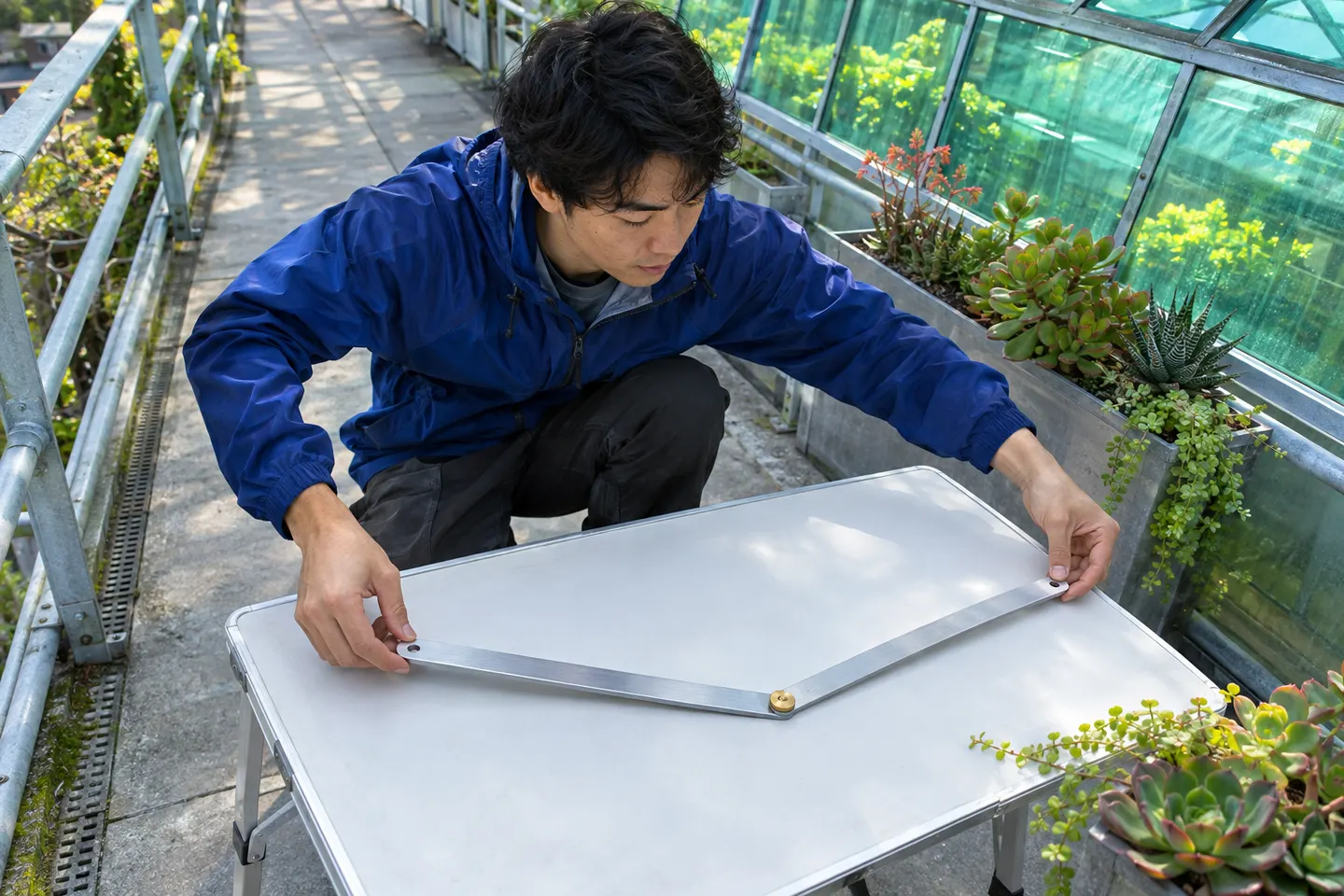
Two aluminum arms attached at a hinge measure 7 cm and 10 cm. While the hinge stays open at 120°, what is the straight-line distance between their free tips? Adding the two lengths gives the distance along the metal. The question asks for the side that would close the triangle. The law of cosines gives that distance once you match the opening at the hinge with the side across from it.
Work through the geometry before taking a photo of your work. Then use Eqora to inspect whichever step you find hardest to explain, such as the sign of a cosine or the placement of a bracket. Finish by calculating a new case with the same method on paper. Doing the calculation yourself will show whether you can still identify the included angle when the diagram and the numbers change.
Match the sides and angle on your sketch
Put the hinge at C and mark the two free tips A and B. Use lower-case c for the side AB, which connects the tips. The lengths a and b belong to the arms opposite A and B, respectively. You can give a the value 7 cm and b the value 10 cm. That choice leaves C at the joint where the two known sides meet. If your worksheet uses different letters, keep the same opposite-side relationships with its notation.
Trace a path from one free tip to the other through the hinge. You have followed two known sides and turned at their shared vertex. The angle measured inside the triangle at that vertex is the included angle. Mark its arc on the sketch and label the side you want with a question mark. A sketch can be rough. Its job is to record relationships, and measuring a length on that sketch gives no extra information about the exercise.
If a problem gives an angle opposite one of the known sides, the information has a different arrangement. Applying the formula with that angle in the same position changes the triangle you are solving. Draw the unknown side and check its position before entering anything into a calculator.
Use the law of cosines to find the third side
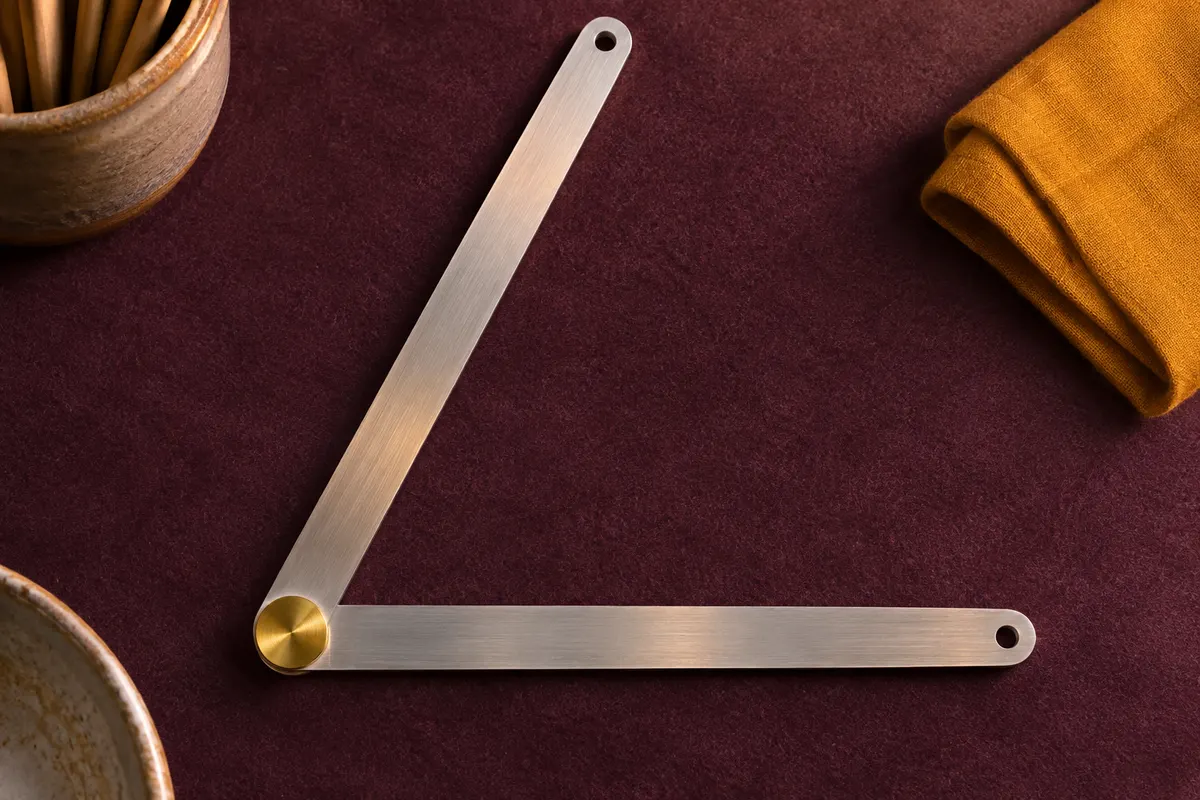
With two sides and the included angle, use c² = a² + b² − 2ab cos(C). The shared vertex supplies C, and the two factors in 2ab are the sides that touch this vertex. The first numerical line is c² = 7² + 10² − 2 × 7 × 10 × cos(120°). Read the brackets before pressing enter so that the calculator evaluates the cosine of the whole angle.
In degree mode, cos(120°) = −1/2. This gives c² = 49 + 100 − 140 × (−1/2) = 219 cm². The two minus signs leave a positive contribution of 70. A length is positive here, so c = √219 cm ≈ 14.80 cm. Keep the square root in your notes if another part of the question needs c. A rounded number is fine when you present the answer to two decimal places.
A common calculator error is entering 120 with radians selected. Check that the display indicates degrees, or convert 120° to 2π/3 before using radian mode. Trying cos(60°) and expecting 1/2 is a quick way to verify the setting. A familiar angle can reveal a mode error before you repeat the entire exercise.
Predict the result from the opening
Keep both arm lengths fixed and think about how far apart the tips are as the hinge opens. At 90°, the cosine term vanishes and the distance is √149 cm, about 12.21 cm. That is the Pythagorean case. The opening at 120° is wider, so the calculated distance should exceed the right-angle value. Your answer of about 14.80 cm passes that check. At 60°, cos(60°) = 1/2 and c is √79 cm, about 8.89 cm. The effect of the sign has a visible geometric meaning.
There is a second check that works without a calculator. The third side must lie strictly between the difference and the sum of the two known lengths. Here that means 3 cm < c < 17 cm. The equality at either end would place all three vertices on one line. A value of 18 cm would fail immediately, whatever method produced it.
The visual trigonometry guide uses drawings to connect quantities to angles. Here a useful version of that habit is to draw the same two arms twice, once narrow and once wide. Estimate which closing side is longer before you calculate either value.
See where the cosine term comes from
Place the hinge at the origin of a coordinate plane with one arm of length a on the positive horizontal axis. One tip is then (a, 0). The other arm of length b points at angle C, so its tip is (b cos(C), b sin(C)). The distance between the tips, squared, is (a − b cos(C))² + (b sin(C))². This expression uses the horizontal and vertical differences of the two points.
Expanding the first square produces the term −2ab cos(C). The other two terms involving b combine into b² because cos²(C) + sin²(C) = 1. This argument also fits an obtuse opening. At 120°, the horizontal coordinate of the second tip is negative, so the horizontal separation increases. That explains why the correction from the cosine can increase the squared distance.
Find an angle when all three sides are known
Now suppose a different triangle has sides 5 cm, 7 cm and 10 cm. Find the angle opposite the 10 cm side. Check that the shortest pair can reach across the longest side: 5 + 7 = 12 > 10. As all lengths are positive and 10 is the largest, this comparison is sufficient to check the triangle inequality for these three values. Name the two shorter sides a and b and the longest c.
Rearrange the equation to get cos(C) = (a² + b² − c²)/(2ab). Substitute the three lengths before simplifying. The fraction is (25 + 49 − 100)/70 = −26/70 = −13/35. The denominator is the product of the two adjacent sides times two. Keep both the whole numerator and the whole denominator in brackets on your calculator.
Apply arccos to the fraction and read the result in degrees: C ≈ 111.80°. Arccos takes a cosine value and returns the corresponding angle between 0° and 180°. A negative cosine gives an obtuse angle in that interval. If you see a result near 1.95, check the units. The angle itself is the same in radians, and the numerical answer is different because the unit changed.
Use Eqora to check the first uncertain line
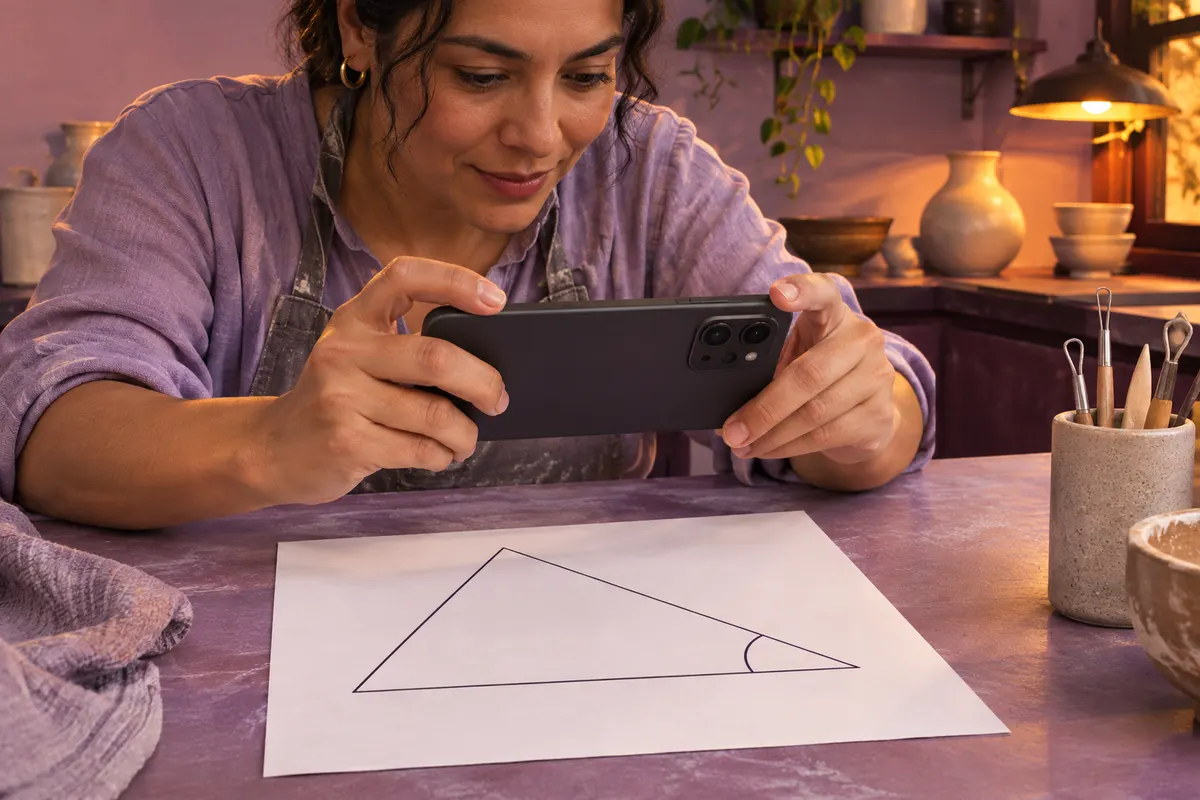
Suppose your page shows c² = 79 for the 120° hinge problem and you cannot see how that happened. Put the question, the sketch and your calculation on one flat sheet. Mark 120° at C, write both given lengths with units, and keep the whole line with the cosine visible. Use good lighting and hold the phone steady. Photograph the exercise in Eqora when the degree sign and both endpoints are easy to distinguish.
Read the displayed problem and the first relevant solution step. Confirm that the app is working with a 120° included angle, the two given arms and the distance between their tips. A cropped arc or a faint digit can lead to a different interpretation. If something is missing, retake the photo with the entire drawing in frame. Keep your own sketch nearby for comparison.
Ask a focused follow-up, for example, “Why does the term after 149 add 70 when the formula has a minus sign?” Decide whether the explanation identifies cos(120°) as negative and keeps the original subtraction. Then reproduce that line on paper directly beneath your original work. If the first difference appears earlier, at the label for angle C, correct the sketch first. Eqora is a study aid. Verify the notation, assumptions and result yourself, and do your own work in an assessment.
Check whether the method fits the given data
The two situations above give you either both arms and their shared angle, or all three sides. In the first situation you square the given sides, evaluate a cosine and take a positive square root. In the second you isolate the cosine and use its inverse to obtain an angle. Saying which quantity you are trying to recover can prevent a surprisingly plausible mistake, such as taking arccos to find a distance.
If the angle falls outside the triangle, check whether the diagram marks an exterior angle. When the adjacent interior and exterior angles form a straight line, they add to 180°. In that arrangement, an exterior mark of 60° corresponds to a 120° interior angle. Feeding the exterior angle directly into the formula would produce 8.89 cm in our example, which is a sensible length for the wrong opening.
A worksheet may also mix right triangles and triangles with no right angle. Review choosing a right-triangle ratio if you tend to reach for sine, cosine or tangent from a single angle and one side. For our hinge, the 120° angle and the two arms tell you which version of the law of cosines to use. Check the triangle before choosing a familiar shortcut.
Draw and solve a fresh version on paper
Set the app aside and make a sketch for two bars of length 6 cm and 9 cm with an included angle of 60°. Name the opening and its opposite side before writing any squares. Also predict whether the closing distance will be below or above the right-angle value. Leave enough room to show the cosine contribution on its own line, so you can see exactly where its sign comes from.
At 60°, the cosine is 1/2, so c² = 36 + 81 − 2 × 6 × 9 × (1/2) = 63 cm². Thus c = √63 cm ≈ 7.94 cm. Your result should be below √117 cm, the right-angle length, and between 3 cm and 15 cm. Then turn just the hinge to 120° while leaving the two bars unchanged. The new square is 117 + 54 = 171 cm², giving about 13.08 cm. Both results fit the side bounds and the second is larger, as the drawing predicts.
Finally, try the reverse task. Suppose the sides are 6 cm, 8 cm and 10 cm. Compute the angle opposite 10 cm. The numerator is 36 + 64 − 100 = 0 and the denominator is 96, so its cosine is zero. The angle is 90°. You can recognize this right triangle early and still use the cosine calculation to confirm the answer. If you can explain which side goes across from the angle in all three practice sketches, you can carry the method into a differently worded problem.