
Rational equations · Eqora guide
Solve rational equations reliably
Record excluded values, clear denominators carefully, solve the resulting equation, and test every candidate in the original problem.
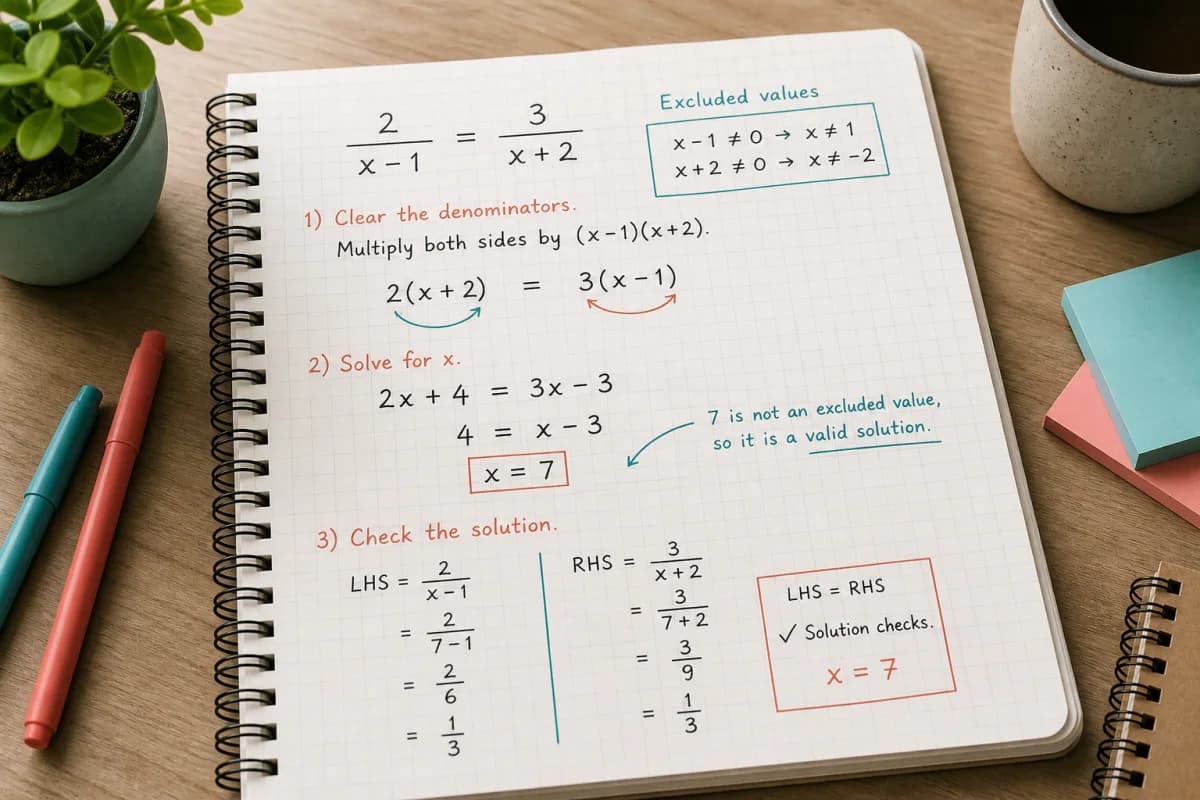
A rational equation contains one or more fractions whose denominators include a variable. The reliable method is not to cross-multiply on sight. First identify values that make a denominator zero, then multiply every term by a common denominator, solve the simpler equation, and check each candidate in the original equation.
Those opening restrictions matter because clearing denominators changes the form of the problem. It can produce a value that satisfies the transformed equation but was never permitted in the original. The worked examples below show the full chain, including a valid linear solution, a rejected candidate, and a case that becomes quadratic.


Restrictions and the first worked example
Solve 2/(x − 1) = 3/(x + 2). The denominators tell us immediately that x cannot equal 1 or −2. These are excluded values, not possible answers waiting to be tested later. Write x ≠ 1, −2 before changing the equation so the original domain stays visible.
The least common denominator is (x − 1)(x + 2). Multiplying both sides by it gives 2(x + 2) = 3(x − 1). Expand and solve: 2x + 4 = 3x − 3, so x = 7. It is not excluded, and substitution gives 2/6 = 3/9 = 1/3. Therefore x = 7 is the solution.
Write the excluded values before clearing denominators, and check the final candidate in the untouched equation.
Clear denominators without losing a term
The least common denominator must contain every distinct factor to the highest power used in any denominator. For 1/(x − 2) + 3/(x + 2) = 8/(x² − 4), factor x² − 4 as (x − 2)(x + 2). The restrictions are x ≠ 2, −2, and that product is already the least common denominator.
Multiply every term, not just the fractions that look inconvenient. Cancellation gives (x + 2) + 3(x − 2) = 8. Then x + 2 + 3x − 6 = 8, so 4x = 12 and x = 3. Substitution into the original gives 1 + 3/5 = 8/5, so the candidate is valid.
- Factor every denominator completely
- List every zero of those denominator factors
- Build the least common denominator from the distinct factors
- Distribute it to every term on both sides
Understand why cancellation is allowed
Multiplying an equation by a nonzero expression preserves equality. On the permitted domain, each denominator factor is nonzero, so its matching factor may cancel. The restriction is what justifies the move. Without it, the multiplier could be zero at a value where the original equation is undefined.
Keep parentheses around each numerator during cancellation. If the term is −(x + 4)/(x − 3), multiplying by x − 3 produces −(x + 4), not −x + 4. Many rational-equation errors are ordinary distribution or sign mistakes that appear after the fractions have disappeared.
Reject an extraneous candidate
Consider (x + 1)/(x − 1) = 2/(x − 1). The restriction is x ≠ 1. Multiplying by x − 1 leads to x + 1 = 2 and therefore x = 1. The algebra after cancellation is correct, but its only candidate is forbidden by the original denominator.
This equation has no solution. Do not write x = 1 and do not erase the restriction simply because the denominators cancelled. A candidate can be rejected either because it makes an original denominator zero or because direct substitution fails to make both sides equal.
Handle equations that become quadratic
Solve 1/x + 1/(x − 2) = 1 with x ≠ 0, 2. Multiply every term by x(x − 2): (x − 2) + x = x(x − 2). Simplifying gives 2x − 2 = x² − 2x, or x² − 4x + 2 = 0.
The quadratic formula gives x = (4 ± √(16 − 8))/2 = 2 ± √2. Neither value is 0 or 2, and substituting each into the original confirms the equality. Rational equations do not always become linear; once the denominators are cleared, use the method appropriate to the resulting polynomial.
Separate restrictions from the solution set
An excluded value comes from the original denominators, while a solution must satisfy the entire original equation. Keep these lists separate. A restriction is not automatically an extraneous solution, and it should never be included in the final solution set.
Also watch for identities and contradictions. Clearing denominators may reduce an equation to a true statement such as 0 = 0, in which case every permitted value is a solution. A false statement such as 0 = 5 means there are no solutions, even though many values remain in the domain.
Avoid the common shortcuts that fail
Cross-multiplication is safe only for a proportion with one fraction on each side, and even then the denominator restrictions still come first. It does not directly handle a sum such as 1/x + 1/(x − 2). For a multi-term equation, use the least common denominator across every term.
Other common mistakes include cancelling across addition, forgetting a factor in the least common denominator, multiplying only one side, and checking in the transformed equation instead of the original. Use one line for factoring, one for restrictions, and one for the multiplication step. That layout makes omissions visible.
Practise independently and use Eqora as a reviewer
Try these without a solution in view: 3/(x + 1) = 2/(x − 2); 1/(x − 3) + 2/(x + 3) = 3/(x² − 9); and (x + 2)/(x − 4) = 6/(x − 4). The results are x = 8 for the first, x = 2 for the second, and no solution for the third because its candidate x = 4 is excluded.
For each problem, show four items: restrictions, least common denominator, transformed equation, and original-equation check. If a line is unclear, scan the complete problem into Eqora and ask it to inspect that specific cancellation or candidate. Confirm that signs and denominators were read correctly, then close the explanation and solve a parallel problem alone. AI can misread notation or make an algebra error, so your written restrictions and substitution remain the final evidence.
Put it into practice now
Choose one problem from your current homework or review set. Attempt it before opening Eqora, then use the app only at the point where your own reasoning stops.
- State what the problem is asking before you solve it
- Identify the first step you cannot justify
- Ask Eqora one focused follow-up about that step
- Finish with a similar problem and no solution in view
The session is complete when the method is clearer, not simply when the worksheet has one more answer.