
Fractions · Eqora guide
Dividing fractions in homework: flip only the divisor
Make sense of reciprocal multiplication, catch the tempting wrong flip, and use one checked example to practise independently.

Dividing fractions in homework often turns into a memory test: keep the first fraction, change division to multiplication, flip the second. The order is easy to chant and surprisingly easy to misapply. For 3/4 ÷ 1/8, the question is how many eighth-sized units fit into three quarters of a whole. Six eighths fit, so the answer is 6. The written calculation agrees: 3/4 × 8/1 = 6. Understanding what is being counted makes the rule easier to check than a rhyme alone.
The specific mistake this guide tackles is flipping the first fraction, both fractions, or neither one. We will read the dividend and divisor, model a simple case, derive the reciprocal rule, work a less friendly example, and use multiplication to verify the result. Then we will put one uncertain homework line through Eqora: capture the complete problem, inspect the recognized expression and the displayed steps, ask about the exact flip, and close the explanation before solving a related exercise alone.
Eqora publishes this article and is the only app recommended here. It can support learning, but it cannot certify that a photographed expression was read correctly or that a generated step matches your course method. Keep the original task and your first attempt beside the app. Check notation, assumptions, arithmetic, units, and the final answer yourself, and follow your instructor's rules for homework and assessments.

Dividing fractions means counting copies of the divisor
In A ÷ B, A is the quantity you start with, called the dividend, and B is the size of each group or the number of groups, called the divisor. For the measurement reading of 3/4 ÷ 1/8, start with 3/4 of a whole and ask how many pieces of size 1/8 it contains. Rewrite 3/4 as 6/8. The answer is six pieces. A visual model does not prove every symbolic rule, but it gives this example a concrete meaning and an immediate estimate.
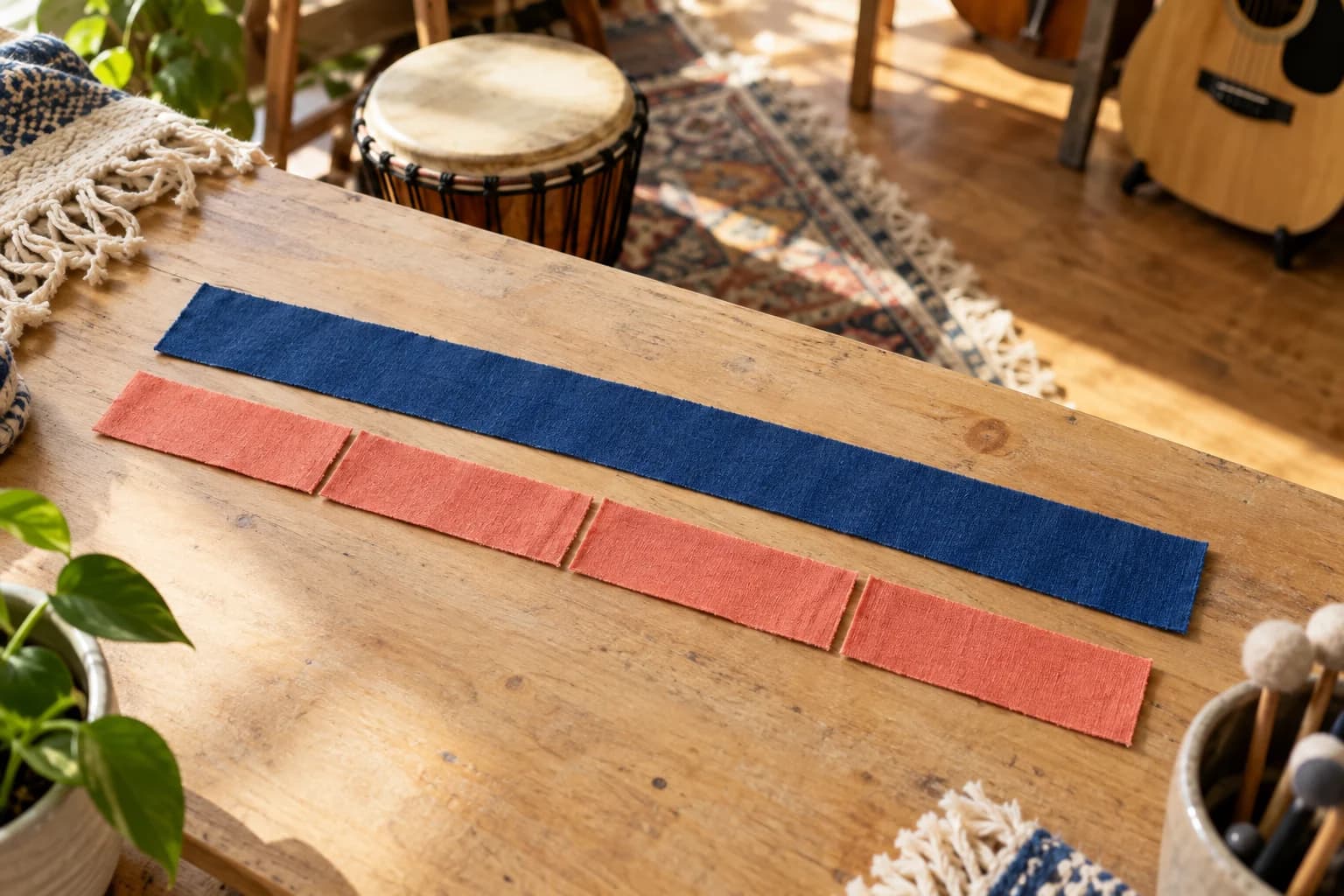
The blue and coral fabric strips in the photograph are an analogy for a long span and smaller repeated spans. They are not a measured fraction diagram: their physical lengths are not calibrated to 3/4 or 1/8. On paper, draw a bar split into eight equal parts and shade six. The equality 3/4 = 6/8 follows by multiplying numerator and denominator by 2. Counting six eighths then matches both the picture and the written calculation.
Why the reciprocal belongs to the second fraction
Division asks for the number q that satisfies q × B = A. For A = 3/4 and B = 1/8, we want q × 1/8 = 3/4. Multiplying both sides by 8 undoes the multiplication by 1/8, giving q = 3/4 × 8 = 6. The factor 8 is the reciprocal of the divisor 1/8. We do not replace the starting amount 3/4 by 4/3; that would ask a different question.
For nonzero fractions a/b and c/d, the reciprocal of c/d is d/c because (c/d)(d/c) = 1. Starting from q(c/d) = a/b, multiply both sides by d/c. The divisor becomes 1 and q = (a/b)(d/c). Thus (a/b) ÷ (c/d) = (a/b) × (d/c). The restriction c ≠ 0 matters: zero has no reciprocal, and division by zero is undefined. Denominators b and d must also be nonzero.
OpenStax's fraction-division lesson uses models and then states the reciprocal procedure with the nonzero conditions. Its examples offer a useful independent comparison if your class uses a different visual explanation. The wooden cards in our photograph contain no printed rule; the algebra here supplies the actual justification.
Work a fraction division that needs simplification
Take 5/6 ÷ 10/9. First name the roles: 5/6 is the amount and 10/9 is the divisor. Its reciprocal is 9/10, so 5/6 × 9/10 = 45/60 = 3/4. You may simplify before multiplying: 5 cancels with 10 to leave 1 and 2; 9 and 6 reduce to 3 and 2. That gives (1 × 3)/(2 × 2) = 3/4. Both routes describe the same multiplication, and neither changes the starting dividend.
The quotient is less than 5/6 because we divided by 10/9, a number greater than 1. That size check catches a common misplaced reciprocal. Reverse the operation to verify exactly: 3/4 × 10/9 = 30/36 = 5/6. A decimal approximation, 0.75, is optional; the fraction check preserves the relationships without rounding. If your answer is 4/3 or 5/6, ask which step changed the divisor or whether you simply copied the original amount.
Capture the whole homework line before asking Eqora
Make your own first attempt, even if it stops at identifying the divisor. When you use Eqora, photograph the complete expression, including parentheses, a leading minus sign, mixed-number marks, and any instruction to leave the answer exact. Keep the image flat and well lit. Remove unnecessary personal details, but do not crop off a denominator or the line that defines a unit. A beautiful explanation of a misread problem is still an explanation of the wrong problem.
Before inspecting the generated solution, compare the recognized expression with the paper character by character. Is 5/6 still the first fraction? Is the divisor 10/9 rather than 10/6? Did the app retain the division sign? For stacked fractions, explicitly identify the main fraction bar. If the transcription is uncertain, retake the photo or type the expression clearly. The photograph here shows an empty screen and abstract marks; it is a reminder to verify a real capture, not a claim about what Eqora displayed.

Ask about the one step that is uncertain
A useful follow-up is precise: “In 5/6 ÷ 10/9, why do we replace 10/9 with 9/10 but leave 5/6 unchanged?” The expected explanation should identify 10/9 as the divisor and show that multiplying it by 9/10 gives 1. If a reply merely repeats “keep, change, flip,” ask for the inverse-multiplication check or draw the equal-part model yourself. A verbal rule without the operand roles will not catch a reversed problem.
You can also ask, “Which factor did I cancel when I reduced 5/6 × 9/10?” Check the result by working both the unsimplified and simplified versions. If the reply says that 5/6 ÷ 10/9 equals 4/3, test 4/3 × 10/9; it gives 40/27, not 5/6. That concrete failed check locates the error more clearly than deciding that a polished answer simply looks wrong.
Mixed numbers and negative signs need a separate pause
A mixed number must become an improper fraction before you take a reciprocal. For 1 1/2 ÷ 3/4, convert 1 1/2 to 3/2, then compute 3/2 × 4/3 = 2. Flipping the mixed-number notation directly is ambiguous. Check by multiplication: 2 × 3/4 = 3/2, exactly the starting amount. The answer is larger than 1 1/2 because the divisor 3/4 is below 1.
Negative fractions follow the same reciprocal rule with a sign check. For −2/3 ÷ 4/5, compute −2/3 × 5/4 = −10/12 = −5/6. The divisor is positive, so the quotient stays negative. Conversely, dividing a negative amount by a negative divisor gives a positive quotient. A minus sign attached to a numerator, denominator, or whole fraction has the same value, but copying two signs can change the problem. Put parentheses around a negative divisor before rewriting it.
Read the unit in a homework word problem
Suppose a rehearsal has 3/4 of an hour left and each short exercise takes 1/8 of an hour. The question “How many exercises fit?” is 3/4 hour ÷ 1/8 hour per exercise = 6 exercises. The hour units cancel, leaving a count. If instead six exercises must share 3/4 hour equally, calculate 3/4 ÷ 6 = 1/8 hour per exercise. The same numbers appear, but the divisor and requested unit have changed.
For a less tidy case, 2/3 of a meter of ribbon divided into segments of 1/4 meter yields 2/3 ÷ 1/4 = 8/3. That means two complete quarter-meter segments with 1/6 meter left, because 2 × 1/4 = 1/2 and 2/3 − 1/2 = 1/6. It does not mean you can cut eight whole segments. Context decides whether to report 8/3 as an idealized count, two complete pieces plus leftover, or a rounded quantity. Do not round up a physical count of complete segments.
Solve a similar example with the explanation closed
Put the phone face down and solve 7/8 ÷ 1/4. Name 7/8 as the amount and 1/4 as the divisor. Since 1/4 has reciprocal 4, compute 7/8 × 4 = 28/8 = 7/2 = 3 1/2. Verify by multiplying 7/2 × 1/4 = 7/8. A bar model would show three full quarters and half of another quarter inside seven eighths, so the noninteger quotient has a concrete meaning.
Try one more with a divisor above 1: 3/5 ÷ 6/5 = 3/5 × 5/6 = 1/2. Verify 1/2 × 6/5 = 3/5. State why this quotient is smaller than the dividend: dividing by 6/5 asks how many groups larger than one whole fit in 3/5. If your answer is larger than 3/5, inspect which fraction you flipped before checking any small multiplication error.
Reopen Eqora only after you have a complete attempt. Compare the captured task, the first reciprocal step, the simplification, and the multiplication check in that order. If you disagree, record the first line where your methods diverge. Then close the app and redo that line on another problem. Independent transfer, not an answer copied into the homework, is the evidence that the method has become yours.
A short routine for the next dividing fractions assignment
Write the original expression first. Underline the divisor, estimate whether the quotient should be above or below the starting amount, convert mixed numbers, and mark any zero restriction. Replace only the division by multiplication with the divisor's reciprocal. Simplify legal numerator–denominator factors, multiply, and use the reverse operation to verify. In a word problem, finish with the unit and a sentence that matches the question.
If you need Eqora, keep its role narrow: check that it read the task, inspect the first uncertain step, ask a focused follow-up, and solve a related example by yourself. A correct-looking app result cannot replace your check of notation, assumptions, course rules, and final answer. That last check is the part of homework most worth carrying into the next class or exam.
Put it into practice now
Choose one problem from your current homework or review set. Attempt it before opening Eqora, then use the app only at the point where your own reasoning stops.
- State what the problem is asking before you solve it
- Identify the first step you cannot justify
- Ask Eqora one focused follow-up about that step
- Finish with a similar problem and no solution in view
The session is complete when the method is clearer, not simply when the worksheet has one more answer.