Algebra · Eqora guide
Fractions in math homework: multiply every term
Clearing denominators changes the whole equation, not just its fractions. Keep constants, parentheses and signs in the calculation.

Fractions in math homework often cause trouble at a surprisingly ordinary place: the whole number without a denominator. You multiply the fractions to remove their denominators, leave that whole number alone, and obtain a tidy but different equation. For (x + 1)/3 − (x − 2)/4 = 2, multiplying by twelve must also turn the right-hand two into twenty-four. The goal is not to erase fraction bars wherever they appear. It is to perform one reversible operation on the entire equality.
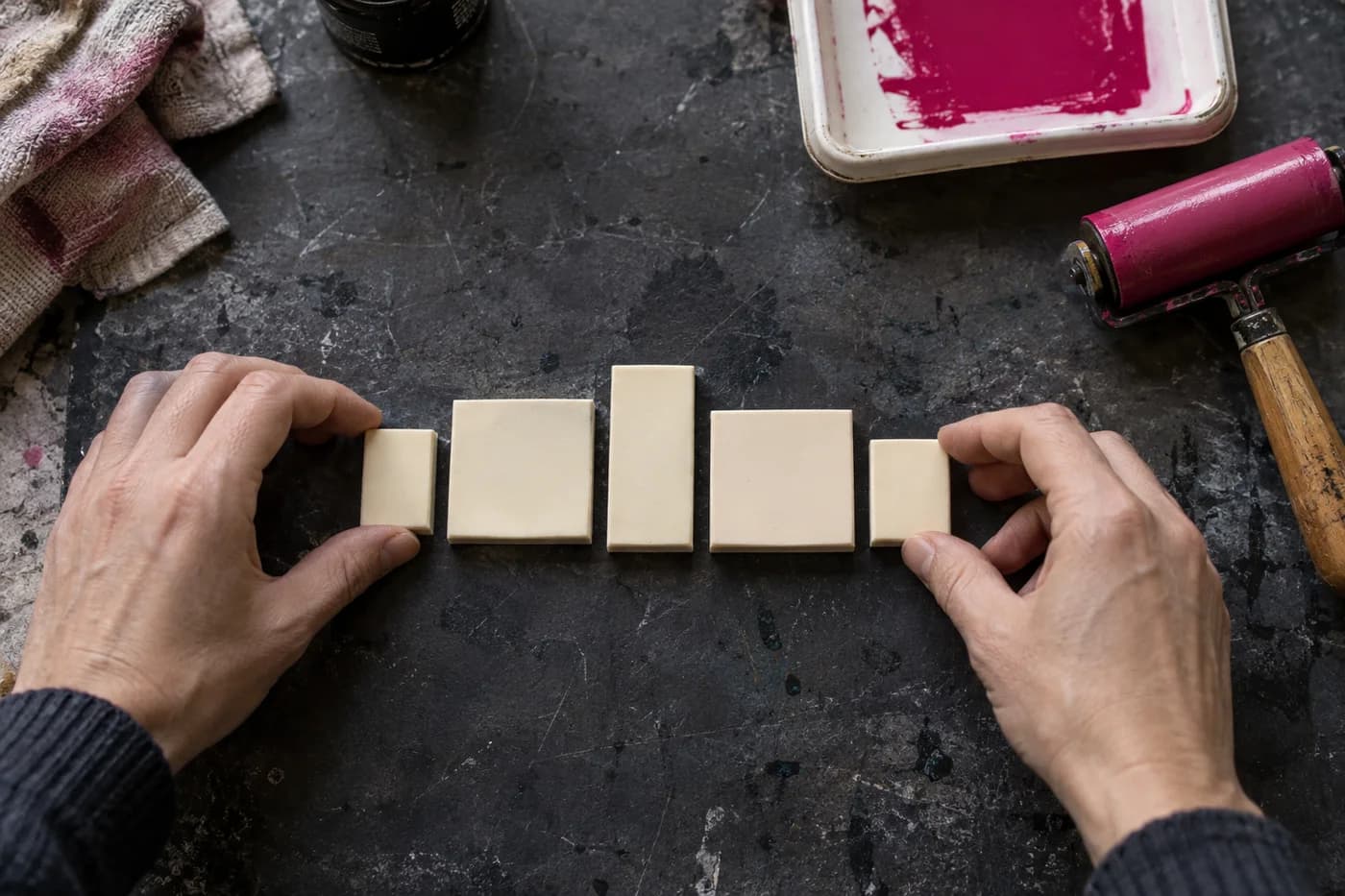
We will solve that example, diagnose two plausible mistakes and handle an answer that remains a fraction. Then you can use Eqora to inspect one uncertain transition before completing a new problem independently. All numerical examples are constructed for teaching. The printmaking photographs illustrate complete coverage and an overlooked item; their blocks do not encode the equation's coefficients, measured lengths or a product interface. A pencil and paper are enough to follow every calculation.
Eqora publishes this guide and is the learning app used in the study workflow. It is not an independent product comparison, a substitute for your own examination work, or a guarantee of correct answers or grades. Follow your course's rules, attempt the task yourself first, and check the task statement, notation, assumptions and result. The useful outcome is being able to explain the method after closing the app, not merely producing a polished final line.
Fractions in math homework start with careful reading
In the main example, the first denominator divides the complete numerator x + 1, and the second divides x − 2. That is why the parentheses matter when a handwritten fraction becomes a typed line. The expression (x + 1)/3 is not x + 1/3. At x = 5, the first is two and the second is sixteen thirds. Copy the original scope faithfully before evaluating any steps. A correct method cannot repair a silently changed question.
The denominators are three and four, so twelve is their least common multiple. It is a convenient common denominator because 12/3 = 4 and 12/4 = 3. A larger common multiple, such as twenty-four, would also work but produces larger intermediate numbers. You do not have to find the smallest multiplier for correctness; you do need a nonzero number divisible by every numerical denominator. For denominators four and six, use twelve rather than automatically using their product twenty-four.
Keep the distinction between a term and a factor visible. The minus sign separates two fractional terms on the left. Inside each numerator, addition or subtraction joins smaller pieces that must remain grouped until you distribute. Mark the outer terms in your own copy, including the right-hand constant. This small reading task is especially useful when a line contains three fractions, a constant, and an unknown on both sides rather than a single neat proportion.
Multiply both complete sides, then distribute
Write the operation before simplifying: 12[(x + 1)/3 − (x − 2)/4] = 12 × 2. Distribution gives 12(x + 1)/3 − 12(x − 2)/4 = 24. Simplifying the numerical factors leaves 4(x + 1) − 3(x − 2) = 24. The constant on the right was just as much a part of the equality as either fraction. A term with no displayed denominator can be thought of as having denominator one.
This step combines two ordinary rules, not a special trick. Equal quantities remain equal when multiplied by the same number, and multiplication distributes over addition and subtraction. OpenStax's treatment of equations with fractions explains the multiplication property of equality and checking by substitution. We use a nonzero multiplier so that dividing by twelve can recover the previous equation. Multiplying by zero would destroy information and leave the useless statement zero equals zero.
Do not confuse this with rewriting one fraction as an equivalent fraction. Multiplying its numerator and denominator by the same nonzero number preserves that fraction's value. Multiplying a whole equation by twelve instead changes each side's value by a factor of twelve while preserving their equality. Saying which object you are changing—the fraction or the equation—helps prevent a mixture of incompatible operations in one line.
Keep the minus attached to the entire numerator
Now expand 4(x + 1) − 3(x − 2) = 24. The first product gives 4x + 4. The second is a negative three times the whole group, giving −3x + 6, not −3x − 6. Therefore 4x + 4 − 3x + 6 = 24 becomes x + 10 = 24. Subtract ten from both sides to obtain x = 14. You may also calculate the positive product 3(x − 2) first and then subtract that entire result.
Check fourteen in the original fractions, not just in x + 10 = 24. The left side is 15/3 − 12/4 = 5 − 3 = 2, matching the right side. This independent substitution checks the fraction scope, minus sign and clearing step together. A check in the final simplified equation only tells you that the last bit of algebra is consistent; it cannot reveal an earlier line that changed the original problem.
Compare a nearby error: treating −3(x − 2) as −3x − 6 leads to x − 2 = 24 and x = 26. The original left side at twenty-six is 27/3 − 24/4 = 9 − 6 = 3, not two. The failed check points you backward. Locate the first transition with a changed value rather than repeating the whole solution blindly or assuming that the last subtraction caused the trouble.
The forgotten constant produces a different problem
If the right-hand two stays two after clearing denominators, the incorrect line becomes 4(x + 1) − 3(x − 2) = 2. It yields x = −8. Substitution gives −7/3 − (−10/4) = −14/6 + 15/6 = 1/6, not two. The wrong answer solves a different question: one with one sixth on the original right side. That is a useful diagnosis because it identifies the omitted factor rather than treating the result as an unexplained arithmetic accident.
Try another boundary case. In x/3 + 2 = 5/6, multiplication by six gives 2x + 12 = 5. The unfractured two becomes twelve. Subtract twelve and divide by two to obtain x = −7/2. Checking gives −7/6 + 12/6 = 5/6. A negative fractional answer is perfectly possible in a real-number equation. Do not alter it simply because you expected a positive integer or because the denominators disappeared during the calculation.

Cleared denominators do not promise a whole-number answer
For (2x − 1)/6 + (x + 2)/4 = 1, multiply every term by twelve. You obtain 2(2x − 1) + 3(x + 2) = 12, then 4x − 2 + 3x + 6 = 12. Combining gives 7x + 4 = 12, so 7x = 8 and x = 8/7. Fractions were removed from the equation's displayed coefficients, not prohibited from its solution. Keep the exact fraction instead of introducing an early rounded decimal.
The original first fraction evaluates to (16/7 − 1)/6 = (9/7)/6 = 3/14. The second evaluates to (8/7 + 2)/4 = (22/7)/4 = 11/14. Their sum is one, as required. Writing each side separately makes this check readable. If your course requests a decimal, convert only at the end and follow its rounding instruction; an approximate equality should not be presented as an exact one.
Not every linear-looking equation has one solution. Clearing (x + 1)/2 = x/2 + 1/2 gives x + 1 = x + 1, true for every real x. Clearing (x + 1)/2 = x/2 + 1 gives x + 1 = x + 2, which is impossible. All-real and empty solution sets are legitimate outcomes. If the unknown appears in a denominator, record values that make it zero first; that is a separate domain issue, not the numerical-denominator case taught here.
Capture the whole homework line and inspect coverage
After a genuine attempt, capture one legible task in Eqora. Include both sides, every fraction bar, the full numerators, minus signs and any stated domain. Avoid cropping off a trailing constant or showing unrelated personal information. Our clear math-photo guide explains useful framing habits. Compare the captured mathematical input with the original before studying the solution: an image that turns (x − 2)/4 into x − 2/4 has created another exercise.
Inspect the first clearing step term by term. Which common multiplier was selected? Did it reach the right-hand constant and every unfractured term? Were numerator groups retained? For our main example, use 4(x + 1) − 3(x − 2) = 24 as a reference you can justify independently. Then inspect the negative product. Eqora can support this review, but a fluent explanation or plausible answer is not proof that the captured notation and each transformation are correct.

Ask why the constant changes, then close the explanation
Ask a focused question: why must the two become twenty-four when multiplying (x + 1)/3 − (x − 2)/4 = 2 by twelve, and why does the minus give a positive six? Request the unsimplified distribution line rather than another unexplained final answer. Compare the response with multiplying both complete sides and with direct substitution. If it only says to cancel denominators, ask which rule accounts for the constant without a fraction bar.
Explain the repaired step aloud: I multiplied each side by the same nonzero number, distributed across all outer terms, preserved the grouped numerators and then simplified. Our guide to understanding math rather than memorizing answers develops this habit. You should also be able to reverse the clearing step by dividing the complete equation by twelve. A reversible explanation is more useful than recognizing a familiar sequence of symbols on the screen.
A fresh equation for independent practice
Put the phone aside and solve (x + 2)/4 − (x − 1)/6 = 2 without looking at the earlier working. Choose the common multiplier, write its action on both whole sides and expand the negative product carefully. Before reading the check below, explain why the right side changes and what the parentheses protect. This problem keeps the same learning obstacle but changes the denominators and numerators, so copying the previous numerical line will not work.
Multiplication by twelve gives 3(x + 2) − 2(x − 1) = 24. Expansion gives 3x + 6 − 2x + 2 = 24, hence x + 8 = 24 and x = 16. The original left side is 18/4 − 15/6 = 9/2 − 5/2 = 2. If your result differs, compare the first line where the two methods separate. Record one precise reminder, such as multiply the constant too, and repeat a new example later rather than recopying this answer.