
Geometry · Eqora guide
Geometry diagram problems: read without guessing
A dependable method for turning marks, labels, and written conditions into a proof you can trust, even when the sketch is not to scale.
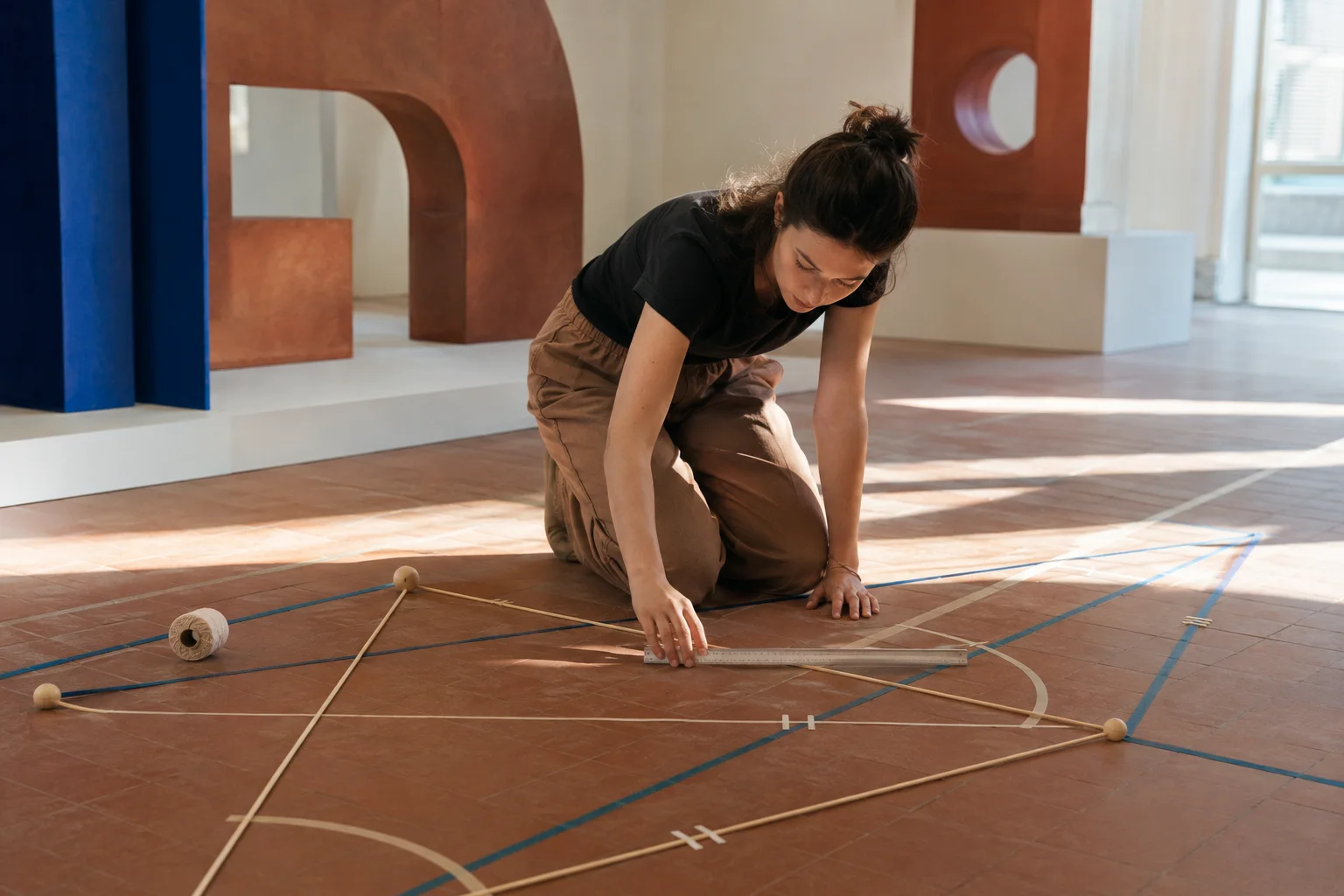
Geometry diagram problems become much easier when you stop treating the picture as a photograph. A sketch is a map of stated facts. Its labels, tick marks, angle arcs, right angle squares, arrows, and written conditions tell you what is true. The apparent length of a side or size of an angle may tell you nothing at all. A narrow angle can represent 70 degrees, and two segments that look different can be equal when matching marks say they are.
Consider triangle ABC. The problem states that AB = AC and angle A is 40 degrees. The drawing may lean to one side and make the base angles look unequal. Ignore that impression. The equal sides make the triangle isosceles, so the angles opposite them, B and C, are equal. The three angles total 180 degrees. That leaves 140 degrees for B and C together, which means each is 70 degrees. Every step comes from a given fact or a theorem, not from measuring the sketch.
This guide builds a repeatable routine for reading figures, selecting a theorem only when its conditions are present, redrawing crowded diagrams, separating area from perimeter, and checking the finished result. Keep a short two-column list beside your work: facts you were given and conclusions you have proved. That small habit prevents most visual guesses from slipping into the solution unnoticed.

Read geometry diagram problems as a list of claims
Before calculating, translate the entire figure into sentences. A number beside a segment may be its length. An arc beside a vertex marks an angle. Matching single ticks indicate one group of congruent segments; matching double ticks indicate a different group. Parallel arrows, a right angle square, a diameter through a center, and a dashed construction line all have distinct meanings. Record only what the problem actually states or marks.
Then write the target in a separate sentence: find angle C, prove two lines are parallel, calculate the shaded area, or determine the missing radius. A diagram often contains more information than one question needs. Naming the target helps you notice which facts can connect to it. It also stops you from performing familiar calculations that do not answer the prompt.
Separate given facts from visual impressions
Draw a line down the page and label the columns Given and Proved. Put AB = AC in the first column only if it appears in the text or matching marks are shown. Do not add AB = AC because the sides look similar. Put angle B = angle C in the second column after you cite the isosceles triangle theorem. This creates a visible chain from evidence to conclusion.
The same rule applies to familiar-looking quadrilaterals. A shape that resembles a rectangle is not necessarily a rectangle. You need right angles and the appropriate parallel or equal-side information. A slanted four-sided shape is not automatically a parallelogram, and a diagonal that appears to bisect an angle may not do so. When a conclusion depends on appearance, pause and ask which mark, statement, definition, or theorem licenses it.
If you cannot point to a given fact or a proved result, the claim is still a guess.
Translate every mark and label into words
Geometry symbols are compact instructions. Matching arcs identify congruent angles. A small square means exactly 90 degrees. Arrowheads on two lines indicate parallel lines, while tick marks on segments indicate equal lengths. A point marked at the center of a circle makes every segment from that point to the circle a radius. These details determine which relationships you may use.
Read groups carefully. One tick does not match two ticks, and one arrow does not match two arrows. Labels must also stay attached to the right object. The notation angle ABC names B as the vertex because the middle letter is the turning point. Segment AB has the same length as BA, but ray AB and ray BA point in opposite directions. Rewriting each symbol in words reduces silent notation errors.
Solve the isosceles example without measuring
Return to triangle ABC, where AB = AC and angle A = 40 degrees. Equal sides in a triangle have equal opposite angles. Side AB is opposite angle C, and side AC is opposite angle B, so angle B = angle C. Let each base angle be x. The angle sum gives 40 + x + x = 180. Therefore 2x = 140 and x = 70 degrees.
Check the result using all available facts. The angles 40, 70, and 70 add to 180. The equal angles sit opposite the marked equal sides. Both base angles are larger than the apex angle, which is plausible but not the proof. If the printed drawing makes one base angle look like 55 degrees, the calculation still wins because the sketch was never evidence of its exact size.
Choose a theorem only after checking its conditions
A theorem is not a formula chosen because the picture looks familiar. The Pythagorean theorem requires a right triangle. Before writing a² + b² = c², locate a right angle in the givens and identify c as the side opposite it. Similar triangles require justified equal angles or proportional corresponding sides. Congruence rules require specific combinations such as SSS, SAS, ASA, AAS, or the permitted right-triangle condition in your course.
Write the condition beside the theorem name. For example: right angle at C, therefore AB is the hypotenuse; or lines l and m are parallel, therefore alternate interior angles are equal. This one sentence keeps a valid tool attached to the fact that activates it. If the activating condition is missing, look for another theorem or an intermediate result you can prove first.
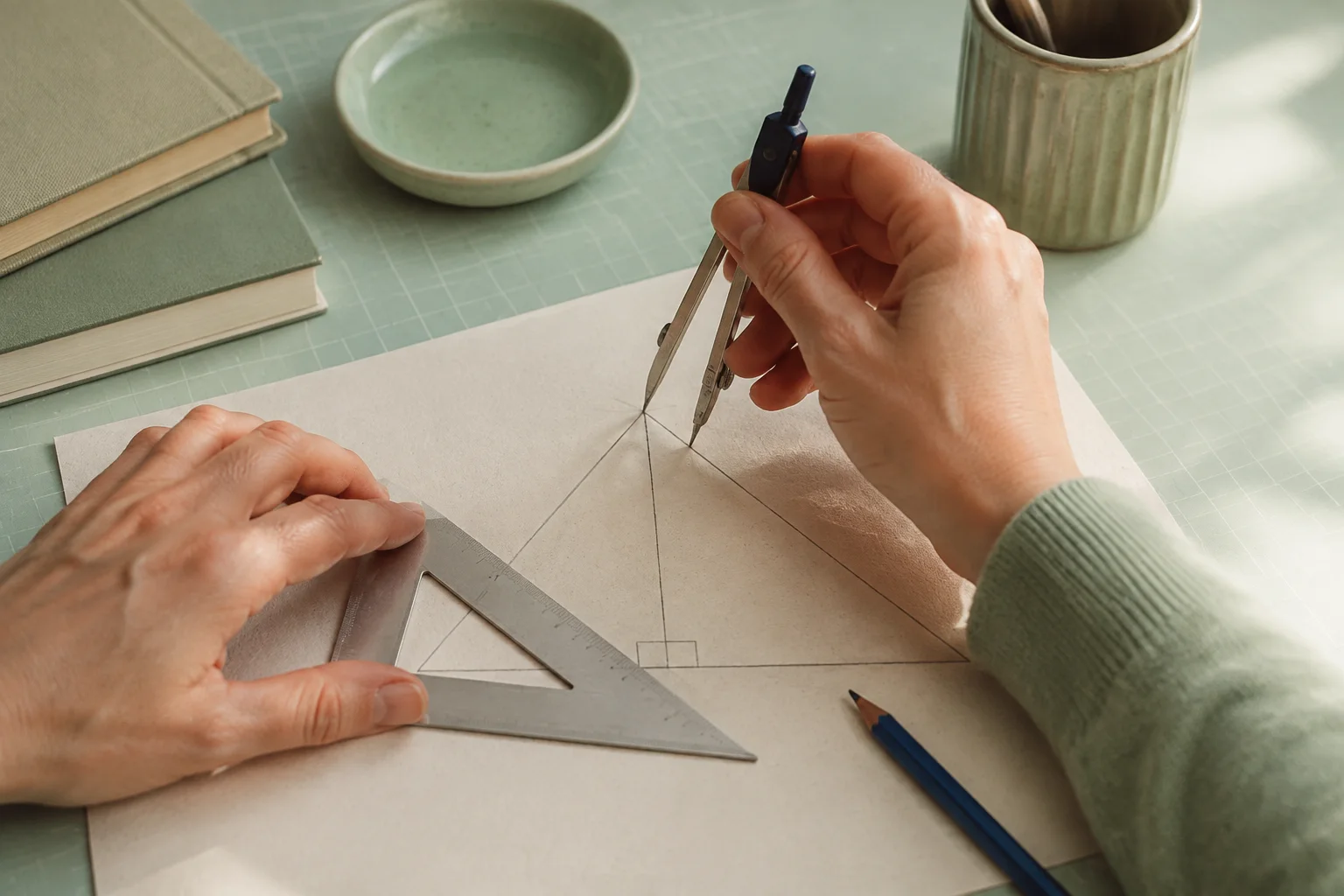
Redraw crowded figures and add one useful line
A clean redraw is not cosmetic. It can reveal structure hidden by labels, shading, overlapping triangles, or a three-dimensional perspective. Copy the essential vertices and marks, exaggerate small angles, and separate composite shapes into smaller panels. Preserve the mathematical relationships, but do not try to reproduce the original proportions. A deliberately distorted redraw can help break the habit of trusting appearance.
For a composite area, divide the region into rectangles, triangles, trapezoids, or circles whose dimensions you can justify. For a triangle proof, extend a side or draw a parallel line only when that construction serves a purpose, such as creating alternate interior angles. State what you added. A construction line does not automatically create a midpoint, perpendicular, angle bisector, or equal length.

Keep units, scale, area, and perimeter separate
Length uses linear units such as centimeters. Perimeter is also a length because it follows the boundary. Area counts square units, and volume counts cubic units. A rectangle measuring 8 centimeters by 3 centimeters has area 24 square centimeters but perimeter 22 centimeters. The numbers are close enough to swap accidentally, so write the requested quantity and its unit before substituting values.
Circle questions have another frequent trap. If a diameter is 10 centimeters, the radius is 5 centimeters. The area is πr² = 25π square centimeters, while the circumference is 2πr = 10π centimeters. Do not insert the diameter into a formula that expects the radius. Sketch a short radius from the center and label it before calculating.
Verify the result against the original givens
A final geometry answer should survive several checks. First, substitute or recombine: triangle angles must total 180 degrees, a full turn 360 degrees, and component areas must add to the total. Second, check constraints: lengths are positive, a triangle's two shorter sides sum to more than the longest, and a probability represented by an area cannot be negative. Third, inspect units and rounding.
Then walk backward through the proof. Underline every place where you used a given. Circle each theorem and confirm its conditions had already been established. In the isosceles example, the chain is short: AB = AC, so angle B = angle C; angle sum is 180 degrees; therefore both base angles are 70 degrees. Nothing depends on the drawing's proportions.
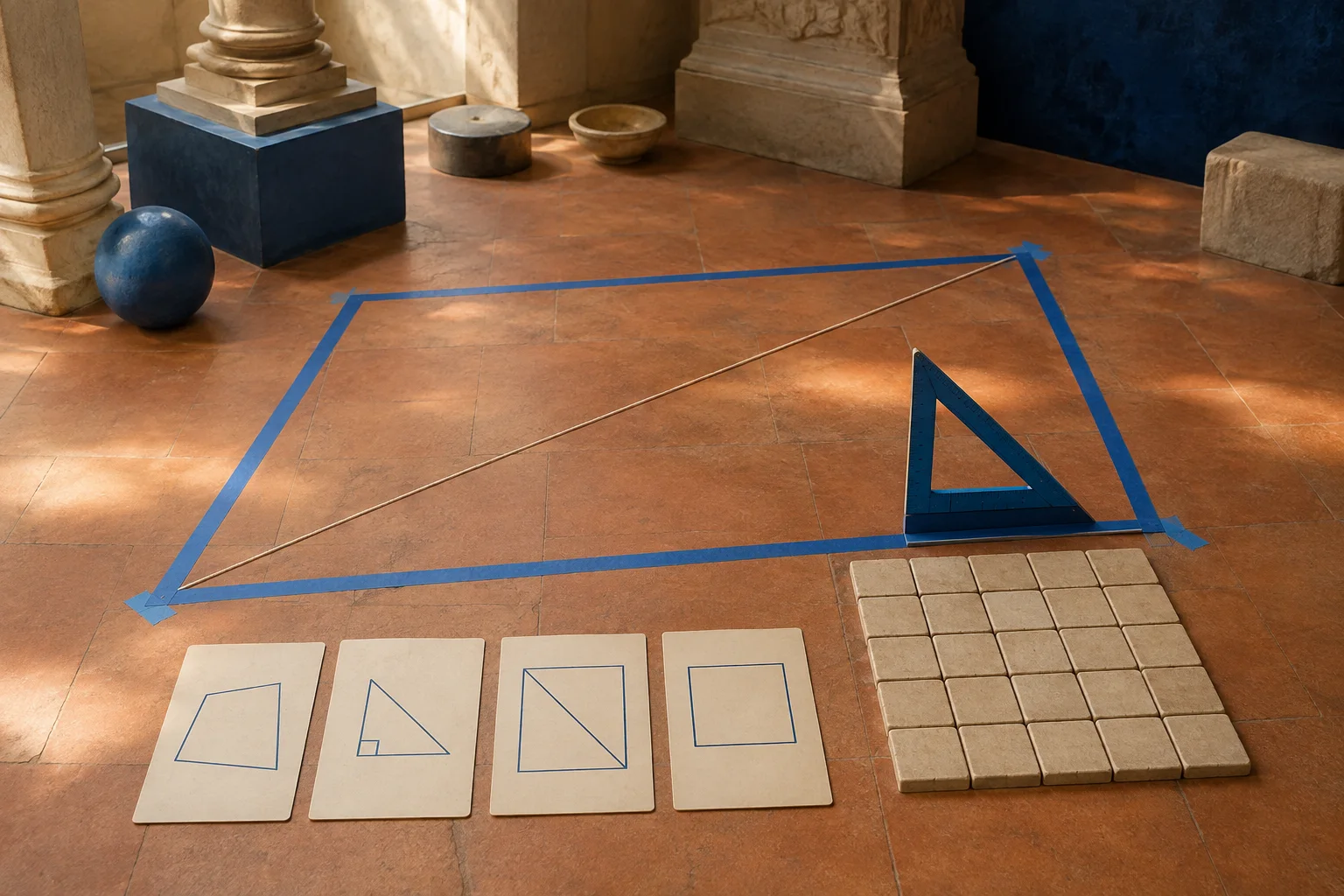
Use a repeatable routine for every geometry figure
On the first pass, read the text without solving. On the second, inventory labels and marks. Write the target, list the givens, and mark visual impressions as unproved. Next, choose a relationship that connects a known fact to the target. Perform one justified step at a time and add each new conclusion to the Proved column. Redraw only the portion you need.
After solving, explain the chain in ordinary language. For the sample: two marked sides are equal, so their opposite angles are equal; the top angle uses 40 of the triangle's 180 degrees; the remaining 140 degrees are shared equally; therefore each base angle is 70 degrees. If you can explain the solution without pointing vaguely at how the picture looks, the reasoning is likely visible and reusable.
Put it into practice now
Choose one problem from your current homework or review set. Attempt it before opening Eqora, then use the app only at the point where your own reasoning stops.
- State what the problem is asking before you solve it
- Identify the first step you cannot justify
- Ask Eqora one focused follow-up about that step
- Finish with a similar problem and no solution in view
The session is complete when the method is clearer, not simply when the worksheet has one more answer.