
Math at home · Eqora guide
Help your child with math homework when you feel stuck
A calm, practical routine for parents who want to support mathematical thinking without giving answers or reteaching the whole lesson.
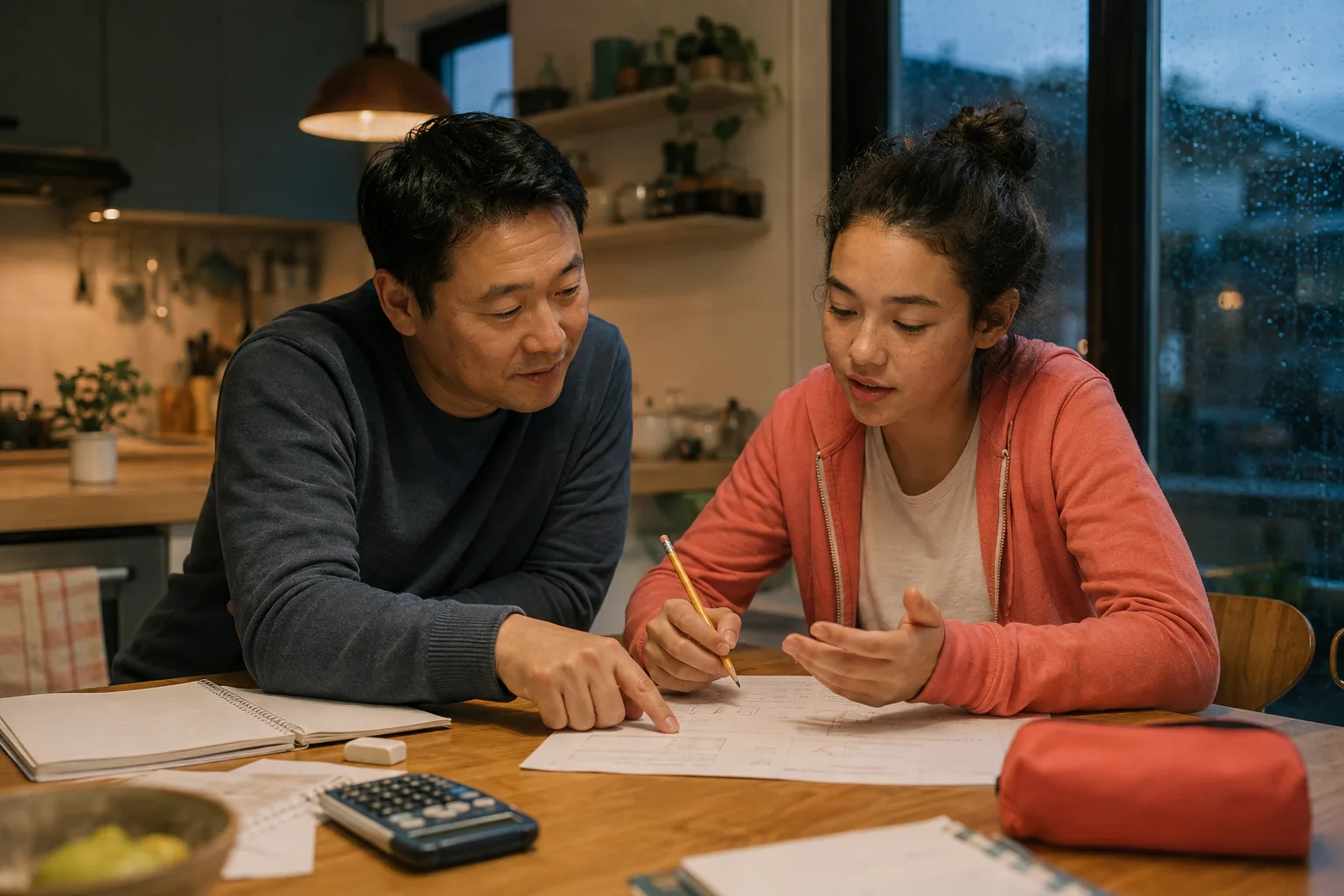
You can help your child with math homework even when you do not remember the method. Your most useful role is not to become a second teacher at the kitchen table. It is to create enough calm for the learner to explain the task, identify the exact point of confusion, use materials from class, and make one next move. A completed page may feel like success tonight, but a child who can describe what they tried has learned something that carries into tomorrow.
This guide gives parents and caregivers a repeatable routine: pause before explaining, ask the child to read and restate the problem, separate known information from the question, choose a visual representation, offer one small hint, and then hand the pencil back. It also explains when to stop, what to record for the teacher, and how to protect the relationship when homework becomes tense. You do not need perfect mathematics to use any of these steps.
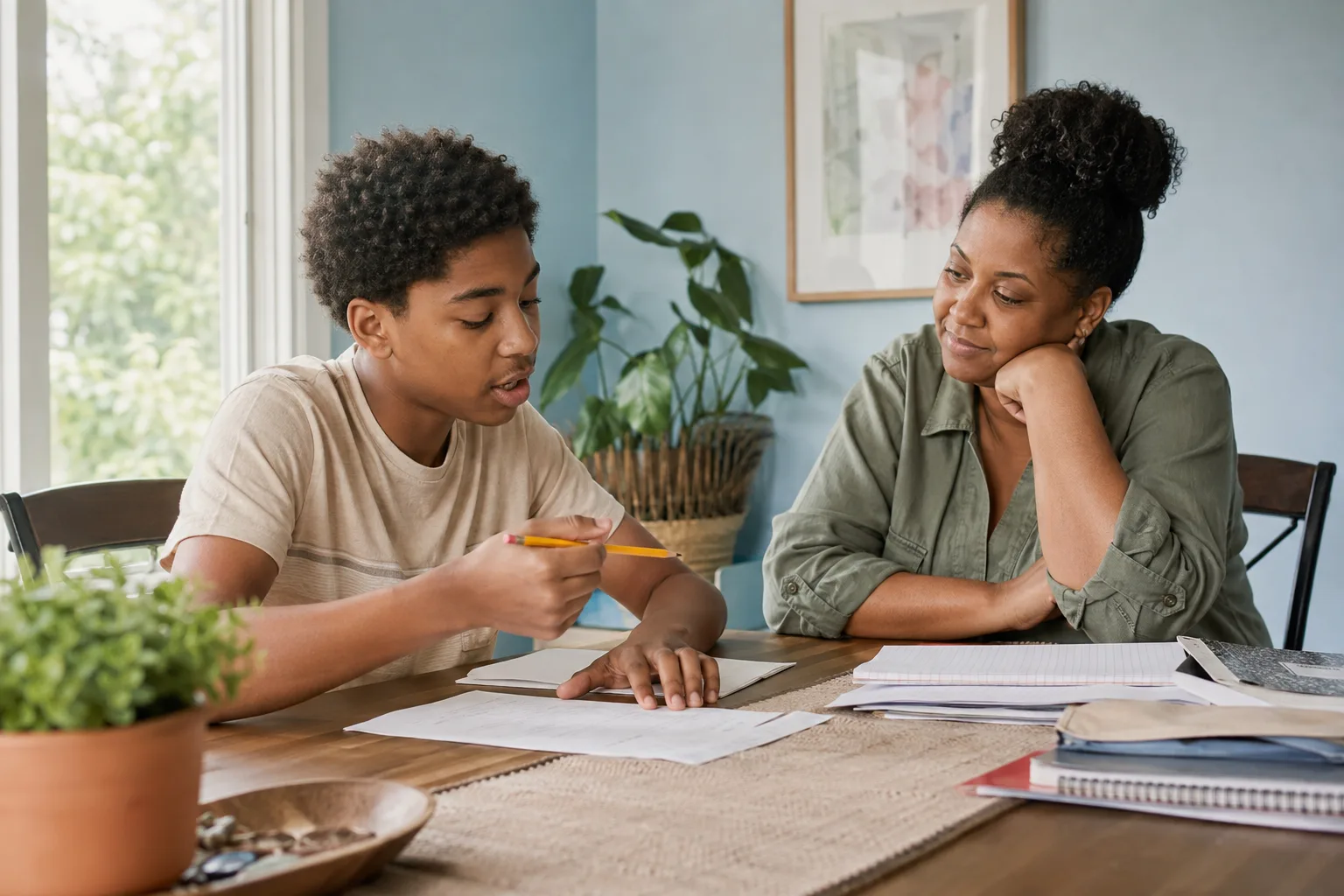
To help your child with math homework, begin by listening
When a child says “I don’t get it,” resist the urge to start a lesson. Ask them to show the exact problem and tell you what the directions mean. Then wait. The first explanation may be incomplete, but it reveals vocabulary, remembered examples, and assumptions. Useful prompts include: “What is the problem asking you to find?”, “What information do you already have?”, and “Which part still makes sense?” These questions turn a broad feeling of failure into a smaller, workable obstacle.
Keep the pencil and paper with the learner. If you take them, your speed can replace their thinking before either of you notices. Sit beside rather than across like an examiner, and look at the same page. Reflect back what you heard: “You know the total is 48, and you are unsure how the two distances are related.” A neutral summary confirms progress without approving a calculation that has not yet been checked.
Find the smallest point where the reasoning stopped
Ask the learner to cover everything after the last step they understand. Read only the problem and the work up to that point. The obstacle may be decoding a word, recalling a fact, choosing an operation, drawing a diagram, handling a negative sign, or explaining why a step is allowed. Name that obstacle narrowly. “Fractions are impossible” is too large to act on; “I do not know how to make the denominators equal” suggests a specific next question.
Look for a nearby worked example in the notebook, textbook, or teacher handout. Ask the child to compare structures rather than copy numbers: “What stayed the same between the example and this problem?” and “What changed?” If the class uses a number line, area model, ratio table, or equation balance, begin with that representation. Familiar classroom language reduces the risk that a correct but different adult method makes the assignment feel more confusing.
Turn a word problem into something visible
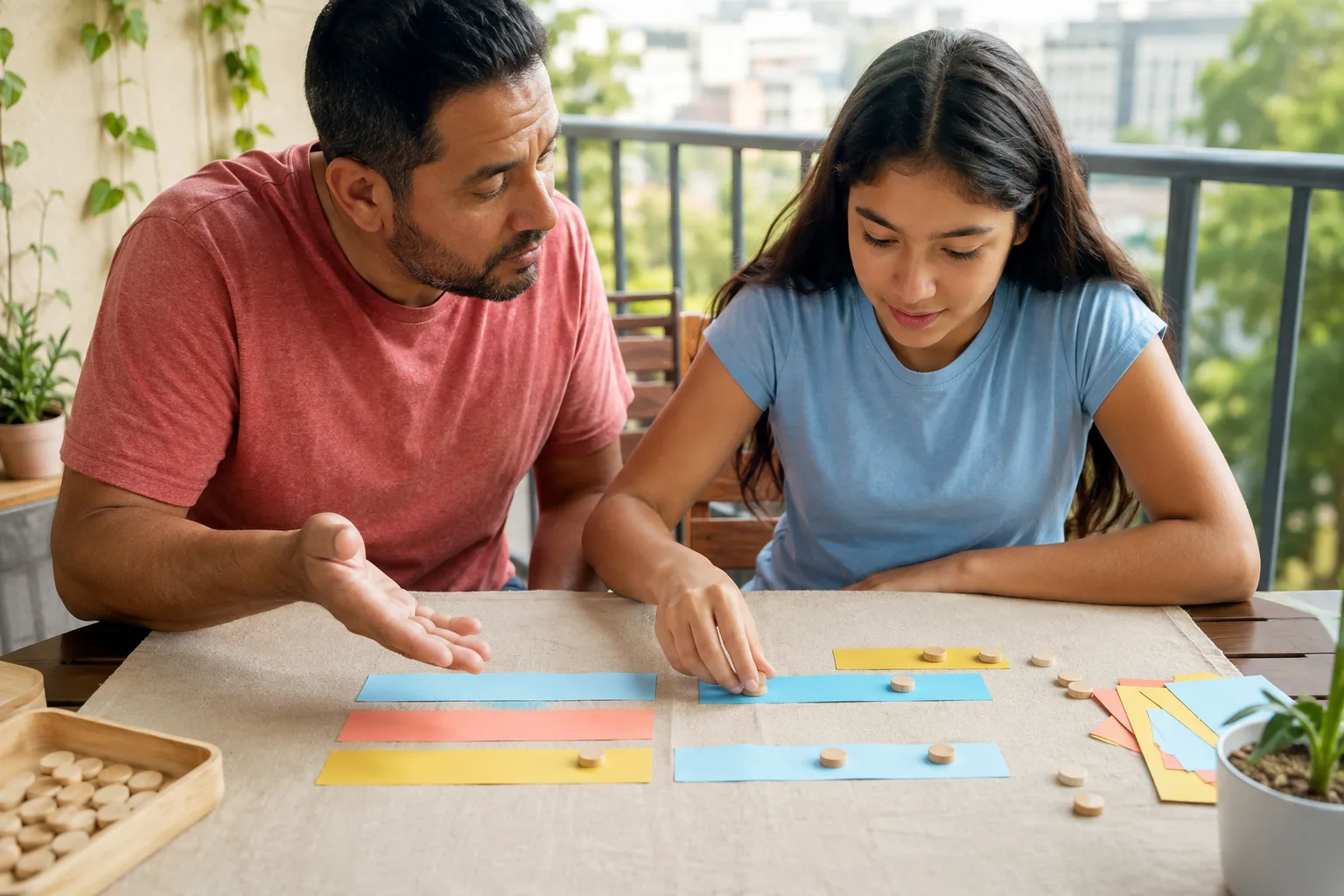
Suppose the problem says: Gus and Ike ran 48 miles in total, and Gus ran three times as far as Ike. How far did Ike run? Do not begin by announcing 48 ÷ 4. Ask the child to draw or build what the relationship means. Four equal paper strips can represent the whole distance: three for Gus and one for Ike. Once 48 is connected to four equal parts, the division and the answer 12 have a reason.
A visual model can be a sketch, number line, table, array, strip diagram, labeled shape, or a handful of counters. It is not decoration added after the answer. It exposes how quantities are related before an equation is chosen. The Institute of Education Sciences family guide recommends helping children represent mathematical information visually and consider more than one problem-solving approach. Use the model that fits the classroom and the child’s current level.
Give one hint, then return the work
A useful hint is the smallest prompt that restarts thinking. Point to a relevant example, ask for a drawing, suggest naming the unknown, or remind the child of one definition. Avoid stacking hints until they become a disguised solution. After one hint, say, “Try the next line and tell me why it follows.” Move your hands away from the page and give enough time for an imperfect attempt.
Use a ladder of support. First ask an open question. Next narrow the choice: “Would a table or a diagram show the relationship better?” Then recall a prior case: “What did you do when the total was split into equal groups?” Only after those steps should you model a different, simpler example. If you demonstrate, change the numbers and let the child finish the actual assignment independently.
- Ask one open question
- Offer one small hint
- Return the pencil
- Wait through the first attempt
- Ask the learner to justify the next step
Handle a method you do not recognize
School mathematics may look different from the way you learned it. Before calling a method inefficient or wrong, ask the child to explain what each mark represents and find the matching class example. Many contemporary representations are designed to show place value, equivalence, or relationships before moving to a compact algorithm. The goal of tonight’s assignment may be that representation, not merely the numerical answer.
You can say honestly, “This is not the method I learned, so let’s use your notes.” That models learning without embarrassment. Read headings, examples, and vocabulary together. If you know another method, save it until the assigned approach is understood, then compare them only if the comparison helps. Introducing two unfamiliar procedures at once increases the child’s burden and can undermine trust in the teacher’s instruction.
Pause before frustration becomes the lesson
Watch for signs that thinking has stopped: repeated guessing, rushing, tears, silence, arguing about unrelated details, or erasing every mark. At that point, more explanation usually adds noise. Take a short reset away from the page. Get water, stretch, or walk to another room. Keep screens out of the break if returning will be difficult. State clearly that the pause is a strategy, not a punishment or escape.
When you return, shrink the task. Choose one problem, one representation, or the first justified step. If tension rises again quickly, stop for the evening according to the family’s and school’s expectations. Record how long the child worked and where the difficulty began. Homework that regularly requires excessive time is information the teacher needs; it is not a reason to turn the home into a second classroom late at night.

Check understanding without taking over
After the child reaches an answer, ask for a check that matches the problem. They might estimate the likely size, substitute a value, reverse an operation, compare units, calculate through a second method, or explain why the result is reasonable in the story. Do not simply announce whether the answer is correct. A learner who can detect an unreasonable result is less dependent on an answer key and better prepared for independent work.
Then ask for a one-minute explanation with the page partly covered: “What was the first decision?” “Why did the model have four equal parts?” “Which step would you use again on a similar problem?” If the explanation collapses without the completed lines, the child may have followed prompts without understanding them. Return to one key connection rather than repeating the entire solution.
Leave the teacher a useful map of the sticking point
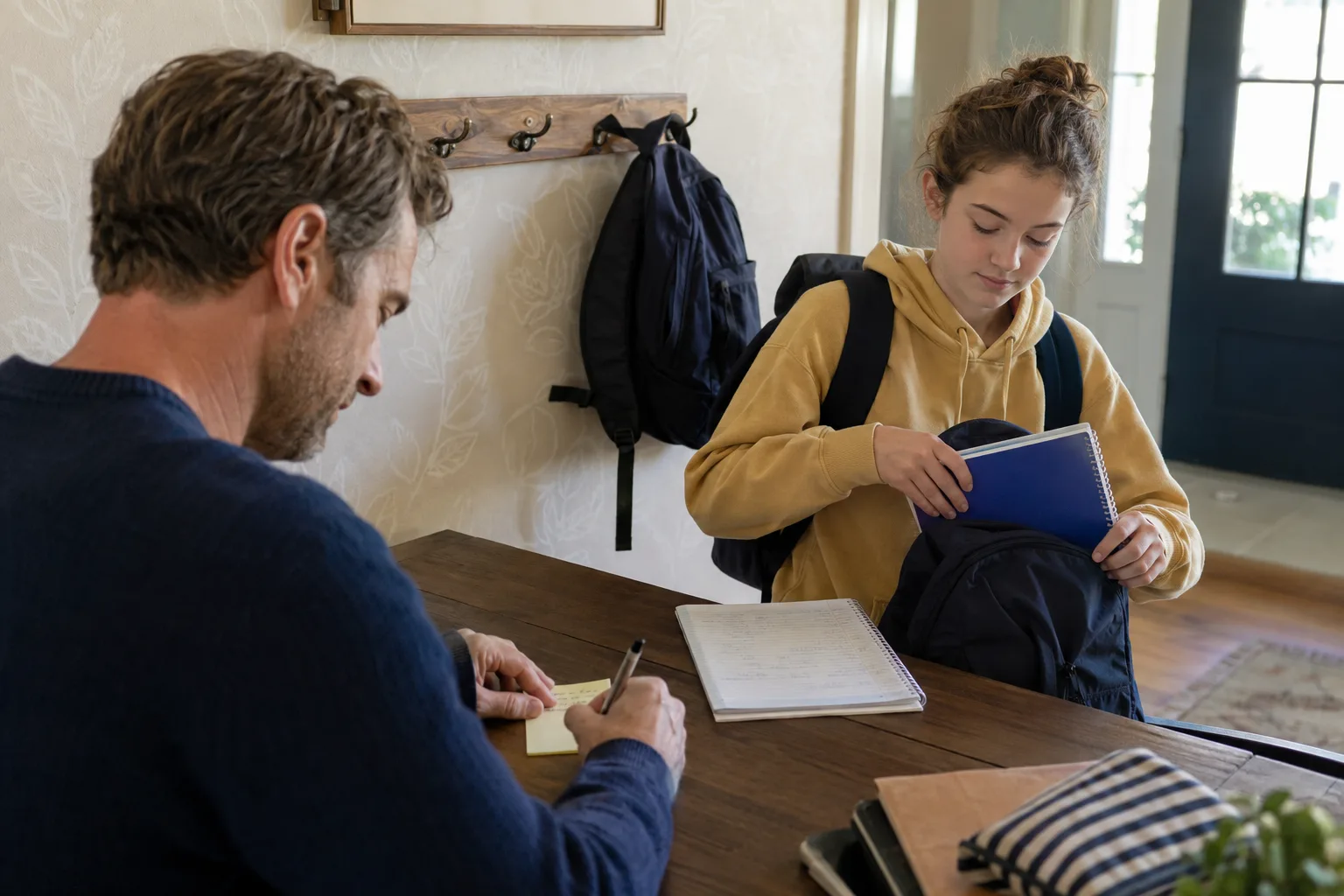
If the work remains unfinished, keep the child’s attempt intact. On a separate note, record the problem number, approximate time spent, strategies tried, and the first step that could not be justified. A useful note might say: “Worked for 25 minutes. She identified four equal groups and found 12, but could not connect the strip diagram to the equation 3x + x = 48.” It reports observable facts without blaming the learner or evaluating the lesson.
Encourage the child, especially an older student, to help write or deliver the question. This preserves agency and gives the teacher language to respond to. Avoid correcting the page after the child leaves or replacing their method with yours. Teachers need to see authentic work to identify misconceptions, choose examples, and decide whether the issue is individual or shared across the class.
Build a routine that needs less parent help over time
Use the same opening questions each evening until the child begins asking them independently: What am I finding? What do I know? What representation fits? What similar example do I have? How will I check? Keep a small supply of blank paper, counters, ruler, graph paper, and colored pencils nearby so choosing a representation does not become another interruption. Predictable materials and language reduce friction.
Gradually step back. Begin close enough to help define the obstacle, then move to another task while the child tries one line. Return only at an agreed checkpoint. Ask for the explanation rather than scanning for every error. Independence does not mean leaving a struggling learner alone; it means adjusting support so the learner performs more of the planning, calculating, checking, and communicating each week.
Put it into practice now
Choose one problem from your current homework or review set. Attempt it before opening Eqora, then use the app only at the point where your own reasoning stops.
- State what the problem is asking before you solve it
- Identify the first step you cannot justify
- Ask Eqora one focused follow-up about that step
- Finish with a similar problem and no solution in view
The session is complete when the method is clearer, not simply when the worksheet has one more answer.