
Geometry · Eqora guide
The Pythagorean theorem starts with a right angle
Identify the legs and hypotenuse, find a missing side, test the converse, and avoid using a right-triangle formula on the wrong figure.

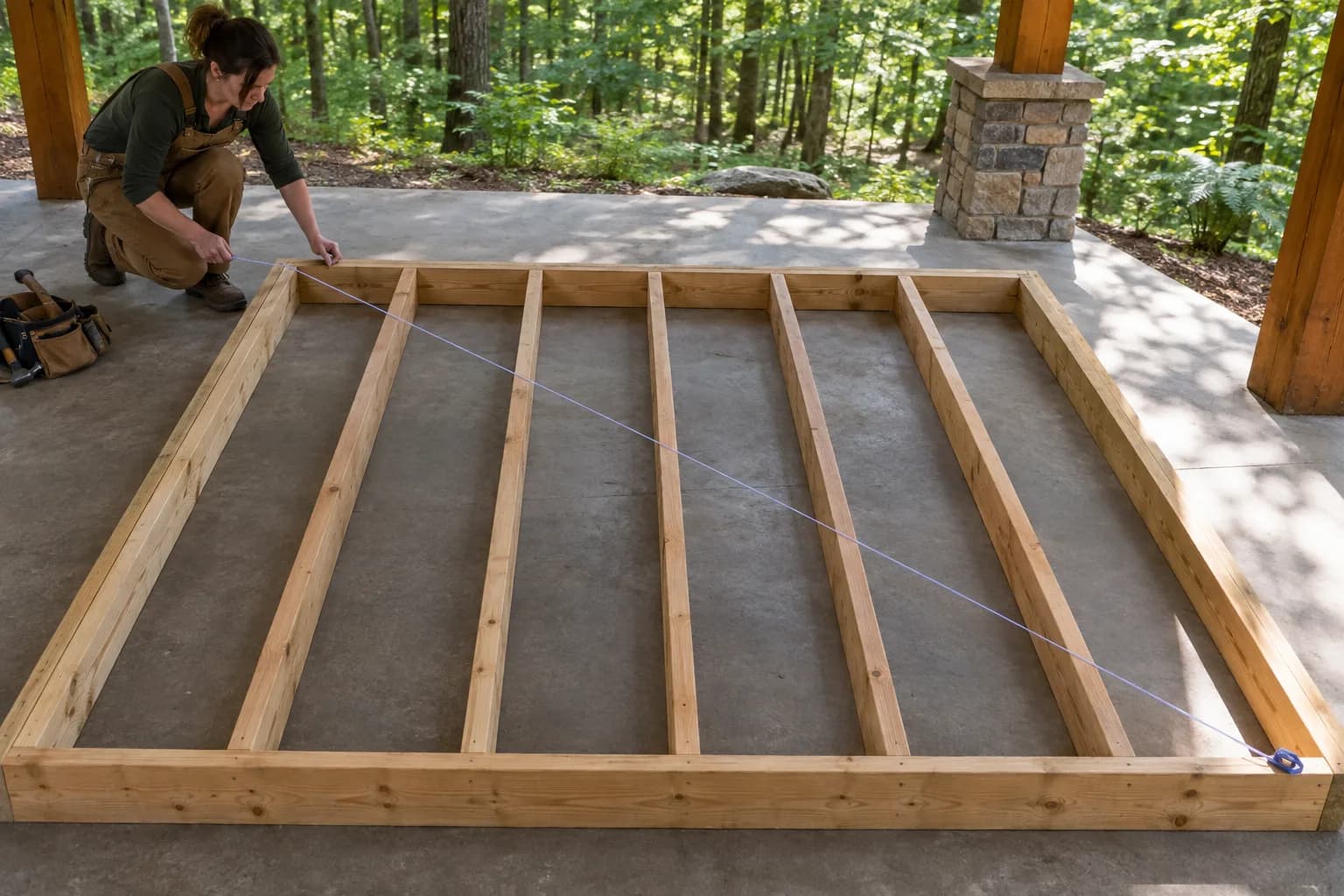
A timber frame is 6 units wide and 8 units long. How long is the brace from one corner to the opposite corner? The Pythagorean theorem gives 10 units, but only after one essential observation: adjacent sides of a rectangle meet at a right angle. Without that condition, the familiar calculation 6² + 8² = 10² would not describe the diagonal. A slanted parallelogram can have the same adjacent lengths and a different diagonal. The angle is part of the data, not a decorative square drawn in a corner.
This guide solves the rectangle, a triangle with a missing leg, and a case in which three given lengths must be checked before calling a triangle right-angled. You can do every calculation with paper, a square-root key when needed, and a careful sketch. The photographs show woodworking ideas, not measured mathematical diagrams. Their visible proportions do not prove the numerical examples. Use the stated lengths and marked angle in a question, not a visual guess.
OpenStax states the theorem for right triangles: the squares of the two legs add to the square of the hypotenuse. A source from the University of Würzburg emphasizes the same prerequisite. The rule is powerful because it connects sides without measuring an angle, but it does not apply to an arbitrary triangle. Begin each problem by identifying or establishing the right angle. Only then label the side opposite it as the hypotenuse and choose the right calculation.
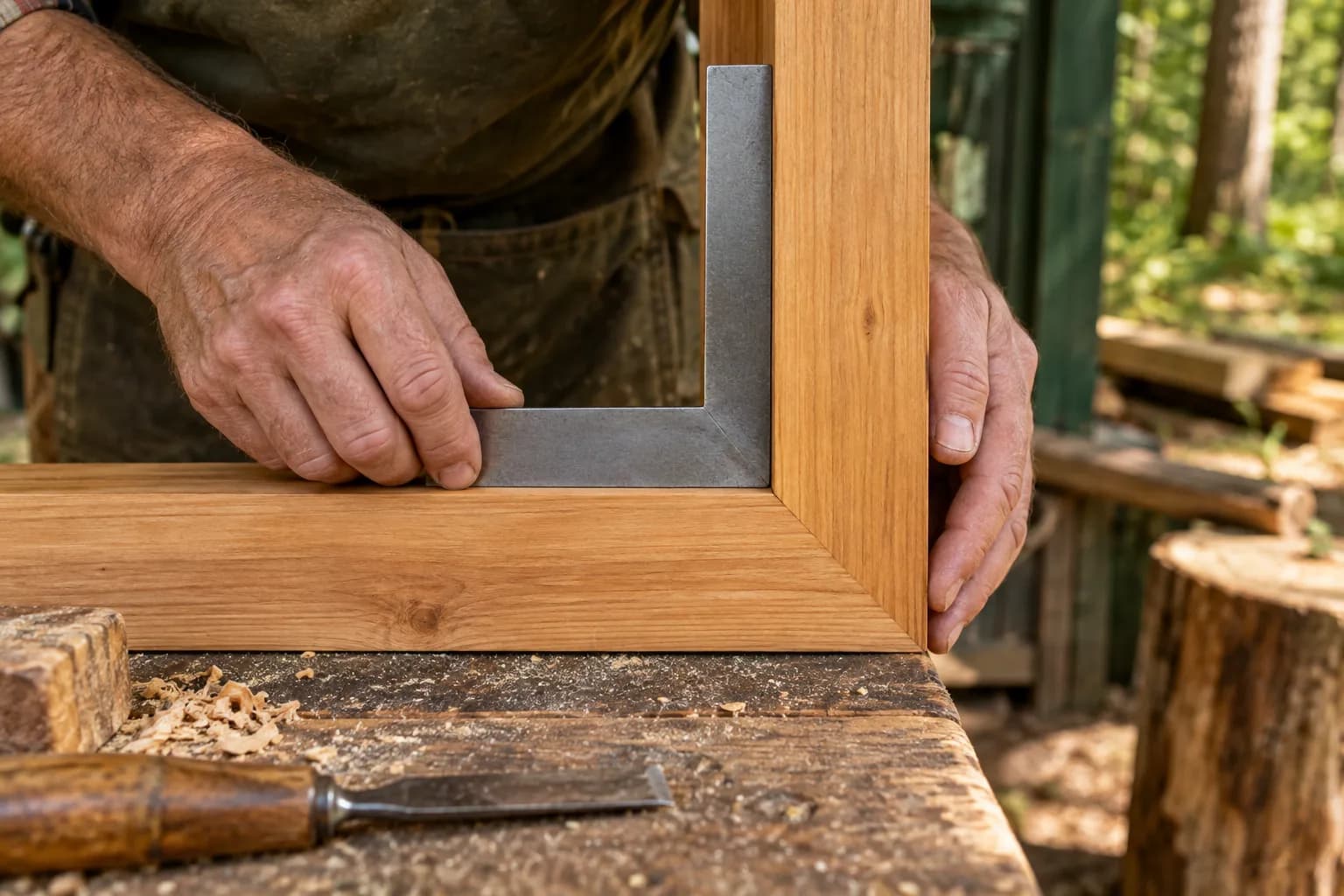

The Pythagorean theorem has a condition
A right triangle has one angle of exactly 90 degrees. The two sides that meet at this angle are the legs, often called a and b. The third side lies opposite the right angle and is the hypotenuse, often called c. The theorem says a² + b² = c². Letters are conventions, not magic: if a worksheet names the hypotenuse h, write the relationship with h² on the side by itself. The structural fact is that the square on the longest side equals the sum of the squares on the two perpendicular sides.
Before calculating, inspect the information that establishes the right angle: a square corner marker, a statement that two segments are perpendicular, or the definition of a rectangle. A drawing that merely looks square is not proof. Conversely, a triangle may be drawn crookedly even though the text says its angle is 90 degrees. Trust the given condition. Our guide to reading geometry diagrams develops the habit of separating written facts from apparent shapes. That habit prevents a beautifully calculated answer to the wrong triangle.
Identify the hypotenuse before placing numbers
The hypotenuse is opposite the right angle and must be the longest side of a nondegenerate right triangle. If two lengths are 6 and 8 and both touch the right-angle marker, they are legs; the unknown diagonal is the hypotenuse. If the given lengths are 5 and 13 and 13 lies opposite the right angle, then 13 is the hypotenuse and 5 is a leg. Swapping these roles can turn subtraction into addition and produce an answer longer than the supposed longest side.
Do not infer which side is c from the page orientation. A triangle can be rotated or reflected without changing its side roles. Trace the two rays meeting at the square angle mark; those are the legs. The remaining side is c. Label the diagram in your own notation before substituting. If no right angle is given and you only have two side lengths, you generally cannot determine the third side from this theorem. More information about the included angle or the triangle's shape is needed.
Find a diagonal from two perpendicular legs
Return to the 6-by-8 rectangle. A diagonal divides it into two right triangles because a rectangle's corners are right angles. The sides along one corner have lengths 6 and 8, so c² = 6² + 8² = 36 + 64 = 100. The length c is the positive square root of 100, or 10. Use the positive root because a physical length cannot be negative. Write the unit after the number: if the sides are meters, the diagonal is 10 meters, not 10 square meters.
An important check is size. A straight diagonal must be longer than either individual leg, so 10 > 8 and 10 > 6 are sensible. It must also be shorter than the path along both sides, so 10 < 14. The equalities of squared lengths provide the exact check: 6² + 8² = 10². A mistaken result of 14 adds raw lengths and measures a two-segment path, not the straight brace. The photographs are not scaled to 6 and 8; the arithmetic comes from the problem statement.
Why squares appear instead of raw side lengths
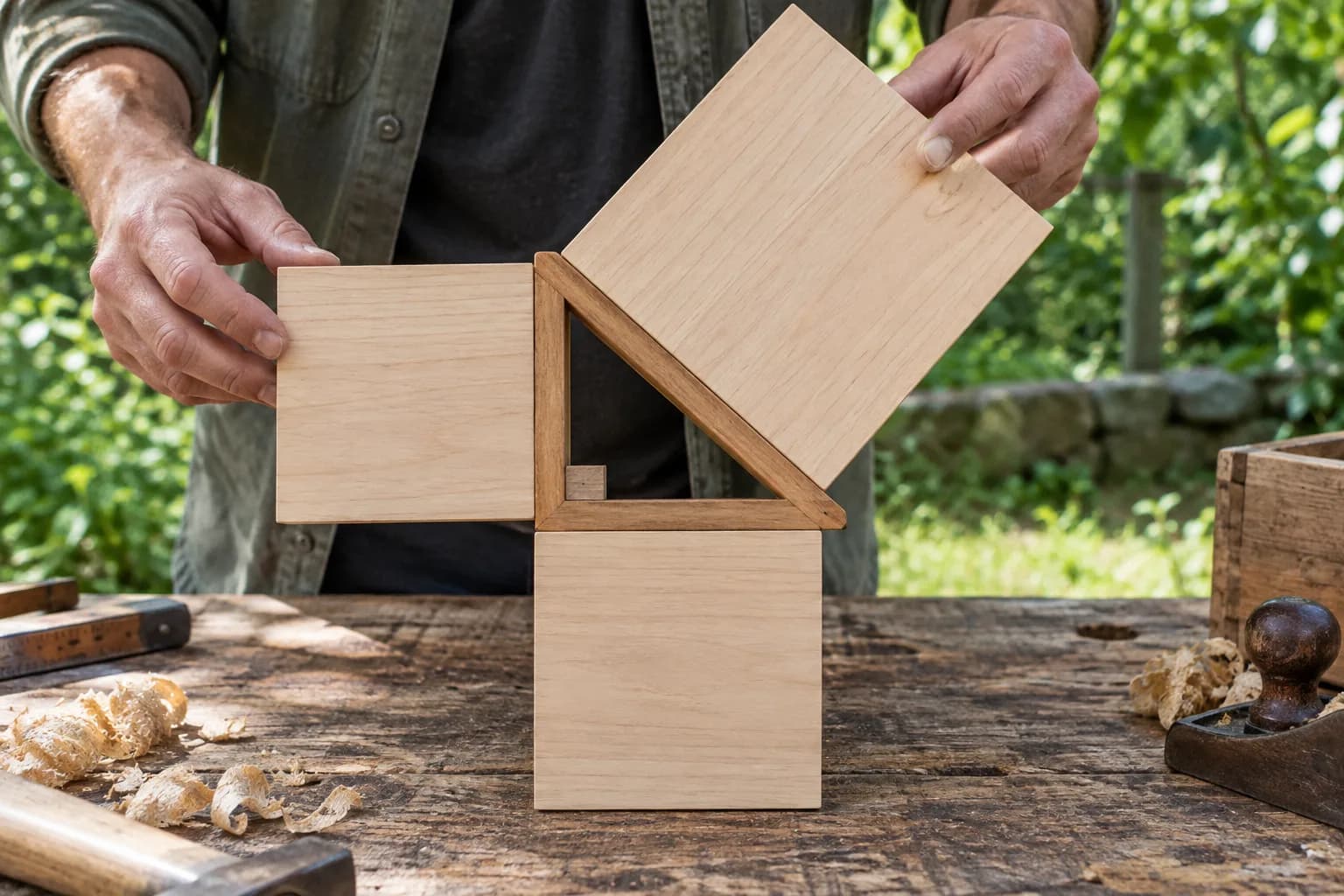
A square built on a side of length 6 has area 36 square units. On a side of length 8, its area is 64 square units. The theorem says these two square areas together equal the square area on the hypotenuse: 36 + 64 = 100. Taking the square root returns to a side length of 10. This area picture explains why 6 + 8 is not the answer. The numbers 36, 64, and 100 are areas used inside the calculation; the final diagonal is a length.
The theorem does not require you to construct physical squares for every problem. They explain the relation, while the algebra computes it efficiently. Be careful with notation: 6² means 6 × 6, and (6 + 8)² is not the same as 6² + 8². The first is 196; the second is 100. If a calculator shows an unexpected answer, verify where the parentheses and square-root operation were placed. The wooden tiles in the photograph are conceptual and not sized to the numerical areas.
Find a missing leg by subtracting squares
Suppose a right triangle has hypotenuse 13 and one leg 5. Let the other leg be b. Start from 5² + b² = 13², so 25 + b² = 169. Subtract 25 from both sides: b² = 144. Since b is a side length, b = √144 = 12. Check 5² + 12² = 25 + 144 = 169 = 13². Here adding 13² and 5² would be wrong because the hypotenuse square is already the total that contains both leg squares.
A missing-leg answer must be less than the hypotenuse. If you obtained √194, about 13.93, the result would exceed 13 and reveal that you added instead of subtracted. If the given leg is longer than the alleged hypotenuse, stop: the labels, measurements, or claim that it is a right triangle are inconsistent. A negative number under the square root after subtraction is a warning, not a request to report an imaginary side in an elementary length problem.
Check the converse when all three sides are known
The converse asks whether three given lengths make a right triangle. Put the longest length in the potential hypotenuse position, then compare squares. For sides 5, 12, and 13, compute 5² + 12² = 25 + 144 = 169 and 13² = 169. The equality holds, so a triangle with these sides is right-angled, and the right angle lies opposite the side of length 13. This is a test of the angle from side data, not an assumption that every drawn corner is already square.
Now test 4, 5, and 6. The longest side is 6, but 4² + 5² = 16 + 25 = 41, whereas 6² = 36. The three lengths can form a triangle because 4 + 5 > 6, yet it is not a right triangle. Do not force 4² + 5² = 6² by rounding 41 to 36. The University of Würzburg's mathematics didactics material states both the original theorem and its converse. Distinguish their directions: known right angle predicts a side relation; known exact side relation proves a right angle.
Translate a word problem into the correct triangle
In a room 9 meters by 12 meters, a straight cable across the floor from one corner to the opposite corner is a rectangle diagonal. Its length is √(9² + 12²) = √225 = 15 meters. If the cable must run along the two walls instead, the distance is 9 + 12 = 21 meters. The same numbers yield different answers because the routes are different. Draw the path described by the words before choosing a formula. Our word-problem guide can help identify what the question actually requests.
A wall and a level floor usually create a right angle in an idealized textbook task; a ladder leaning between them is the hypotenuse. Real construction requires additional safety, measurement, and installation rules, so do not use a school calculation as a structural or ladder-safety guarantee. For a tilted surface that is not perpendicular, the simple formula is not justified. State the modeled assumption in your answer: ‘Assuming the floor and wall are perpendicular…’ or ‘Because the figure is a rectangle…’ This sentence records why the method applies.
Keep exact roots, units, and a final check
Not every result is an integer. If the perpendicular legs are 2 and 3 centimeters, the hypotenuse is √(2² + 3²) = √13 centimeters, approximately 3.61 centimeters. Keep √13 as the exact result unless the question requests rounding; then state the requested precision. Do not round the squares early. If measurements themselves are approximate, the computed value is also approximate, no matter how many digits a calculator displays. Use a consistent unit before squaring; convert mixed centimeters and meters first.
Finish each exercise with four checks: confirm the right angle, locate the hypotenuse, decide whether to add or subtract squares, and substitute the result back into the original relation. For independent transfer, try a rectangular panel 7 units wide and 24 units long. Its diagonal is √(49 + 576) = √625 = 25 units. Then test sides 7, 24, and 26: 49 + 576 = 625, but 26² = 676, so that second triangle is not right-angled. If you can explain both outcomes without relying on how a sketch looks, you have learned the method rather than memorized a triple.
Put it into practice now
Choose one problem from your current homework or review set. Attempt it before opening Eqora, then use the app only at the point where your own reasoning stops.
- State what the problem is asking before you solve it
- Identify the first step you cannot justify
- Ask Eqora one focused follow-up about that step
- Finish with a similar problem and no solution in view
The session is complete when the method is clearer, not simply when the worksheet has one more answer.