
Functions · Eqora guide
Piecewise functions: which rule owns x = 1?
Choose the correct branch at a boundary, calculate values, read open and filled endpoints, and test a new example without assistance.

Piecewise functions appear in a homework question that gives f(x) = 2x + 3 when x < 1 and f(x) = (x − 2)² when x ≥ 1. It asks for f(0), f(1), and f(3). The tempting mistake is to substitute 1 into the first expression because that line appears first: 2(1) + 3 = 5. Yet the condition x < 1 explicitly excludes 1. The second expression owns that input, so f(1) = (1 − 2)² = 1. The inequality, not the order on the page, chooses the rule.
This guide solves the exercise and shows how to use Eqora as a careful learning aid. Capture the whole definition, inspect which inequality applies before trusting a calculation, ask about a single confusing boundary step, then solve a similar function independently. The station photographs suggest routes that branch; they are not literal graphs and their shapes must not be used to infer a numerical answer. Eqora does not guarantee correct recognition or reasoning, and it is not a substitute for permitted independent work in an exam.
OpenStax presents piecewise-defined functions as one function with different formulas on stated portions of the domain. Its calculus material also distinguishes a function's value at a point from the limits approached on either side. Those ideas are enough to handle this example precisely. You do not need to guess which curve looks closer, and you do not need calculus for the basic evaluations. First read the input restriction; only then do the arithmetic.

Piecewise functions begin with a condition, not a calculation
Rewrite the definition in words: use 2x + 3 for every input strictly smaller than 1; use (x − 2)² for every input equal to or greater than 1. The two conditions cover all real inputs and do not overlap. That means each real x receives exactly one output. A brace joins the rows into a single function; it does not ask you to add the formulas or solve two simultaneous equations. Think of the inequalities as a routing instruction attached to the input.
For x = 0, the statement 0 < 1 is true, so f(0) = 2(0) + 3 = 3. For x = 3, the statement 3 ≥ 1 is true, so f(3) = (3 − 2)² = 1. Notice that f(1) and f(3) happen to have the same output, 1. A function may assign the same output to several different inputs; the rule is that one particular input cannot have two conflicting outputs. Write the chosen condition beside each substitution to make the reasoning visible.

At x = 1, choose the row that includes equality
Test the exact boundary rather than a nearby number. The claim 1 < 1 is false, but 1 ≥ 1 is true. Therefore the second row supplies f(1) = (1 − 2)² = (−1)² = 1. The number 5 produced by the first formula at x = 1 is only a hypothetical continuation of that formula. It is not the value of this function there. A strict sign, < or >, excludes the endpoint; a non-strict sign, ≤ or ≥, includes it.
A good quick check uses values close to the boundary. At x = 0.9, the first rule gives 4.8. At x = 1.1, the second gives 0.81. Those values help you anticipate how the graph behaves near 1, but neither replaces the exact calculation of f(1). You should not round 0.9 up to 1 before selecting a row. The input interval is determined by the original exact x. If the assignment gives a decimal approximation, note whether it is genuinely the input or a rounded display of another quantity.
Capture the entire definition before using Eqora
A piecewise exercise is unusually sensitive to cropping. Photograph the full brace, every formula, each inequality, the specified input values, and any instruction about the domain or graph. A cropped ≥ can look like >, changing f(1) even if every later algebraic step is flawless. Keep the page flat and evenly lit. Exclude names and unrelated personal information when possible, while preserving every condition needed to solve the task. Our photo guide explains how to balance a readable frame with a minimal upload.
After capture, compare the recognized problem with the page before reading an answer. Does the first line say 2x + 3 rather than 2x − 3? Is the square on the entire (x − 2), not merely on 2? Is the boundary exactly 1, and is equality attached to the lower row? Correct these details or type the definition if recognition is uncertain. AI help can clarify a method, but no explanation of a different expression solves the assigned problem. Retain a written copy of your own version to check against.
Inspect the branch choice before the substitution
When Eqora shows a solution, pause at the line that selects a formula. For f(1), a defensible line is ‘1 ≥ 1, so use (x − 2)².’ Only after that should you see (1 − 2)² = 1. If the explanation jumps directly to a number, add the missing justification yourself. If it uses the first row, identify the precise false statement 1 < 1 rather than merely saying the answer looks wrong. Locating the first invalid step teaches more than comparing final numbers.
Check the other evaluations the same way: 0 < 1 leads to 2(0) + 3 = 3; 3 ≥ 1 leads to (3 − 2)² = 1. Parentheses matter. For x = 0, (x − 2)² would be 4, but that second formula is not authorized for x = 0. For x = 3, 2x + 3 would give 9, but that first formula is not authorized. In a piecewise problem, a correct arithmetic result from the wrong row is still an incorrect function value.
Ask one focused question about the boundary
If the endpoint still feels arbitrary, ask Eqora a narrow question: ‘Why does x = 1 use the ≥ row, and what would x = 0.999 use?’ A useful reply should evaluate the inequalities explicitly, not say that the square expression is preferred because it appears second. You can also ask, ‘What does the open point at (1,5) mean if f(1) = 1?’ That question separates a graph's limiting position from the actual assigned value.
Treat a generated response as something to inspect, not as an authority. Re-evaluate each comparison yourself and substitute into the original definition. If a graph or response disagrees, ask which inequality was applied and check the problem transcription before discussing more advanced topics. A school may restrict AI use for assignments or assessments; follow those rules. In any case, the goal is to explain to another learner why exactly one row applies at the boundary without consulting your phone.
Draw open and filled endpoints without joining the wrong dots
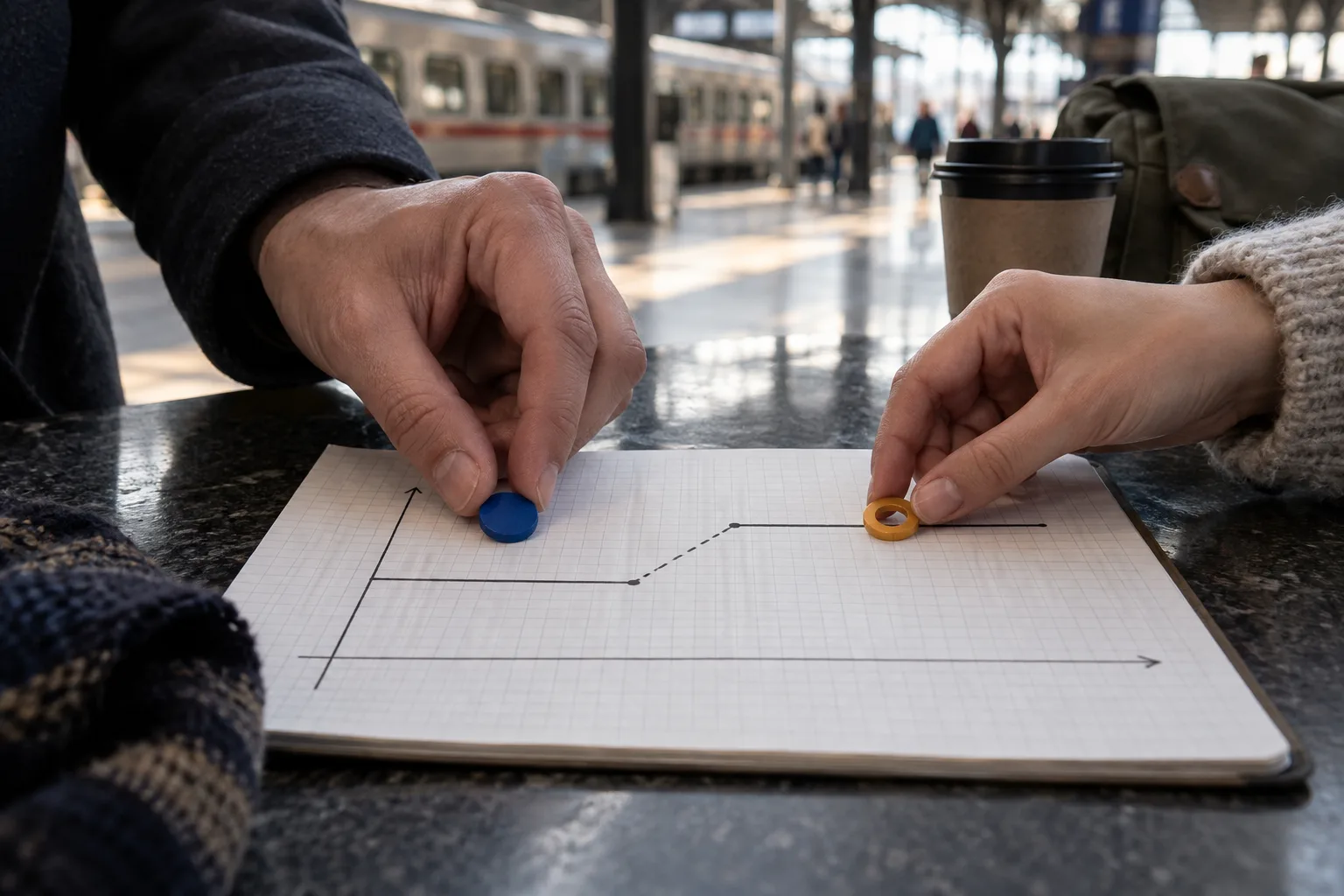
For x < 1, the line y = 2x + 3 approaches y = 5 as x approaches 1 from the left. Because x = 1 is excluded from that branch, place an open circle at (1,5). For x ≥ 1, the parabola y = (x − 2)² begins at x = 1 with y = 1. Place a filled circle at (1,1), then draw only the right-hand portion of that parabola. The two plotted marks share an x-coordinate but have different y-coordinates; only the filled point is in the graph.
Do not draw an invented vertical segment connecting (1,5) to (1,1). Such a segment would give many outputs at x = 1 and would no longer represent the specified function. Nor should you continue the line into the x ≥ 1 region just because a ruler makes that easy. Plot a few permitted values on each side, respect the endpoint symbols, and examine the branch intervals. A hand sketch may be rough, but the filled versus hollow distinction is exact and should agree with the written inequalities.
A function value is not a one-sided limit
The left-hand values of our function approach 5 near x = 1, while the right-hand values approach 1. Since these two one-sided limits differ, the overall limit as x approaches 1 does not exist, even though f(1) is perfectly well defined and equals 1. This is a jump discontinuity. The distinction matters: a question asking ‘find f(1)’ is answered from the row containing equality; a question asking ‘what happens as x approaches 1 from the left?’ concerns nearby x values and uses the first row.
OpenStax's continuity discussion asks readers to compare a function's value at a boundary with the behavior approaching from each side. Do not assume that an open circle means the entire function is undefined at that x; another branch can provide a filled point there. Conversely, a filled point does not make a jump continuous. Read the exact wording of the exercise before choosing between evaluation and limit reasoning. When reporting your conclusion, include both the numerical value and the condition that justifies it.
Solve a new boundary example independently
Put the phone face down and consider g(x) = x² for x ≤ −2, and g(x) = 3 − x for x > −2. First decide which condition each input satisfies. For x = −3, the first row applies and g(−3) = 9. For x = −2, equality belongs to the first row, giving g(−2) = 4. For x = 0, the second row applies and g(0) = 3. A common mistake is to use 3 − (−2) = 5 as g(−2); that expression describes an excluded endpoint of the second branch, not the actual value.
Sketch a filled point at (−2,4) on the left branch and an open point at (−2,5) on the right branch. Then check the interval coverage: x ≤ −2 and x > −2 together include every real x exactly once. The branches approach different heights, so this example also has a jump. You can check all three outputs by retracing condition, substitution, arithmetic, and graph mark in that order. If your independent answer differs from an assisted one, find the first disagreement instead of silently copying either result. That is the transferable skill for the next piecewise definition.
Put it into practice now
Choose one problem from your current homework or review set. Attempt it before opening Eqora, then use the app only at the point where your own reasoning stops.
- State what the problem is asking before you solve it
- Identify the first step you cannot justify
- Ask Eqora one focused follow-up about that step
- Finish with a similar problem and no solution in view
The session is complete when the method is clearer, not simply when the worksheet has one more answer.