Measurement and geometry · Eqora guide
Unit conversion: length, area or volume?
Smaller units mean more units, but the factor depends on the dimension. Derive the relationship before moving a decimal point.
A unit conversion error can look surprisingly tidy: 2.4 m² becomes 240 cm² because a meter contains a hundred centimeters. The length factor is correct, but the question asks about area. A square meter contains a hundred centimeters in each of two directions, so the area factor is 100 × 100 = 10,000. The correct result is 24,000 cm². Before shifting the decimal point, decide what quantity and dimension the task actually describes.
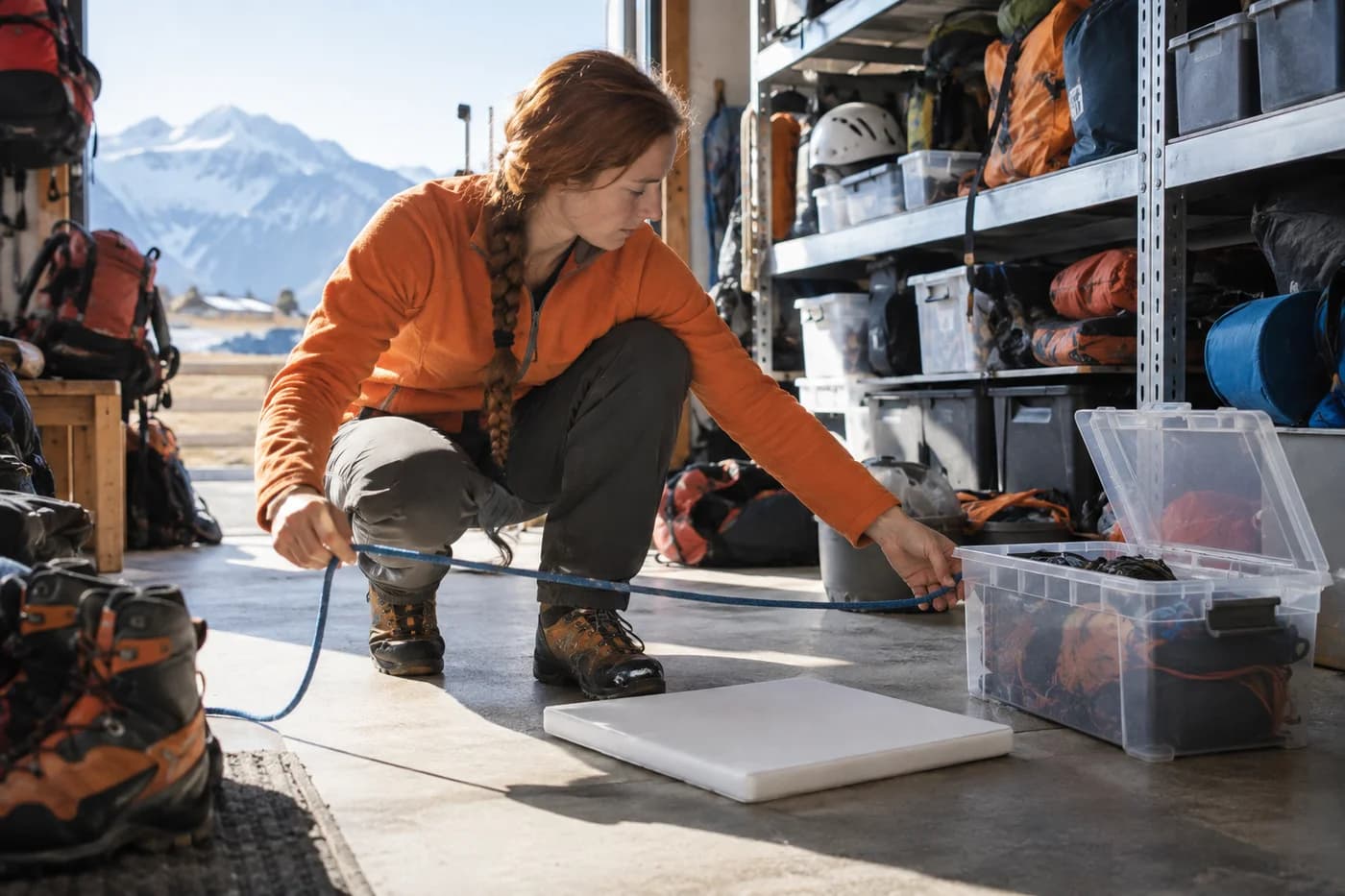
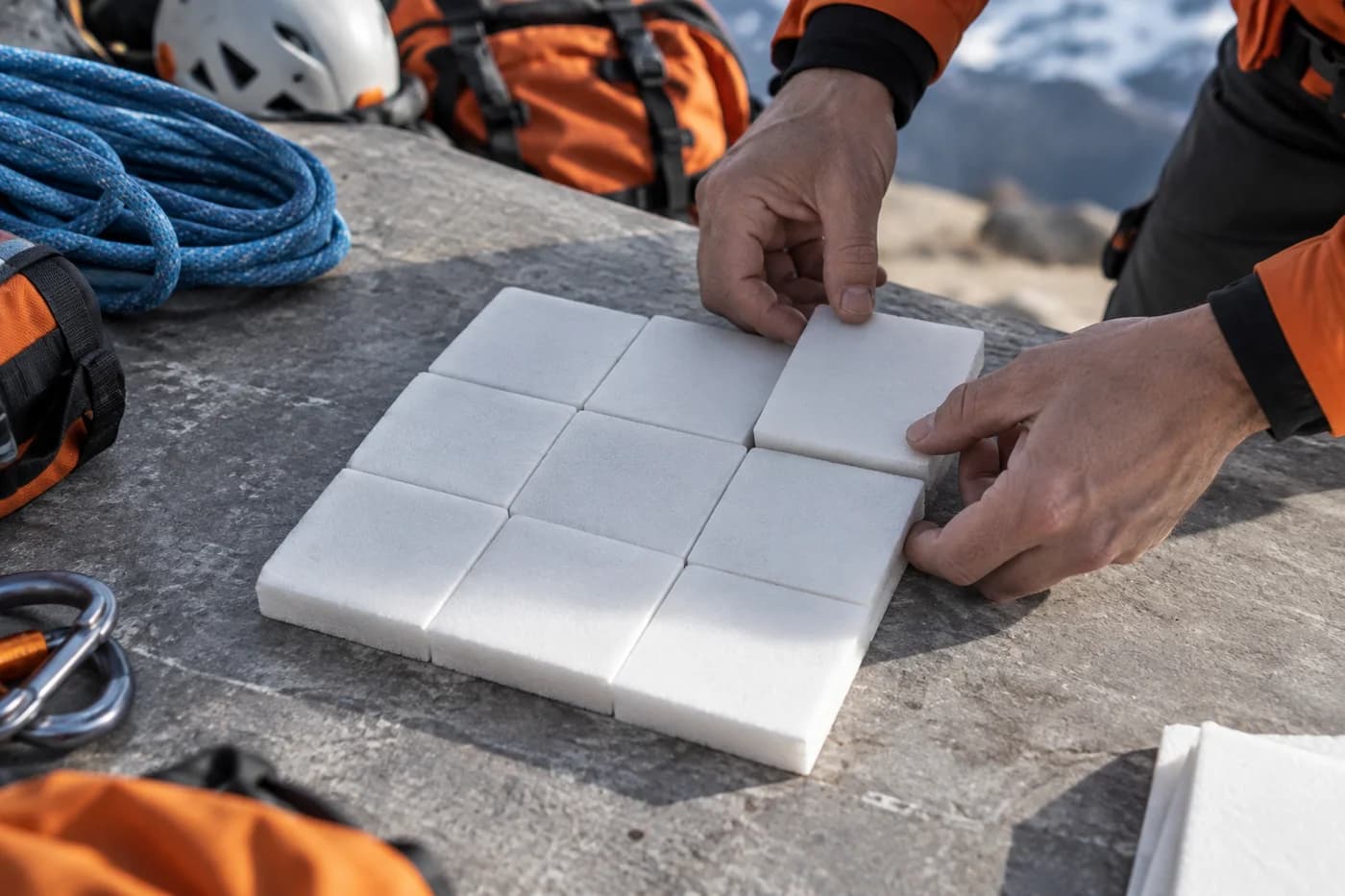
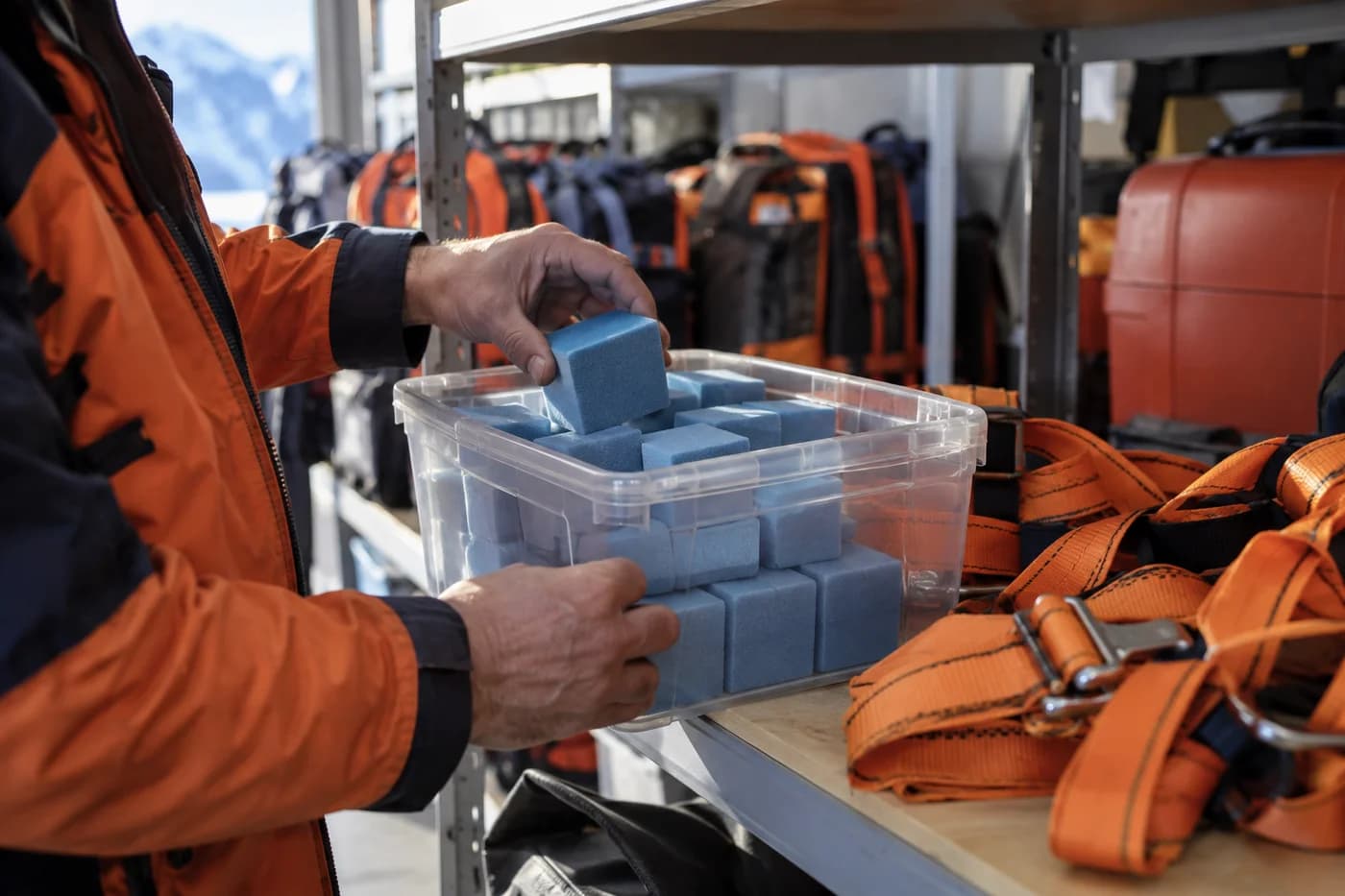
This guide explains length, area and volume factors independently of an app. The constructed examples can be solved with paper and pencil. Photographs from a mountain-rescue depot use cords, panels and packing space as visual analogies; they are not scale drawings or instruments with readable measurements. Use the numbers supplied in a problem, rather than estimating an answer from the image.
Eqora publishes this learning support without replacing your own exam work or guaranteeing correctness or grades. Check the question, notation, assumptions and final answer yourself, including when using an app or calculator. A plausible number with the wrong unit does not answer the question. The aim is a conversion you can explain and independently check.
Unit conversion begins with the quantity being measured
Read the question before collecting the numbers. A cord has a length, covering a surface involves area and space inside a crate involves volume. Meters, square meters and cubic meters describe different quantities. You can convert m² to cm², but not directly from m² to cm³ without another piece of information, such as the thickness of a layer. The exponent belongs to the meaning of the unit rather than decorating its symbol.
Write the starting and target units in full beside the value. Highlight the little two or three if it is easy to miss. Ask how many target units fit inside one starting unit. Our guide to reading geometry diagrams helps distinguish stated data from visual assumptions. A crate drawn in perspective does not supply a missing height. Similarly, the side length of a square is not already its area; the question determines which quantity to calculate.
NIST's introduction to SI length distinguishes the meter, square meter and cubic meter. Use that distinction before choosing a conversion table. The same centimeter prefix leads to different factors in one, two and three dimensions. A table organizes the relationships; it cannot identify the quantity for you. Explain which kind of table applies before relying on its positions or visible zeros.
A length uses the factor once
From 1 m = 100 cm, it follows that 2.4 m = 2.4 × 100 cm = 240 cm. The centimeter is smaller, so more of them describe the same distance. In reverse, 240 cm = 240 ÷ 100 m = 2.4 m. This return calculation is a simple check: it should recover the original distance. Also inspect the scale. Two hundred forty centimeters is a little more than two meters, rather than two hundred forty meters.
A decimal step from m to dm, or dm to cm, has factor ten. Steps multiply: m to cm gives 10 × 10 = 100. The direct relationship between km and m is a thousand. Neighboring names in a shortened list therefore need not differ by ten. The instruction move one unit only works when the specific sequence is clear. Establish the relationship instead of counting boxes in an incomplete chart.
For 85 mm in meters, calculate 85 ÷ 1000 = 0.085. The reverse check, 0.085 × 1000 = 85, confirms the factor. Keep the symbol m and a leading zero. Without the unit, 0.085 could represent a length, a proportion or a volume. Rounding immediately to 0.09 m changes the exact value; retain the precise conversion unless the question requests rounding.

Area needs the square of the length factor
A square with one-meter sides has area 1 m × 1 m = 1 m². Each side is a hundred centimeters, so the same area is 100 cm × 100 cm = 10,000 cm². These are two descriptions of one square. You have not enlarged it; you are counting smaller area units. That gives 2.4 m² = 24,000 cm² and, in reverse, 24,000 cm² = 2.4 m². Sketching the two directions can clarify why one factor is insufficient.
If the length conversion factor is k, the area factor is k². From dm to cm, k = 10, so from dm² to cm² the factor is a hundred. Thus 3.7 dm² = 370 cm². From cm² to m², divide by ten thousand: 450 cm² = 0.045 m². Account for the whole relationship between the units. Two area steps of factor a hundred combine to ten thousand, not two hundred.
Distinguish (2.4 m)² from 2.4 m². The first squares a length and gives 5.76 m². The second already states an area of 2.4 square meters. Converting that area multiplies its value by the unit factor; it does not square 2.4 again. The length conversion factor is what gets squared. Square the numerical measurement only when the actual mathematical operation calls for it.
Volume adds a third direction
A cube with one-meter sides has volume 1 m³. Each of its three dimensions is a hundred centimeters. In cubic centimeters, the volume is therefore 100 × 100 × 100 = 1,000,000. Thus 1 m³ = 1,000,000 cm³. A cubic centimeter is a small unit of space, not a square surface. The third factor comes from depth rather than an arbitrary extra zero in a chart.
For 0.003 m³, calculate 0.003 × 1,000,000 = 3000 cm³. The return gives 3000 ÷ 1,000,000 = 0.003 m³. Between decimal length units differing by ten, the volume factor is 10³ = 1000. For example, 4.2 dm³ = 4200 cm³ exactly. The direction of the numerical change still makes sense: a smaller volume unit requires a larger positive numerical value to describe the same space.
Connect liters with cubic units
NIST's volume guide identifies a liter with one cubic decimeter: 1 L = 1 dm³. A decimeter contains ten centimeters, so the volume is 10 × 10 × 10 = 1000 cm³. Therefore 1 L = 1000 mL = 1000 cm³, giving 1 mL = 1 cm³. A cubic meter contains a thousand cubic decimeters and thus a thousand liters. A small value in cubic meters can consequently represent several liters without contradiction.
Convert 750 cm³ to liters: 750 ÷ 1000 = 0.75 L. For 0.003 m³, pass through 3000 cm³ and then three liters, or calculate 0.003 × 1000 = 3 L directly. Both routes describe the same volume. To convert 2.5 L to cm³, obtain 2500 cm³. Take care with mL and m³: the L and the exponent three distinguish very different units despite the shared first letter.
Volume is not mass. Three liters do not determine a number of kilograms without density and, where relevant, suitable conditions. Area does not turn directly into liters either. A liquid layer over a surface needs its thickness to establish volume. These boundaries matter as much as the numerical factors. Unit conversion changes the unit of one quantity; an additional physical relationship connects different quantities.
Unify mixed measurements before multiplying
Suppose a rectangular panel is 1.2 m long and 35 cm wide. For area in square meters, first convert 35 cm to 0.35 m. Then A = 1.2 × 0.35 m² = 0.42 m². Alternatively, convert 1.2 m to 120 cm and calculate 120 × 35 = 4200 cm². The final conversion, 4200 ÷ 10,000 = 0.42 m², confirms the first route. A decimal result can be perfectly correct.
The isolated calculation 1.2 × 35 = 42 is not yet an answer in m² or cm² because its inputs used different units. You could explicitly carry m × cm and convert afterward, but that is easy to misread. A common length unit before multiplication is generally clearer for learning. Our word-problem planning guide helps separate known measurements from the requested quantity before choosing an operation using every visible number.
If the panel has thickness 8 mm, that is 0.008 m. The rectangular-solid model gives V = 0.42 × 0.008 m³ = 0.00336 m³ = 3.36 L. In centimeters, 120 × 35 × 0.8 = 3360 cm³, also 3.36 L. Convert thickness once as a length. Squaring or cubing it additionally changes the formula and makes the unit check fail. The final cubic unit comes from multiplying three lengths.
Check units, direction and scale
First inspect the units produced by the operation. Length times length gives area; area times length gives volume. Area divided by length gives length again. This check can detect errors even when the numbers look plausible. Add only compatible quantities after making the units consistent. Two meters plus thirty-five centimeters becomes 2.35 m, rather than adding two and thirty-five as bare values.
Then inspect the direction of the value change. If the new unit is smaller, the numerical value of the same positive quantity must increase. An area of 450 cm² cannot become 45,000 m². Imagine a square-meter field: 450 square centimeters is a small part of it. This image does not replace calculation, but it helps detect a reversed factor. Calculate back exactly and compare with the original value.
Round at the end to the requested precision. Exact unit factors do not create extra measurement accuracy. Approximate input lengths still yield a model value for area or volume. Mark approximations and identify the assumed shape, such as an ideal rectangular panel or a rectangular internal space. That lets a reader distinguish the exact conversion relationship from the limits of the measured object.
Try a fresh problem without the conversion table
Try this independently: a rectangular container has internal dimensions 45 cm, 0.3 m and 200 mm. Find the base area in m² and volume in liters, taking the first two measurements as the base sides. Write every length in one common unit. Explain which measurement is unnecessary for the base area. Height changes the space inside, but not the rectangular footprint. This prevents automatically multiplying all three values for both questions.
In meters, the dimensions are 0.45 m, 0.3 m and 0.2 m. The base area is 0.45 × 0.3 = 0.135 m². Volume is 0.135 × 0.2 = 0.027 m³ = 27 L. Check in centimeters: 45 × 30 = 1350 cm² and 45 × 30 × 20 = 27,000 cm³. The appropriate factors recover 0.135 m² and 27 L. The calculation assumes a rectangular internal space without fittings displacing it.
If your result differs, locate the first disagreement: an incorrect length, wrong dimension, reversed factor or missing unit. Record a specific reminder, such as build the area factor from two length factors. Later solve a similar problem with different values and check through another common unit. That practices the reason behind the conversion, rather than a decimal-position shortcut that may fail when the next task asks for volume.