Coordinate geometry · Eqora guide
Ellipse equation: axes, center and foci
Read an ellipse equation to find its center, semiaxes and foci. Normalize an expanded equation and verify the result with points and distances.

The ellipse equation (x − 2)²/25 + (y + 1)²/9 = 1 contains enough information to sketch the curve without plotting dozens of points. Its center is (2, −1), its horizontal semiaxis is 5 and its vertical semiaxis is 3. The denominators give the squares of those lengths. Reading 25 and 9 as lengths would make the sketch much larger than the equation permits.
Start by finding the point where both squared expressions vanish, then move horizontally and vertically from that center. Once those distances are clear, you can locate the foci and check a few points in the original equation. Each step gives a different check on the same curve. This approach works for ellipses whose axes are parallel to the coordinate axes, provided the equation has been normalized so the right side is one.
Read the ellipse equation from the center
The expression x − 2 vanishes at x = 2. The expression y + 1 vanishes at y = −1, because y + 1 means y − (−1). Together they identify the center (2, −1). That point is the intersection of the two symmetry axes. It is inside the ellipse. Substituting the center into the left side gives zero, so the center itself is not on the curve defined by equality to one.
To find the horizontal endpoints, set y = −1. The second fraction becomes zero, leaving (x − 2)²/25 = 1. Thus (x − 2)² = 25 and x − 2 = ±5. The horizontal endpoints are (−3, −1) and (7, −1). In the vertical direction, set x = 2 to get (y + 1)² = 9. The vertical endpoints are (2, −4) and (2, 2). These four points anchor a sketch and show the full width of 10 and full height of 6.
A semiaxis runs from the center to an endpoint, while a full axis runs between opposite endpoints. Keep that distinction when a question asks for dimensions. The OpenStax ellipse lesson describes horizontal and vertical standard forms and distinguishes semiaxis lengths from full axis lengths. If the two squared semiaxis lengths are equal, the curve becomes a circle. You can compare that special case with reading the center and radius of a circle.
Let the larger denominator choose the direction
A larger positive denominator allows a larger displacement before its fraction reaches one. In the opening example, the larger denominator is beneath the x expression, so the longer axis is horizontal. We will call the longer semiaxis a and the shorter b. Here a = 5 and b = 3. Naming them by length avoids assuming that a always belongs under the x term.
For a vertical example, consider (x + 3)²/4 + (y − 2)²/16 = 1. The center is (−3, 2). The horizontal semiaxis is 2, while the vertical semiaxis is 4. With our naming convention, a = 4 and b = 2. The long-axis endpoints are (−3, −2) and (−3, 6). The other two endpoints are (−5, 2) and (−1, 2). The number 16 belongs to the vertical direction even if someone writes the y fraction second.
This reasoning assumes the two coordinate directions use the same physical scale. A graph drawn with unequal scales can make the ellipse look rounder or narrower than the equation says. Use the numerical semiaxes to establish the lengths, then mark equal unit distances on the sketch. If the equation contains an xy term, its axes may be rotated. Reading the denominators as horizontal and vertical semiaxis squares requires a suitable standard form first.
Locate the two foci inside the long axis
For a noncircular ellipse, the foci lie on the longer symmetry axis, equally far from the center. If c is the distance from the center to either focus, then c² = a² − b². In the first example, c² = 25 − 9 = 16, so c = 4. Move four units left and right from (2, −1). The foci are (−2, −1) and (6, −1). They are inside the endpoints at x = −3 and x = 7.
You can understand the subtraction geometrically. Take the upper short-axis endpoint and join it to the two foci. The two distances are equal by symmetry. Their sum is 2a, so each is a. One of these segments forms the hypotenuse of a right triangle with legs b and c. The Pythagorean relation gives a² = b² + c². Solving for c² produces the difference a² − b². This argument also explains why c must be less than a for a genuine ellipse with positive short semiaxis.
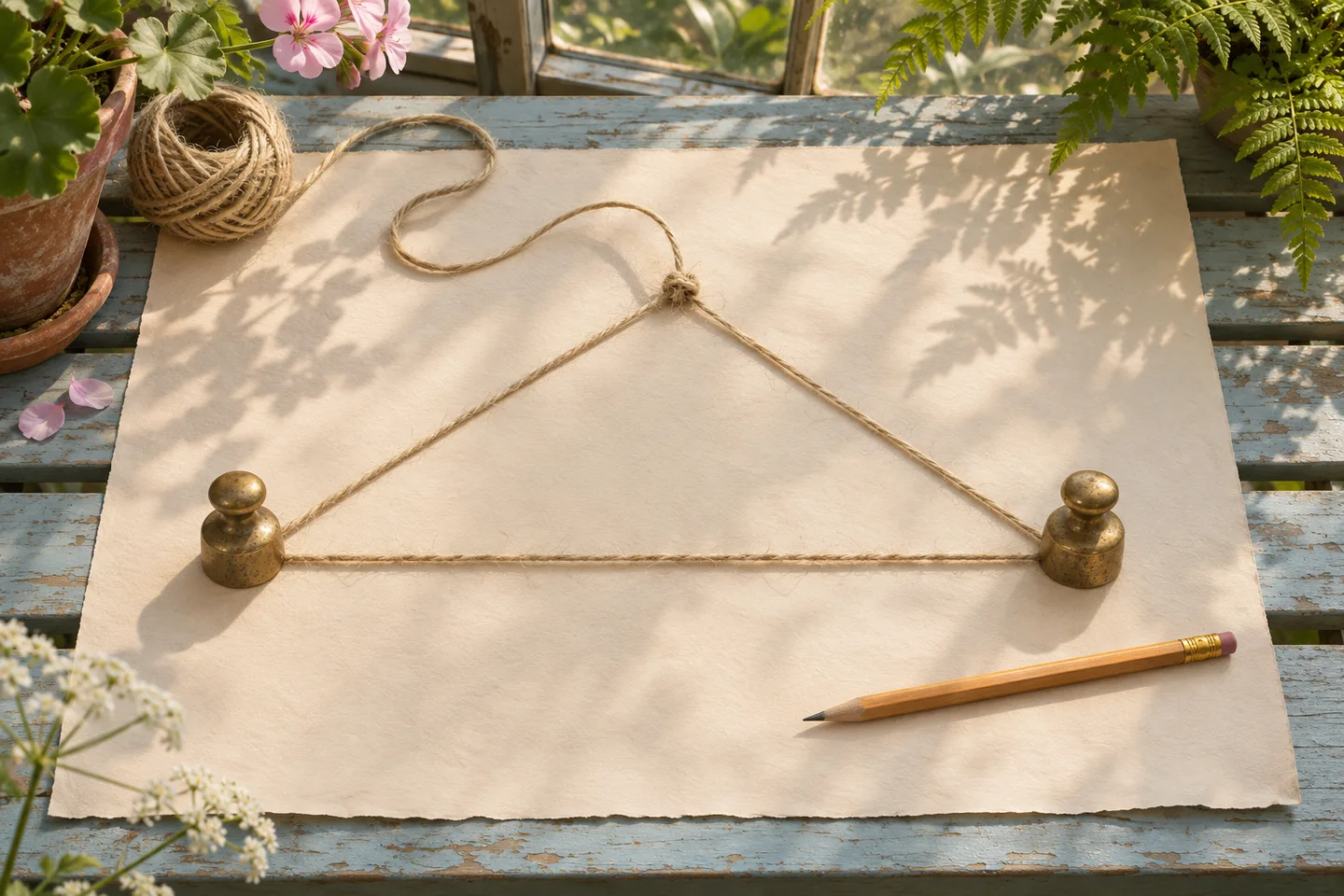
Check the numbers using distances rather than reusing the equation. From the top point (2, 2), the distance to each focus is √(4² + 3²) = 5. The sum is 10. From the right endpoint (7, −1), the distances are 9 and 1, again totaling 10. Every point on this ellipse has that same total distance to the two foci. A string construction models the condition by keeping the sum of two segments fixed. The photographs illustrate the idea and do not encode the worked numerical dimensions.
For the vertical example, c² = 16 − 4 = 12, giving c = 2√3. The foci are (−3, 2 − 2√3) and (−3, 2 + 2√3). Keep the square root until an approximation is requested. The expression is a distance, so c is nonnegative. The ± in the coordinates creates the two focus positions.
The same information can be used in reverse. Suppose you are given the two horizontal endpoints and the two foci of the first ellipse. The midpoint of the endpoints gives the center. Half their separation gives a, and the center-to-focus distance gives c. Recover b from b² = a² − c², which here gives nine. This reconstruction needs a positive difference. If someone supplies a focus at or beyond a long-axis endpoint while claiming a positive short semiaxis, the data cannot describe this kind of ellipse. Check whether the supplied length is a full axis, a semiaxis, or a distance between the foci before changing the calculation.
Another quantity used to describe the shape is the eccentricity e = c/a. The first ellipse has e = 4/5. For an ellipse with a positive short semiaxis, e is smaller than one. If the semiaxes approach equality, the foci approach the center and the eccentricity approaches zero. An eccentricity by itself does not tell you the size. Doubling both semiaxes doubles c and leaves c/a unchanged. You would get a similar ellipse with twice the width and height. Its enclosed area would be four times as large. This gives a useful distinction when two equations have the same shape but different scales.
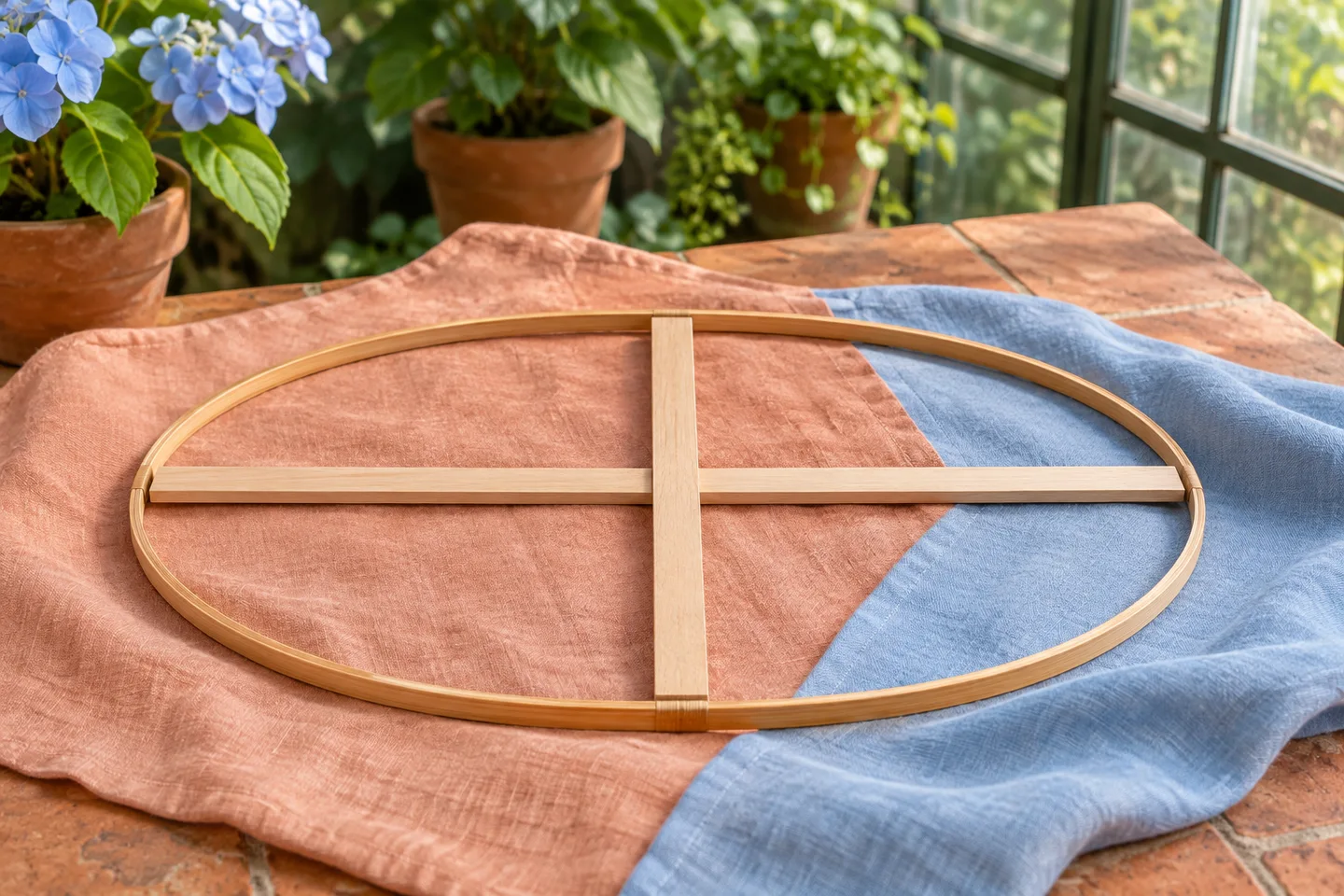
A photograph can introduce a different source of confusion. A circular hoop viewed obliquely may look elliptical on the image. That appearance concerns a projection onto the picture plane. It does not give the physical hoop two different radii. In a coordinate exercise, establish which plane and distances the equation describes before interpreting a sketch or a picture.
Normalize an expanded equation before measuring
An ellipse may arrive in expanded form. Consider 9x² + 25y² − 36x + 50y − 164 = 0. Group the x terms and the y terms, then move the constant to obtain 9(x² − 4x) + 25(y² + 2y) = 164. Complete the squares inside the parentheses. Since x² − 4x = (x − 2)² − 4 and y² + 2y = (y + 1)² − 1, substitution gives 9(x − 2)² − 36 + 25(y + 1)² − 25 = 164.
Move the two negative constants to the right. You obtain 9(x − 2)² + 25(y + 1)² = 225. Divide the whole equation by 225 to get (x − 2)²/25 + (y + 1)²/9 = 1. The original example is recovered. Dividing by the right side matters because an equation such as X²/25 + Y²/9 = 4 has larger semiaxes. Its normalized denominators are 100 and 36.
When completing a square, adding four inside parentheses with a factor of nine changes that term by 36. Account for the outside factor before balancing the equation. The guide to choosing the missing number when completing the square explains that step in more detail. After rewriting, expand the squares once to check that every coefficient and constant matches the original. This verifies the algebra independently of your sketch.

Check points and distinguish the boundary
Substituting (2, 2) into the opening equation gives zero plus 9/9, which equals one. The point lies on the ellipse. Substituting (2, 0) gives 1/9, so that point is inside the enclosed region. Substituting (8, −1) gives 36/25, which is greater than one, so it lies outside. With positive semiaxis squares, the normalized sum describes the boundary at one and the filled region at values at most one.
A plotted point that looks close to the curve still needs a calculation if an exact answer is required. Keep fractions or radicals until you evaluate the normalized sum. Rounding early can make a true boundary point seem slightly inside or outside. Check the original notation too. A minus between the two squared terms changes the type of conic. A zero right side in a sum of positive squared terms leaves just the center, and a negative right side gives no real points.
If a question asks for the area enclosed, use πab. For a = 5 and b = 3 the area is 15π square units. Using the full axis lengths 10 and 6 in place of a and b would give four times the area. The curve itself is the boundary of that region. Write the requested quantity and its units before choosing a formula.
Sketch a second ellipse independently
Try (x + 1)²/16 + (y − 3)²/25 = 1. Find the center, both semiaxis lengths, four endpoints and two foci before checking the results below. Decide the long-axis direction from the denominators, and substitute one of your endpoints into the equation.
The center is (−1, 3). The horizontal semiaxis is 4 and the vertical semiaxis is 5, so the major axis is vertical. Its endpoints are (−1, −2) and (−1, 8). The short-axis endpoints are (−5, 3) and (3, 3). Since c² = 25 − 16 = 9, the foci are (−1, 0) and (−1, 6). At (3, 3), substitution gives 16/16 + 0 = 1. The distances to the two foci are both 5, totaling 10 as required.
Finally, reflect each endpoint through the center and verify that it reaches its opposite partner. Check that the foci lie on the longer axis and between its endpoints. Together with one substitution and one distance-sum calculation, those observations give you a way to review the sketch from several directions.