Geometry · Eqora guide
Circle equations: read the center and radius
Turn an expanded equation into a distance condition, check the radius squared and distinguish a circle from its disk.
A circle equation can hide its center behind an expanded polynomial. Seeing x² and y² is only the start: the coefficients, signs and constant determine whether the real solution set is a circle, one point or nothing at all. The reliable approach is to connect the equation to distance, then complete the square without changing its solutions. That gives a geometric interpretation you can check rather than a list of signs to memorize.
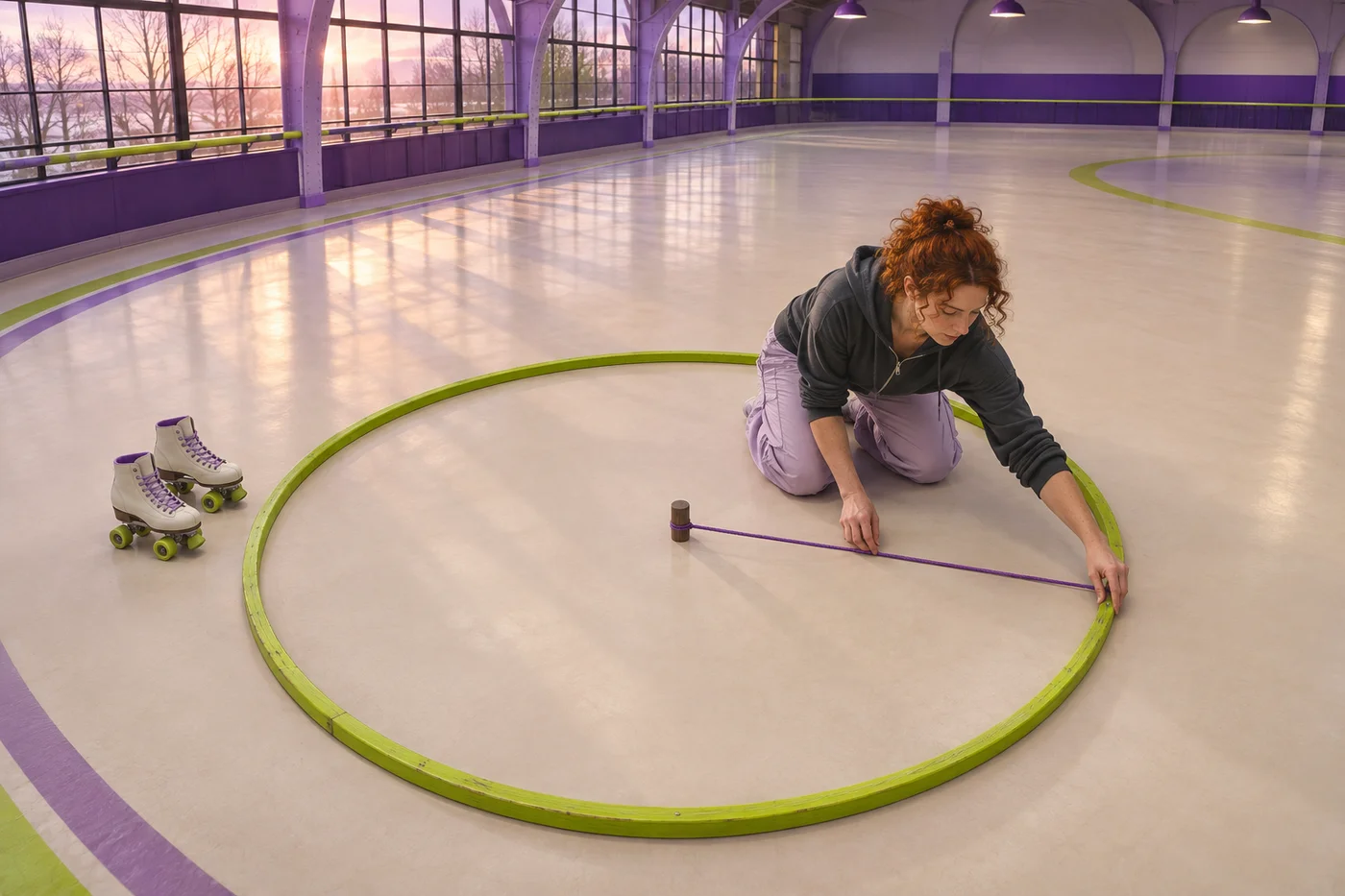
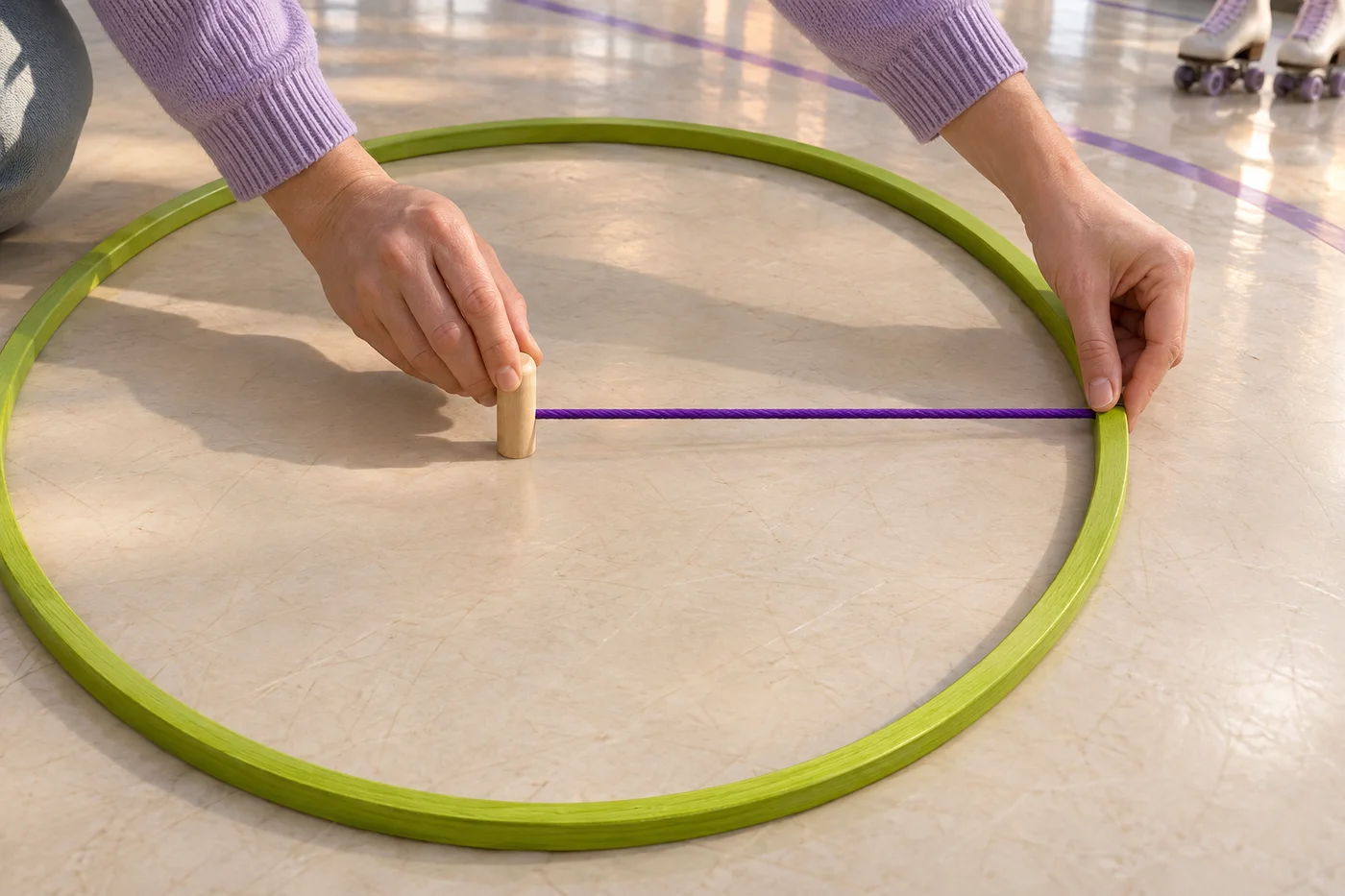
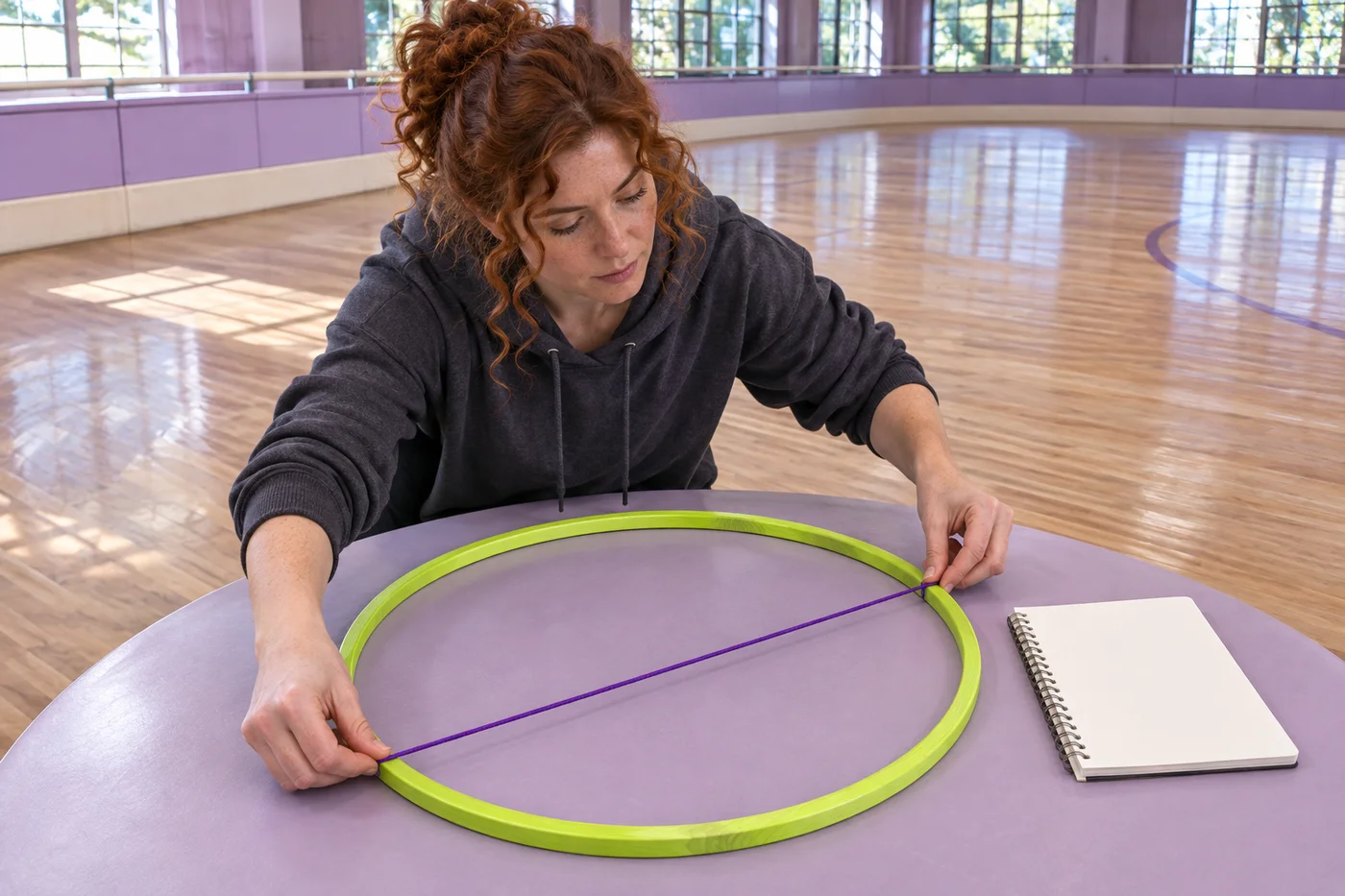
Our main example is x² + y² − 6x + 4y − 12 = 0. We will find its center and radius, verify points on its boundary, and distinguish a circumference from a filled disk. All coordinates use perpendicular Cartesian axes with the same length unit. The accompanying photographs illustrate physical circles and distances conceptually; their objects are not scaled diagrams from which the numerical answers can be measured. Every calculation below can be completed independently on paper.
A circle equation starts with a fixed distance
A circle is the set of points a fixed positive distance r from a center C = (h, k). For a candidate point P = (x, y), the horizontal and vertical coordinate differences are x − h and y − k. The Pythagorean theorem gives CP² = (x − h)² + (y − k)². Requiring CP = r therefore gives (x − h)² + (y − k)² = r². Squaring this distance condition is safe because distances and the chosen radius are nonnegative.
This derivation explains the signs inside the brackets. If the center has horizontal coordinate 3, the horizontal difference is x − 3. If its vertical coordinate is −2, the vertical difference is y − (−2), which becomes y + 2. The bracket sign is a consequence of subtracting the center, not an unrelated reversal trick. Equal scales on the axes matter: stretching only the horizontal drawing scale changes the apparent shape, even though the underlying coordinate equation remains the same.
Read a completed-square form carefully
In (x − 3)² + (y + 2)² = 25, the center is (3, −2) and the radius is 5. The number on the right is r², not r. Taking the nonnegative square root gives r = √25 = 5, rather than 25 or −5. The center itself does not satisfy this circle equation: its left side is zero, while the right side is 25. A center belongs inside its disk but not on a positive-radius circle's boundary.
One quick check uses the point (8, −2). Its horizontal displacement from the center is 5 and its vertical displacement is zero, giving 5² + 0² = 25. The point (3, 3) similarly lies five units directly above the center. By contrast, (8, 3) has squared distance 25 + 25 = 50 and is outside the circle. Moving five units in both coordinate directions does not keep the total distance at five; those perpendicular displacements must combine through the distance formula.
Complete the square in each variable separately
Return to x² + y² − 6x + 4y − 12 = 0. Move the constant to obtain x² − 6x + y² + 4y = 12. For the x terms, half of −6 is −3, whose square is 9. For the y terms, half of 4 is 2, whose square is 4. Add both quantities to both sides: (x² − 6x + 9) + (y² + 4y + 4) = 12 + 9 + 4.
The left side becomes (x − 3)² + (y + 2)², and the right side becomes 25. We have recovered the center-radius form without changing the solution set. Oregon State's explanation of completing the square connects this operation to recognizing a circle from its equation. The essential balance is visible here: adding 9 and 4 only on the left would produce a different equation and a different radius. Group each variable's terms and track the total addition on the right before taking any square root.
Expand back to check the whole transformation
Expand the completed form: (x − 3)² = x² − 6x + 9 and (y + 2)² = y² + 4y + 4. Thus (x − 3)² + (y + 2)² = 25 becomes x² + y² − 6x + 4y + 13 = 25. Subtracting 25 gives x² + y² − 6x + 4y − 12 = 0, exactly the original equation. This reverse check tests every constant, not only the signs of the center.
The guide to checking answers without an answer key develops this habit of using a different direction of reasoning. You can also substitute a boundary point into the original equation. At (8, −2), the left side is 64 + 4 − 48 − 8 − 12 = 0. If a point passes the rewritten equation but fails the original, the rewriting contains an error. A sketch may suggest a plausible location, but a symbolic expansion and an exact substitution are stronger evidence than appearance alone.
Normalize a common coefficient before completing squares
An equation such as 2x² + 2y² − 12x + 8y − 24 = 0 describes the same circle. Divide every term by 2 to recover our original example. Dividing only the squared terms, or forgetting the constant, changes the equation. A nonzero common factor may be removed because multiplying or dividing an entire equality by a nonzero number preserves its solutions. Even a negative common factor can be removed this way; the resulting normalized coefficients determine the interpretation.
In an unrotated equation with no xy term, equal nonzero coefficients of x² and y² are a signal that a circle may be present after normalization. Unequal coefficients generally describe a different conic, not this simple circle form. For example, x² + 4y² = 16 is an ellipse, because dividing by 16 gives different horizontal and vertical squared scales. This guide does not classify every rotated conic. If an xy term appears, do not assume that a center-radius reading remains available without further analysis.

Decide whether the radius squared is positive
After completing the squares, inspect the entire right side before naming a circle. For (x − 3)² + (y + 2)² = 25, the positive value gives a genuine circle of radius 5. For the same left side equal to zero, both squares must be zero simultaneously, so the solution set is only (3, −2). Some courses call this a degenerate circle; others reserve “circle” for positive radius. Describe the actual solution set so the convention cannot hide the mathematics.
If the right side is −1, there are no real points at all. A sum of two real squares cannot be negative. There is no real radius obtained by treating √(−1) as a positive length. These cases help diagnose arithmetic errors but can also be legitimate answers. For x² + y² − 6x + 4y + 14 = 0, completing the squares gives (x − 3)² + (y + 2)² = −1. Recheck the constants, then state the empty real solution set when the computation is correct.
Separate the circle boundary from its disk
The equality (x − 3)² + (y + 2)² = 25 selects points exactly five units from the center. Replacing the equality by ≤ includes the boundary and the interior; this is a closed disk. Using < includes only the interior. The distinction matters when a task describes a coverage region, a circular fence or a permitted distance. The same center and radius can appear in equations or inequalities that specify different sets of points.
For P = (4, −1), the squared distance is 1² + 1² = 2, which is less than 25. The point lies inside the disk and does not lie on the circle. For Q = (9, −2), the squared distance is 36, so it lies outside. You do not need decimal square roots to make these comparisons because squaring preserves order for nonnegative distances. The guide to reading geometry diagrams explains why written conditions and equality symbols should control your interpretation rather than a shaded region that merely looks convincing.
Use a general formula only after understanding its origin
For x² + y² + Dx + Ey + F = 0, completing both squares gives (x + D/2)² + (y + E/2)² = D²/4 + E²/4 − F. The center is therefore (−D/2, −E/2), and the right side is the radius squared. Apply the positive, zero and negative cases just discussed. This formula assumes the squared coefficients are already one and there is no xy term; normalizing an entire equation may be necessary first.
In our example D = −6, E = 4 and F = −12. The center is (3, −2), and r² = 36/4 + 16/4 − (−12) = 9 + 4 + 12 = 25. Notice the last subtraction: a negative F contributes positively here. The formula is a compact record of completing the square, not a substitute for that explanation. If a memorized version gives a different answer, expand your proposed center-radius equation and compare its coefficients with the original.
Solve a changed equation and explain the geometry
Try x² + y² + 8x − 2y + 8 = 0 before reading on. Move the constant, complete the two squares by adding 16 and 1 to both sides, and obtain (x + 4)² + (y − 1)² = 9. The center is (−4, 1) and the radius is 3. The point (−1, 1) lies on the circle, while the center does not. Expand the result to check that the original constant really returns to 8.
Explain each decision aloud: the coordinate differences determine the signs, the added squares preserve the equality, and the nonnegative square root supplies the radius. Eqora publishes this as an independent learning guide; no app is needed for the solution. If you consult a learning aid, verify its transcription, notation, assumptions and answer yourself. Follow assessment rules and treat explanations as material to examine, without guarantees of correctness or grades. A finished exercise should include the actual real solution set and a check you can justify independently.