Trigonometry · Eqora guide
Law of sines: why two triangles may fit
Match each side with its opposite angle, consider both inverse-sine branches and reject candidates that cannot form a triangle.
Your calculator returns an angle, so you complete the triangle and stop. Another answer seems to use a different angle while keeping the same given measurements. The law of sines can produce this situation when two sides and an angle opposite one of them are known. The principal inverse-sine answer is only a candidate. A supplementary angle may also work, or neither candidate may satisfy the geometry. The original data decide how many triangles are possible.
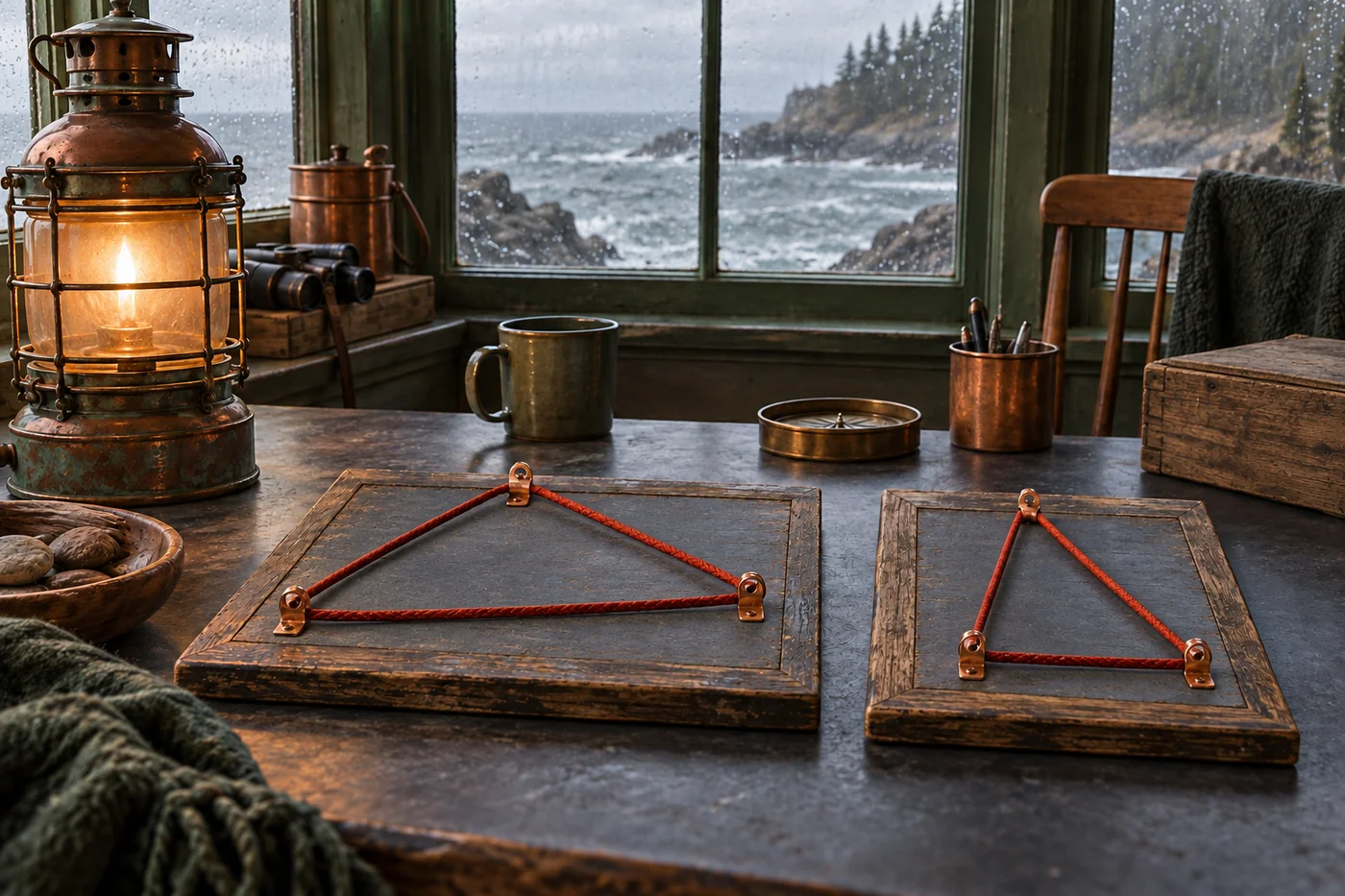
We will work with a Euclidean triangle, positive side lengths and angles strictly between 0° and 180°. The main example has A = 30°, a = 5 cm and b = 8 cm, with each lowercase side opposite its matching uppercase angle. You can solve everything on paper with a scientific calculator, independently of an app. The examples are original constructions; the coastal cord photographs are conceptual illustrations, not scaled diagrams or measurements of these triangles.
Eqora publishes this independent learning guide. Eqora is a study aid, not a replacement for exam work or a guarantee of correct answers or grades. Follow your course rules and verify the task, notation, assumptions and result. Count distinct side-and-angle solutions, not extra copies created by rotating or reflecting an entire triangle. A persuasive sketch or one calculator output cannot replace checking every original condition.
Law of sines starts with opposite side-angle pairs
In triangle ABC, a lies opposite A, b opposite B and c opposite C. The law of sines states a/sin A = b/sin B = c/sin C. Equivalently, sin A/a = sin B/b = sin C/c. The sine of an angle belongs in the formula, not the angle measure itself. Side lengths must use consistent units, and the arguments of the trigonometric functions must follow the angle convention you are using.
OpenStax’s treatment of the law of sines explains the possible outcomes for two sides and a nonincluded angle, often called SSA. Our given A is opposite a; it is not the angle between the two known sides a and b. Begin by marking the opposite pairs on your own sketch. Our visual trigonometry guide develops the distinction between sides and angles, but do not assume the present triangle is right-angled merely because you first learned sine in a right triangle.
Isolate the sine before finding an angle
Use the known pair A = 30° and a = 5 cm with b = 8 cm. Rearranging gives sin B = b sin A/a = 8 × 0.5/5 = 0.8. The length units cancel, so the sine value is dimensionless. Check its range before pressing an inverse function: for an interior triangle angle, the sine must be positive and no greater than 1. A value above 1 cannot be repaired by choosing a different inverse-sine branch.
Work in degree mode for this guide. The principal inverse sine gives B_1 = arcsin(0.8) ≈ 53.130102°. The symbol sin⁻¹ used on many calculators means inverse sine in this context, not 1/sin B. In radian mode the same inverse value is about 0.927295 radians, which must not be inserted as 0.927295° into a degree-based angle sum. Keep a clear angle unit from the first calculation through the final check.
Test the supplementary angle as a separate candidate
For angles between 0° and 180°, sin B = sin(180° − B). Thus our second candidate is B_2 = 180° − B_1 ≈ 126.869898°. Check the remaining angle for each: C_1 = 180° − 30° − B_1 ≈ 96.869898°, and C_2 = 180° − 30° − B_2 ≈ 23.130102°. Both are strictly positive, so both candidates survive the angle-sum test. Do not combine B from one branch with C from the other.
This is why returning only the principal calculator value would omit a valid solution. Conversely, listing a supplementary angle without testing it could add an impossible one. If the sine is exactly 1, both expressions give 90°, which is one candidate rather than two distinct angles. If a computed remaining angle is zero, the points are degenerate instead of forming a triangle. A negative remaining angle is impossible. Each branch needs its own coherent set of measurements.
Complete both triangles and check their side order
Use c = a sin C/sin A = 10 sin C in centimetres. The first branch gives c_1 ≈ 9.928203 cm; the second gives c_2 ≈ 3.928203 cm. The exact lengths are 4√3 + 3 and 4√3 − 3 cm. Report the complete branches: (A, B_1, C_1) with (a, b, c_1), and (A, B_2, C_2) with (a, b, c_2). Merely listing two c values does not identify which angles belong to which triangle.
In the first branch, C_1 is the largest angle and c_1 the longest side. In the second, B_2 is the largest angle and b = 8 cm the longest side. Both have positive lengths satisfying the triangle inequalities. An independent algebraic check uses a² = b² + c² − 2bc cos A: substituting our data gives c² − 8√3c + 39 = 0, whose roots are precisely 4√3 ± 3. This checks the two lengths without reusing the same inverse-sine calculation.
A height explains the acute-angle ambiguous case
For the fixed acute angle A = 30° and b = 8 cm, the relevant height is h = b sin A = 4 cm. Imagine placing side b along one ray of angle A, then finding where a side of length a from its far endpoint meets the other ray. If a is shorter than the height, it cannot reach. If a equals the height, it touches once. If h < a < b, it can meet the ray in two positions.
Our a = 5 lies between 4 and 8, explaining the two triangles. The foot of the perpendicular is 8 cos 30° = 4√3 cm from A; the horizontal offset to either intersection is √(5² − 4²) = 3 cm. The two base lengths are therefore 4√3 ± 3. This height classification is stated for an acute known angle. Do not apply the same case table unchanged to an obtuse known angle or count intersections lying behind the starting vertex.
Check when the same setup gives none or one
Keep A = 30° and b = 8 cm but change a. With a = 3 cm, sin B = 4/3 > 1, so no triangle exists. With a = 4 cm, sin B = 1, giving B = 90°, C = 60° and c = 4√3 cm: one triangle. The inverse-sine calculation and height test agree. Do not round 4/3 down to 1 to manufacture a right triangle from inconsistent measurements.
With a = 8 cm, sin B = 0.5. The candidates are 30° and 150°; the second leaves C = 0° and is rejected. Only B = 30°, C = 120° and c = 8√3 cm survive. More generally, a known obtuse angle must face the longest side. That side-order check can reject impossible data before detailed arithmetic. Positive side lengths alone do not guarantee that a requested angle and two sides fit a nondegenerate triangle.
Choose the method from the given information
Two known angles and one side allow you to find the third angle first, then use the law of sines with a complete opposite pair. Those valid angles determine the shape, and the side sets its scale. Two sides with their included angle describe a different situation: the law of cosines can first find the third side. Do not force a law-of-sines proportion containing two unknown quantities simply because you recognize its formula.
For an SSA problem, a sketch can help organize the possibilities but cannot decide them by appearance. If the question adds that the triangle is obtuse at a particular vertex, apply that condition to the checked branches. If no additional condition chooses one, report both valid branches. A drawing that happens to look acute is not an extra stated measurement. The same discipline applies when a diagram is explicitly not to scale or measurements are given only approximately.
Round after deciding which candidates are valid
Retain sin B = 0.8 and sufficient internal precision while computing the two branches. You might finally report B as 53.13° or 126.87°, with the matching C values 96.87° or 23.13°, and c as 9.93 cm or 3.93 cm. Rounding the first inverse value too early can shift every later result. State the chosen precision instead of presenting approximate angles and lengths as exact equalities.
Near a boundary such as a = h, rounded physical measurements may not determine whether the exact situation has zero, one or two intersections. A reported 4.00 cm is not automatically an exact mathematical 4 cm. Distinguish an exact classroom assumption from measurement uncertainty. Our guide to checking answers without a key recommends another representation: here combine the sine ratios, angle sum, side ordering and, when useful, the independent height or cosine check.
Change the opposite side and solve both branches again
Try A = 30°, a = 6 cm and b = 8 cm independently. Now sin B = 2/3, so B_1 ≈ 41.810315° and B_2 ≈ 138.189685°. The remaining angles are approximately 108.189685° and 11.810315°, both positive. The matching c values are 4√3 + 2√5 ≈ 11.400339 cm and 4√3 − 2√5 ≈ 2.456067 cm. Keep each branch together and verify it against the original three measurements.
Explain why both answers exist before reading any earlier worked line: the height is still 4 cm, and 4 < 6 < 8. Then describe what would change if only one candidate had a positive remaining angle. The transferable method is not simply press inverse sine. It is to label opposite pairs, test the sine range, examine every relevant branch and retain only complete triangles that satisfy all the given conditions. That reasoning also tells you when an answer is missing or an extra one has been invented.