
Applied math · Eqora guide
Average speed for a round trip: why the midpoint fails
A slower outward leg takes longer. Learn to combine distance and elapsed time, include pauses, and check a two-speed result without guessing.
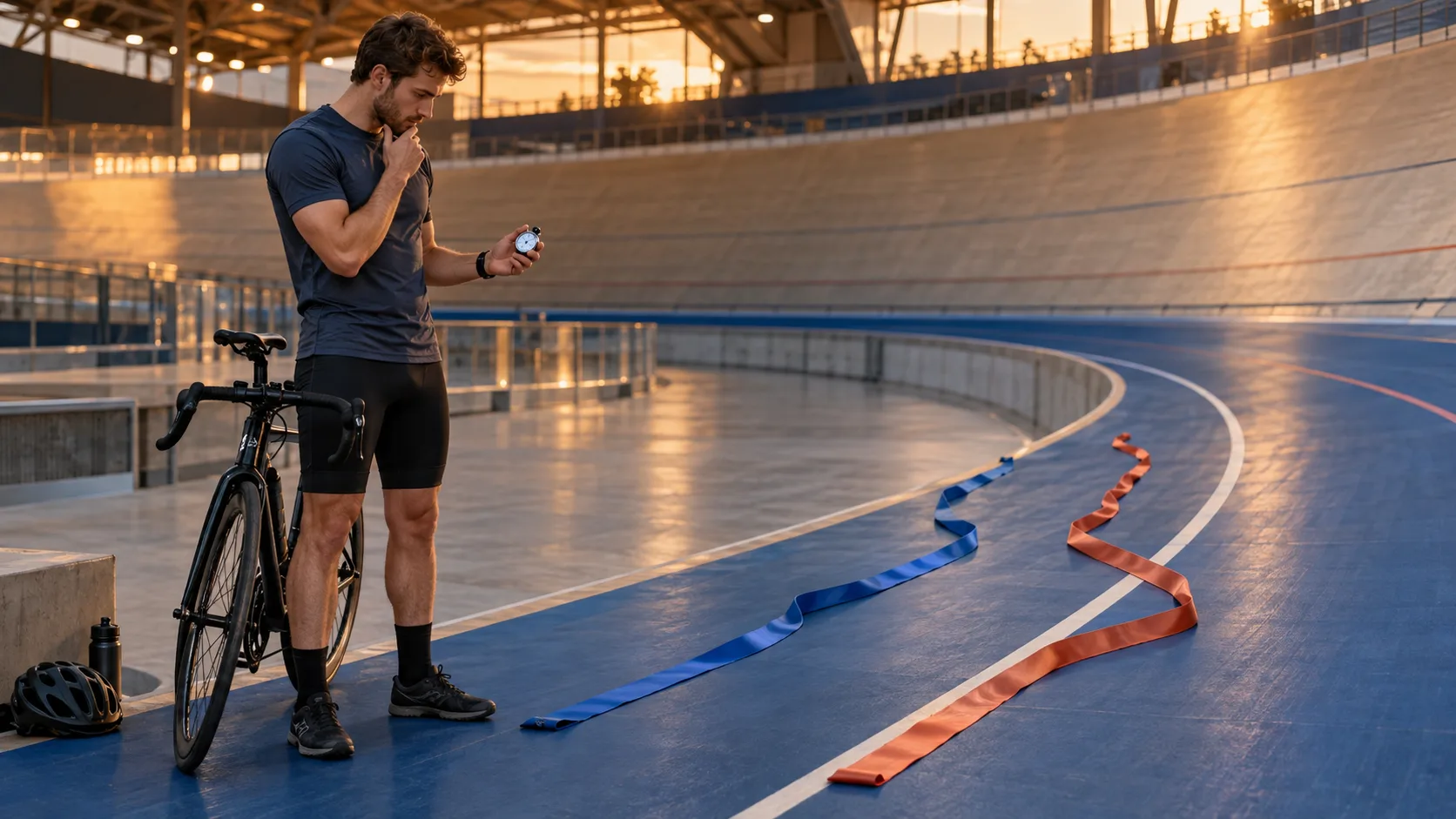
Average speed for a round trip looks like an easy mean: ride out at 12 km/h, return at 18 km/h, and call the answer 15 km/h. Yet that answer is wrong when the two legs cover the same distance. The slower leg takes more time, so it has more influence on the full journey. A simple midpoint treats the two speeds as though they lasted equally long. Before using a formula, decide whether the question gives equal distances, equal times, or neither.
Suppose a cyclist travels 12 km to a sports hall at a steady 12 km/h and the same 12 km back at a steady 18 km/h. The outward trip takes one hour; the return takes two thirds of an hour, or 40 minutes. The whole route is 24 km in one hour 40 minutes. Divide 24 by 5/3 hours and the average is 14.4 km/h. This article shows how to build that calculation, where a break fits, and how to audit an assisted solution.
We will keep speed as distance traveled divided by elapsed time, rather than confuse it with directional average velocity. OpenStax makes that distinction explicit: a person can return to the starting point with zero net displacement but a positive average speed. If a worksheet, diagram, or AI explanation blurs the terms, use the wording and units in the original problem to settle what must be calculated.

Start an average speed for a round trip with the question
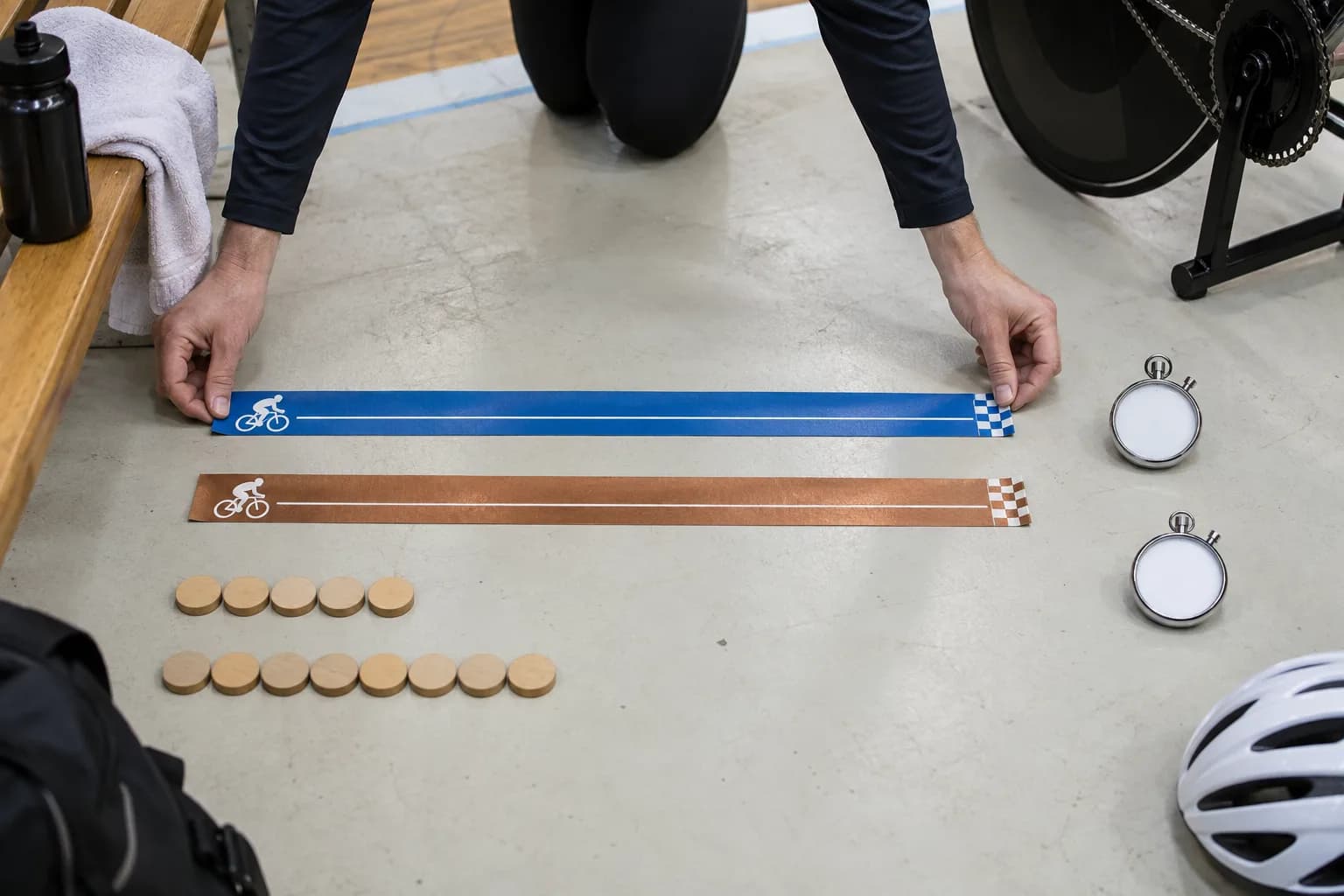
Read the complete task before combining any numbers. Mark the outward distance, return distance, speed on each leg, and any pause. In our cycling example both distances are 12 km. The speeds, 12 km/h and 18 km/h, are rates rather than travel times. The question asks for the average over the whole route, not the typical speedometer reading or the speed on one chosen leg. Write 'total distance / total elapsed time' beside the question before you substitute values.
A small two-row table prevents the common swap between distance and duration. Put 12 km and 12 km/h in the outward row, then 12 km and 18 km/h in the return row. Leave time blank until it is calculated. The units reveal the next operation: kilometres divided by kilometres per hour gives hours. If you instead add the two speed figures, the result remains a speed but tells you nothing about how long either leg lasted.
Find the time for each leg before finding the average
On the outward journey, time = 12 km / (12 km/h) = 1 h. On the return, time = 12 km / (18 km/h) = 2/3 h. Because an hour has 60 minutes, 2/3 h is 40 minutes. Do not read the fraction 2/3 h as two thirds of a minute, and do not enter 0.40 h for 40 minutes; 0.40 h is only 24 minutes. Converting either both durations to hours or both to minutes avoids mixing unlike units.
Now add like quantities. The total distance is 12 + 12 = 24 km. The total time is 1 + 2/3 = 5/3 h, equivalently 100 minutes. Thus average speed = 24 km / (5/3 h) = 24 × 3/5 km/h = 14.4 km/h. In minutes the same calculation is 24 km / (100/60 h) = 14.4 km/h. Two representations leading to the same result are a useful audit, not two separate answers.
Why the arithmetic midpoint gives the wrong answer
The arithmetic midpoint of 12 and 18 is (12 + 18)/2 = 15. That number is the average of two displayed speeds, not automatically the average speed over the full trip. At 12 km/h the cyclist spends 60 minutes covering 12 km. At 18 km/h the same 12 km takes only 40 minutes. The slower rate therefore occupies 60 of the journey's 100 minutes. Giving each rate a 50-minute weight describes a different journey.
There is a compact equal-distance formula: 2ab/(a + b), where a and b are positive speeds. Substituting 12 and 18 gives 2 × 12 × 18 / 30 = 14.4. This harmonic-mean expression is a shortcut derived from two copies of the same distance divided by d/a + d/b. It is not a rule to apply to arbitrary unequal legs. The distance-and-time method still tells you why it works and handles stops or extra segments more safely.
When averaging two speeds really is allowed
Change the story: ride exactly 30 minutes at 12 km/h, then exactly 30 minutes at 18 km/h. The first half-hour covers 6 km; the second covers 9 km. The total is 15 km in one hour, so the average speed is 15 km/h. In this version the two rates act for equal times, not equal distances. The arithmetic midpoint is valid because each has the same time weight. Notice that the route lengths are now different.
The contrast is a useful decision test. Equal time intervals allow a simple average of two constant segment speeds. Equal distances call for each segment time first, or the harmonic-mean shortcut when there are exactly two positive speeds. If neither distances nor times are equal, calculate all segment distances and durations, add each column, and divide the totals. A formula without its conditions is a trap in a word problem.
Consider 3 km in 30 minutes followed by 6 km in 20 minutes. The complete distance is 9 km and the duration is 50 minutes, or 5/6 h. The average is 9 ÷ (5/6) = 10.8 km/h. The segment speeds are 6 and 18 km/h; their simple midpoint, 12, is not the trip average. This example confirms the method even when neither of the two standard shortcuts fits.
Decide whether a pause belongs in elapsed time
Suppose the original 12 km out and 12 km back includes a 30-minute stop at the sports hall. If the question asks for the average speed from departure until arriving home, elapsed time includes the stop: 1 h + 2/3 h + 1/2 h = 13/6 h. Distance stays 24 km because no distance is covered during the pause. The resulting average is 24 ÷ (13/6) = 144/13, about 11.08 km/h. It can fall below the slower moving speed because the stop adds time without adding distance.
A different question might explicitly ask for average moving speed, excluding the stop. Then use only the 5/3 hours of cycling and the result returns to 14.4 km/h. Neither convention is universally right; the wording defines the interval. Write 'elapsed journey' or 'moving only' next to your time total. If a prompt has an arrival time and departure time, subtract those clock times carefully and include the interval between them unless the task states otherwise.
Use Eqora to inspect a doubtful step, not to skip the model
Try the exercise on paper first. If your worksheet contains a route sketch or a two-row table, photograph the complete task in good light so the distances, units, stop condition, and exact question are visible. Compare Eqora's reading with the original before trusting a solution. A missed 'same distance' or a misread 40 minutes can produce neat algebra for the wrong journey. Our photo guide shows how to keep the important context in the frame.
After entering your own totals, ask a focused follow-up such as, 'Why is 15 km/h wrong if both legs are 12 km?' or 'Should the 30-minute stop be in the denominator for elapsed journey speed?' Inspect the line that converts 40 minutes to 2/3 hour and the line that sums time. Eqora can explain a step, but its output is not proof. Check that every copied number, unit, and assumption still matches the prompt.
Then close the explanation and change one condition yourself. Make the return distance 6 km, or remove the stop, and predict whether the result should rise or fall before calculating. Ask for a similar unsolved problem only after you have finished the original. Solving the variation without looking is stronger evidence of learning than recognizing a polished finished calculation. Respect any class rules on AI-assisted work and disclose help when required.
Distinguish average speed from average velocity
A round trip returns to its starting position, but it does not undo the distance traveled. In our example the total path length is 24 km. If the cyclist ends exactly where the ride began, the displacement is zero. Average speed, based on path length, is 14.4 km/h while moving. Average velocity, based on displacement and direction, is zero over the same interval. The terms sound similar in everyday language, yet physics uses different numerators.
OpenStax's Spanish physics text calls the path-length quantity rapidez media and the directional displacement quantity velocidad media. That distinction is useful even in an English math problem: check whether the prompt asks 'how fast over the route' or for change of position in a specified direction. A negative average velocity can make sense after choosing an axis; a negative average speed cannot represent this path-length quotient. Do not insert a sign merely because the cyclist rode back.
Check the result with units and a fresh ride
Check units first: kilometres divided by hours gives kilometres per hour. Dividing 24 km by 100 minutes gives 0.24 km/min, which is equivalent to 14.4 km/h after multiplying by 60. If an answer is 0.24 and the requested unit is km/h, the arithmetic may be fine but the reported unit is not. Also check the range: without a stop, the average must sit between the two positive constant leg speeds; with a stop, it may be lower.
For independent practice, ride 10 km outward at 10 km/h and 10 km home at 20 km/h without stopping. The times are 1 hour and 1/2 hour. The total 20 km divided by 3/2 hours gives 40/3 km/h, or about 13.33 km/h. The arithmetic midpoint would be 15 km/h and is too high. Verify by multiplying 13.33 km/h by 1.5 h: the estimate returns roughly 20 km. Keep the unrounded fraction until the last line.
If your check disagrees, inspect the first place where distance became time or minutes became decimal hours. Rebuild the two-row table rather than adjusting the final number until it looks plausible. Eqora can point to a suspect conversion, but the final authority is the original task and your independent substitution. Our answer-checking guide offers other ways to test a result when no answer key is available. A strong conclusion states the distance, time interval, and average in one sentence.
Put it into practice now
Choose one problem from your current homework or review set. Attempt it before opening Eqora, then use the app only at the point where your own reasoning stops.
- State what the problem is asking before you solve it
- Identify the first step you cannot justify
- Ask Eqora one focused follow-up about that step
- Finish with a similar problem and no solution in view
The session is complete when the method is clearer, not simply when the worksheet has one more answer.