Percentages and word problems · Eqora guide
Reverse percentage homework: before the discount
A discounted price is not the original hundred percent. Identify the remaining share, reverse its multiplier and check your answer forward.

Your reverse percentage homework says that an item costs £72 after a 20% discount. You calculate twenty percent of £72, add it back and get £86.40. The arithmetic is tidy, but the answer is wrong: the discount was a percentage of the unknown original price, not of the smaller final price. The task is asking you to reconstruct the original hundred percent from the eighty percent that remains.
Start with the mathematical relationship before opening an app. We will find the missing price, diagnose the tempting addition and extend the method to two discounts and a fixed voucher. Then use Eqora to check a clearly captured problem, inspect the reasoning, ask a focused question and solve another example yourself. The prices are constructed teaching examples, not shopping recommendations or current offers.
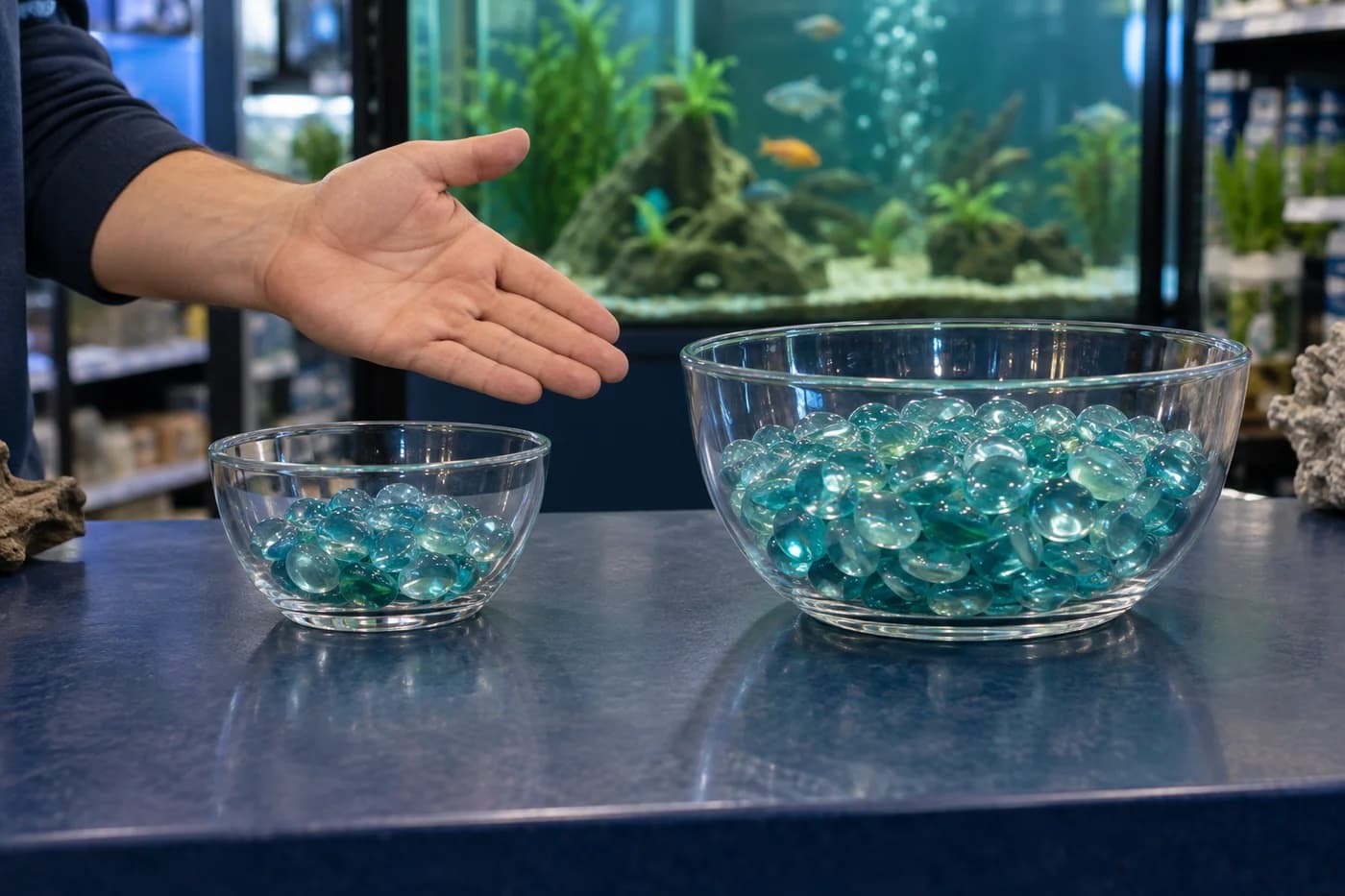
Eqora publishes this guide as learning support, not a substitute for your own exam work or a guarantee of correctness or grades. Check the task, notation, assumptions and final answer yourself. The aquarium photographs illustrate whole and part; pebble counts and bowl sizes do not encode percentages. Only the stated problem data determine the calculation.
Reverse percentage homework starts with the original hundred percent
Label the known quantity before choosing an operation. Here £72 is the price after the reduction, twenty percent is the share removed and P is the unknown original price. The original price represents 100%. Removing 20% leaves 80%, so £72 represents 80% of P. It does not represent the removed 20%. Writing those labels prevents a correct calculation from answering the wrong question.
The direction matters. If P were given and the reduced price were requested, you would multiply by 0.8. In this problem the reduced price is given and P is requested, so you need to undo that multiplication. Ask which price the stated percentage refers to. The phrase twenty percent off the original price establishes the base; a later price increase could establish a different base.
Use the picture only as a reminder that part and whole differ. There is no measurable discount hidden among the pebbles. A simple written statement, original price × remaining share = final price, is more useful than guessing from a drawing. Keep the currency unit beside the values, while recognizing that 0.8 is a dimensionless proportion rather than eighty pounds.

Divide by the remaining multiplier, not by the discount
Convert the remaining eighty percent to a decimal: 80 ÷ 100 = 0.8. The relationship is 0.8P = 72. Divide both sides by 0.8 to obtain P = 72 ÷ 0.8 = 90. The original price was £90. Its twenty-percent reduction is £18, and £90 − £18 = £72. This forward calculation checks the interpretation as well as the division.
The CIMT MEP treatment of reverse percentages uses this inverse-multiplier approach. For a stated discount of r percent, the remaining multiplier is 1 − r/100. Provided that multiplier is nonzero, divide the final price by it. With an ordinary discount below a hundred percent, the multiplier lies between zero and one, so dividing by it makes a positive final price larger. That is exactly the direction expected.
Do not divide £72 by 0.2: that would treat £72 as the discount amount, which the question never says. Avoid entering 72 ÷ 80 as though eighty percent were the number eighty. If you prefer whole percentages, write 72 ÷ 80 × 100. Explain what each number represents; matching an answer without understanding the denominator leaves the same trap in the next problem.
Why adding twenty percent does not undo the reduction
Twenty percent of £72 is £14.40. Adding it gives £86.40, but the original reduction from £90 was £18. The two amounts differ because their bases differ. Twenty percent of a smaller price is a smaller amount. The percentages use the same rate while referring to different wholes, so subtraction and addition of that rate are not inverse operations.
Test the proposed £86.40 instead of arguing from intuition: £86.40 × 0.8 = £69.12, not £72. This failed forward check identifies the error. To return from £72 to £90, you must add £18, which is twenty-five percent of £72. The reverse multiplier is 1 ÷ 0.8 = 1.25. A twenty-percent reduction therefore needs a twenty-five-percent increase on the reduced base to reverse it.
The general lesson is not to memorize another pair of rates. Preserve the original forward equation and undo its operation. Writing the unknown as P makes the reference price visible. When an explanation says simply add the discount back, ask which monetary discount amount is known. Adding a known £18 would be valid; adding twenty percent of the wrong base is not.
Use one percent or a fraction as a second route
A proportion method gives an independent way to organize the same relationship. If eighty percent is £72, one percent is £72 ÷ 80 = £0.90. A hundred percent is £0.90 × 100 = £90. Dividing by eighty finds one percent, not the full price. Multiplying by a hundred then reconstructs the whole. These labels make a proportion table meaningful instead of turning it into an unexplained cross-multiplication rule.
You can also recognize 80% as four fifths. If four fifths of P is £72, one fifth is £18 and five fifths is £90. The fraction route is especially convenient for familiar discounts. Suppose another exercise gives £63 after a 25% reduction. The remaining three quarters is £63; one quarter is £21 and the original is £84. Check: £84 × 0.75 = £63.
Both routes must use the remaining share, not automatically the printed discount rate. They are checks on your interpretation, not unrelated tricks. For an awkward percentage, the decimal multiplier may be simpler. Keep enough precision until the final step and follow the rounding instruction. An exact textbook relationship and a receipt rounded to cents are different models; rounded data may not identify a unique exact earlier price.
Two discounts and a voucher require the stated order
If a twenty-percent discount is followed by ten percent off the reduced price, the forward relationship is final = P × 0.8 × 0.9 = 0.72P. With a final price of £72, P = £100. The total reduction is twenty-eight percent, not thirty percent, because the second rate acts on the already reduced price. Check the stages: £100 becomes £80 and then £72.
A fixed voucher is not another percentage multiplier. If the question applies twenty percent off and then a £10 voucher, a final £62 satisfies 0.8P − 10 = 62. Reverse the last operation first: add ten to get 0.8P = 72, then divide by 0.8 to get £90. If the £10 voucher comes first, the forward equation is 0.8(P − 10). Starting from £90, that sequence ends at £64 instead.
Write the operation chain before using a calculator. Do not infer missing conditions such as taxes, delivery costs, voucher eligibility or a rounding policy. This guide models only the operations explicitly stated in a homework problem. If the question gives an order, preserve it. Even when two pure percentage multipliers can be exchanged, a fixed subtraction generally cannot be moved past a multiplier without changing the expression.
Capture the whole question and inspect Eqora's first step
Now use Eqora on the original £72 exercise. Place the page flat, use steady lighting and capture the complete wording, including after a twenty-percent discount and the request for the original price. Keep every relevant line readable, remove glare and avoid cutting off percent signs or currency symbols. Our photo tips for math problems explain why an apparently small crop can remove the condition that determines the method.
Compare the captured task with your paper before relying on any steps. Verify that 72 is recognized as the final price and that the discount is twenty percent, not two percent. Inspect the first mathematical relationship. It should connect the original price to eighty percent remaining. A fluent-looking explanation built on a misread amount or percentage is still solving a different problem; correct the input before continuing.
Then inspect the inverse operation and substitution check. Do the steps establish 0.8P = 72, isolate P by division and reproduce £72 from £90? You can perform that check on paper independently of the displayed result. Eqora is a learning aid, and a generated explanation can contain mistakes. Neither a confident tone nor several lines of arithmetic replaces checking the stated base, units and assumptions.

Ask about the base rather than requesting another answer
A focused follow-up is: Why does £72 represent eighty percent rather than a hundred percent? Explain what 0.8 multiplies. Another useful question is: Show why adding twenty percent of £72 gives a different result from reversing a twenty-percent discount. These questions target the interpretation that caused the error. Asking only for a shorter answer can leave that misunderstanding untouched.
Compare the response with the two forward checks you already know. The correct candidate gives 90 × 0.8 = 72; the tempting candidate gives 86.4 × 0.8 = 69.12. Explain the difference in your own words without copying a paragraph. Our guide to understanding steps rather than just answers discusses this learning habit. A useful explanation connects each operation to a known quantity and the unknown, not merely to a calculator button.
Put the phone aside and recover a new price
Try this without looking at the worked example: an item costs £68 after a 15% discount. Find its original price and show a forward check. First write which price is the original hundred percent, what share remains and which direction the operation goes. Do not use the earlier twenty-percent multiplier simply because the problem looks similar. The structure transfers, but the rate changes.
The remaining share is 85%, so 0.85P = 68 and P = 68 ÷ 0.85 = 80. The original price was £80. Fifteen percent of eighty is twelve; subtracting twelve gives sixty-eight. If you added fifteen percent of £68, you would obtain £78.20, which fails the stated discount check. This contrast shows whether you recognized the base rather than recalled a number from the previous example.
Record one precise correction if needed: the final price represents the remaining share of the original whole. Next time, write that relationship before consulting a solution. Finish with a sentence stating the price and the assumed single discount. Being able to reproduce the reasoning on a fresh question is a more useful learning check than seeing the same answer twice on a screen.