Algebra · Eqora guide
Work rate problems: two printers, one job
Solve work rate problems by adding jobs per minute. Check a two-printer example, a late start, and a second order you can solve yourself.

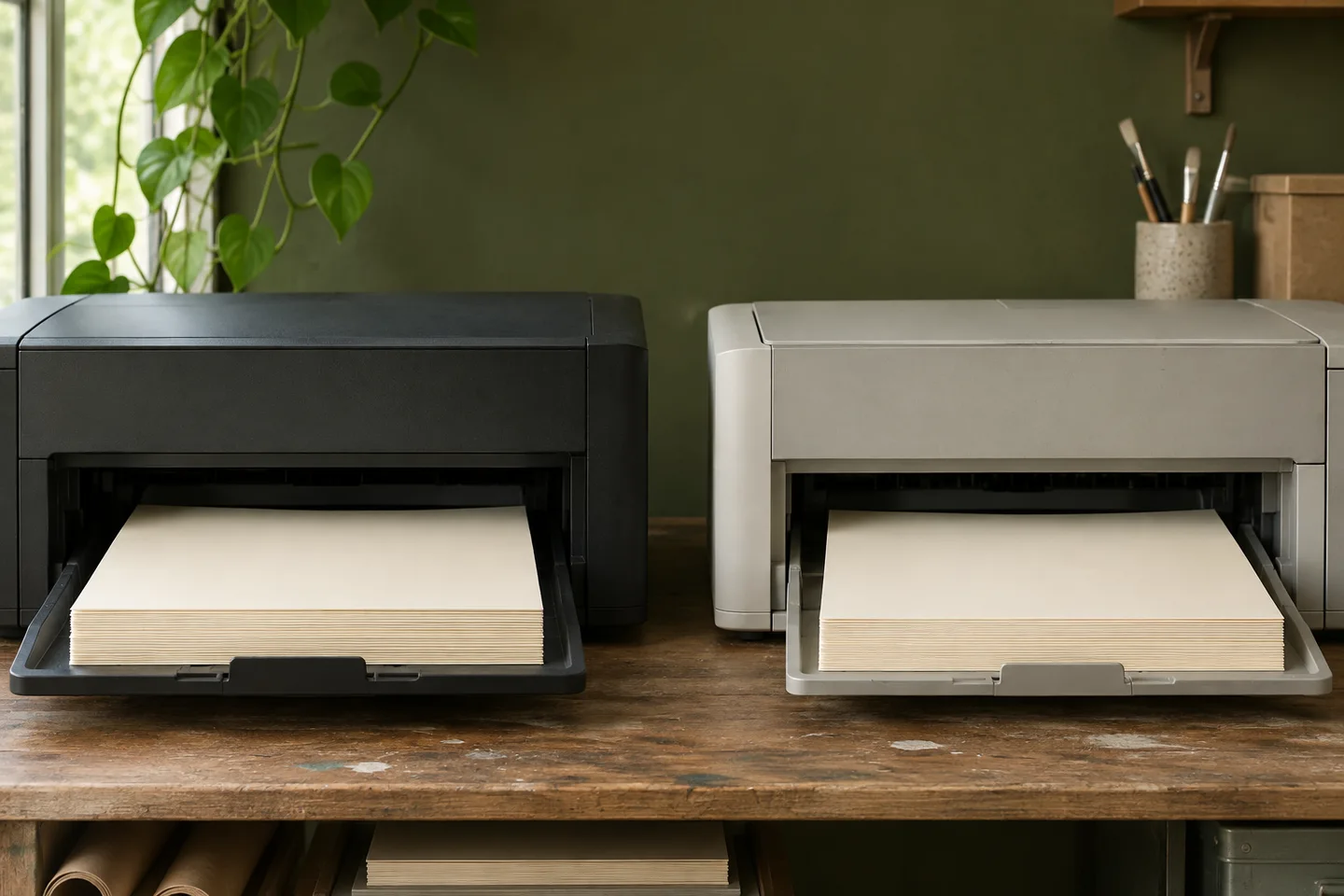
One printer can finish a 120-sheet order in six minutes. Another can finish the same order in four minutes. Both start at the same time, their speeds stay constant, and the sheets can be divided between them. The homework asks when the whole order will be ready. Five minutes sounds reasonable if you average the two times, until you notice that the faster printer could already finish the order alone in four.
In work rate problems like this, the quantities you can combine are the amounts printed in a minute. In this case, the slower printer makes 20 sheets per minute and the faster one makes 30. Together they make 50 sheets per minute, so 120 sheets take 2.4 minutes. You can also solve the problem without knowing the number of sheets. Treat the entire order as one job and use fractions to track how much of it each machine completes.
Work rate problems start with jobs per minute
The six-minute figure describes how long the first printer needs to make one complete order. In one minute it completes 1/6 of the order. The second printer completes 1/4 in the same minute. Each fraction has the same unit, jobs per minute, so you can add them. The lesson on work applications at OpenStax uses this conversion to build an equation for several workers on one job.
It helps to put the original times in one column and the rates in another. Write 6 minutes per job beside 1/6 job per minute, and do the same for 4 and 1/4. The direction of the units is useful evidence. The smaller number in the time column gives the larger number in the rate column, which matches what you know about the faster printer. A rate of 4 jobs per minute would mean four complete orders every minute. That interpretation contradicts the problem immediately.
Use the same definition of a job for both machines. Here, one job means the entire 120-sheet order. It never means a printer's share of the order. The shares depend on how long the printers run and on how much each produces during that time. If the order were twice as large and the printer speeds stayed the same in sheets per minute, the times per order would double and the rates in orders per minute would halve. Rates only make sense once the unit is settled.

Add the rates and recover the time
Write 1/6 as 2/12 and 1/4 as 3/12. The total is 5/12 of a job per minute. The denominator 12 is a common unit for the fractions and does not mean you have to wait 12 minutes. At the combined rate you need 1 ÷ (5/12) = 12/5 minutes for one full job. If you are unsure why the division gives the reciprocal, review dividing by a fraction and keep the unit on the result.
You can also let t stand for the elapsed minutes. Then t/6 is the first printer's contribution and t/4 is the second's. The equation is t/6 + t/4 = 1 because both contributions together must make one full order. Multiplying every term by 12 gives 2t + 3t = 12. From 5t = 12, you get the same t = 12/5. The equation keeps the meaning of the unknown visible, which is especially helpful when a later problem gives one machine a head start.
Check 12/5 in the original model. The first printer completes 2/5 of the order and the second completes 3/5. For 120 sheets those shares are 48 and 72, which add to 120. Both machines run for the same time, but the faster one does more of the work. Finally, 2.4 minutes is 2 minutes and 24 seconds, because the fractional part of a minute is multiplied by 60. It is also less than four minutes, as you would expect when both machines contribute positively.
Sometimes the question gives you the time for the team and asks for one printer's time alone. The same rate table still works. Suppose you know the two printers finish one order together in 12/5 minutes, and the first takes six minutes alone. The combined rate is 5/12 of an order per minute. The first printer's contribution is 1/6, or 2/12. Subtract that contribution to get 3/12 = 1/4 of an order per minute for the second printer. The reciprocal gives four minutes for one order.
This calculation also gives a quick test of the numbers in the question. If the combined rate is smaller than the rate of the first printer, subtracting would give a negative rate. That cannot describe a second machine producing more sheets under the stated conditions. Check whether the question describes a delay, lost output, or a different order size before you conclude that it has an error.
Check the setup in Eqora
Try writing your rate table and one equation before opening Eqora. The point is to have something specific to compare. If the assignment includes a sentence about when the printers start or how many sheets each must print, keep that sentence in view. Those details can change the model even when the numbers in the problem look familiar.
Capture a clear photo of the full question with the app. Keep the camera square to the paper, avoid a shadow across the numbers, and include the units and any restrictions. If you are photographing handwritten work as part of the question, separate your attempt visually from the printed prompt. When you inspect the steps, first verify that the problem was read correctly. A 4 read as 9 changes the rate, and a missing phrase about a late start changes the amount of time one printer is available.
Look for the first step that differs from yours. If the response displays 1/6 and 1/4 but your work begins with 6 + 4, ask a targeted follow-up such as “What does each fraction measure in one minute, and what unit does their sum have?” If you both reach 5/12, but your final answer is 5/12 minutes, ask “How do I turn jobs per minute into minutes for one job?” You can also check the equation yourself by using every term when clearing denominators and comparing the result with the rate calculation.
Put the app aside after the explanation. Explain in your own words why one job divided by a rate gives a time, and test the answer in the original question. Eqora is a study aid. Verify the copied notation, the modeling assumptions, and the final calculation yourself. Whether an app is allowed on a test depends on the rules for that test.

Use separate time intervals for a late start
Now suppose the slower printer starts by itself and runs for two minutes before the faster one joins. Those two minutes complete 2 × 1/6 = 1/3 of the job. There is 2/3 left. After the second printer starts, the rate is 5/12 of a job per minute. The remaining time is (2/3) ÷ (5/12) = 8/5 minutes. The elapsed time from the first start is 2 + 8/5 = 18/5 minutes, or 3 minutes and 36 seconds.
A useful check is to give each printer its own running time. The first runs for 18/5 minutes and makes 3/5 of the order. The second runs for 8/5 minutes and makes 2/5. Those fractions add to one. Starting with the simultaneous rate would count production by the second machine before it was turned on. Adding two minutes to the original 2.4 minutes would miss the progress made during the first interval.
The assumptions also matter for an actual print shop. If a required setup takes a minute, that minute belongs in the schedule. If a particular sheet can only go through one machine, you may be unable to divide the order in the proportions given by the model. If the question gives two different batch sizes, convert both rates into sheets per minute before adding. In the textbook problem the rates are constant and the whole order can be split. For other problems, check those conditions before borrowing the equation.
Solve a different order on your own
Two printers can each finish the same 180-sheet order in nine and six minutes, respectively. They start together and keep constant speeds. Work out the completion time and how many sheets come from each printer. Before reading further, try the problem once using fractions of an order and then check it using sheets per minute. State what the variable represents if you write an equation.
The rates are 1/9 and 1/6 of the order per minute. On a denominator of 18 these are 2/18 and 3/18, totaling 5/18. The completion time is 18/5 minutes, which is 3 minutes and 36 seconds. The individual amounts are (18/5)/9 = 2/5 and (18/5)/6 = 3/5. The slower printer therefore makes 72 sheets and the faster one makes 108. For the second check, 180/9 = 20 and 180/6 = 30 sheets per minute. At 50 sheets per minute, 180 sheets take 3.6 minutes.
This is the same elapsed time as the late-start example, but it represents a different schedule. Here both printers work for the entire 3.6 minutes. In the earlier example the second printer runs for only 1.6 minutes. If the answers happen to agree, look at the individual contributions to see whether you used the right model. On your next homework problem, write the job, the unit of time, and the operating interval of each contributor before you combine any numbers.
One more way to test the setup is to imagine replacing the faster printer with a copy of the slower one. Two equal printers would each produce 1/6 of the order per minute. Together they would produce 1/3 per minute, so the order would take exactly three minutes. In the original example the second printer is faster than that copy, which makes an answer below three minutes plausible. This comparison uses the rates without requiring you to remember the result of the fraction calculation. It also shows where a familiar shortcut belongs: dividing an individual time by two works for two identical machines starting together. It cannot tell you the completion time when the machines work at different speeds.